

Renovation projects have a well-earned reputation for complexity. Coordinating architects, general contractors, subcontractors, material suppliers, and permit offices simultaneously places enormous demands on homeowners and investors alike, and the consequences of poor coordination are predictable: budget overruns, scheduling delays, and quality disputes that erode property value rather than build it. This guide to turnkey renovation addresses those challenges directly, walking you through every phase of the process from pre-construction planning to final project closeout. Whether you own a single-family home in Jacksonville or manage a portfolio of investment properties, understanding the turnkey renovation process gives you the framework to make confident, financially sound decisions.
Table of Contents
- Key Takeaways
- Guide to Turnkey Renovation: What It Means and Why It Matters
- Essential preparations before starting
- The turnkey renovation process, step by step
- Common mistakes to avoid during turnkey renovations
- Maximizing property value and ROI
- My perspective on turnkey renovation's real value
- How Ofirengineering delivers turnkey renovation results
- FAQ
Key Takeaways
| Point | Details |
|---|---|
| Single-source accountability | Turnkey providers manage design, permitting, construction, and finishing under one contract, reducing communication gaps. |
| Budget realism matters | Setting a realistic budget with a contingency reserve prevents scope creep and costly project interruptions. |
| Third-party inspections protect you | Independent inspections verify structural quality that move-in readiness alone does not guarantee. |
| Minor renovations yield higher ROI | Minor kitchen remodels return approximately 96% ROI versus 38% to 59% for major gut renovations. |
| Provider selection is critical | Choosing a licensed, experienced turnkey contractor like Ofirengineering directly determines project quality and timeline. |
Guide to Turnkey Renovation: What It Means and Why It Matters
What is turnkey remodeling, exactly? The term refers to a project delivery model in which a single firm handles every phase of the renovation, from initial design and permitting through construction and final staging, and then hands the completed property to the client ready for immediate use. The client does not manage separate contracts with an architect, a plumber, an electrician, and a tile installer. One team carries the entire scope.
This model originated in commercial construction and has become increasingly common in residential renovation for a straightforward reason: it eliminates the coordination burden that causes most renovation failures. Turnkey remodeling integrates design, permitting, construction, and finishing under one firm with a shared timeline, shared budget, and unified accountability. When a problem arises on site, there is no question about who owns the solution.
For property investors, the advantages of turnkey remodeling extend beyond convenience. Turnkey properties generate immediate rental income upon project completion, reducing vacancy periods and holding costs that erode returns. For homeowners, the benefit is simpler: a professionally managed renovation that finishes on time and within the agreed scope.
Ofirengineering, licensed under CHC1540016 and based in Jacksonville, has built its practice around this model. With over 15 years of experience in residential construction and full-home renovation, the firm manages all project phases cohesively, which is precisely what a well-executed turnkey renovation requires.
Essential preparations before starting
Preparation separates successful turnkey renovations from expensive lessons. Before any contractor sets foot on the property, several foundational steps require attention.
Assess the property and define your goals
Begin with a clear-eyed evaluation of the property's current condition and your intended outcome. Are you renovating to increase rental yield, to sell at a premium, or to improve long-term livability? The answer shapes every subsequent decision, from material selection to the sequence of trades on site.

Pro Tip: Document existing conditions with photographs and written notes before the project starts. This record protects you if disputes arise and helps the turnkey team identify items that need remediation before construction begins.
Budget planning and realistic expectations
A well-structured budget accounts for both anticipated costs and unforeseen conditions. Industry practice recommends maintaining a contingency reserve of at least 10% to 15% of the total project budget. For older properties, that figure should move closer to 20%, because concealed issues behind walls and under floors are common.
The following items represent the core budget categories for most residential turnkey renovation projects:
- Design and engineering fees
- Permit and inspection fees
- Structural and mechanical systems (HVAC, plumbing, electrical panel assessment)
- Finishes, fixtures, and appliances
- Project management and contractor fees
- Contingency reserve
Required documents and permits
| Preparation Item | Purpose |
|---|---|
| Property survey | Confirms boundaries and identifies setback restrictions |
| Existing floor plans | Baseline for design modifications |
| Building permits | Legal authorization for structural and systems work |
| HOA approval (if applicable) | Confirms exterior changes comply with community rules |
| Third-party inspection report | Identifies hidden structural or systems deficiencies |
Independent inspections are critical even when a property appears move-in ready. Turnkey status reflects cosmetic completion, not necessarily the condition of the structural frame, electrical panel, or subfloor. A licensed inspector can uncover issues that surface photos and walkthroughs miss entirely.
Ofirengineering routinely incorporates this pre-construction due diligence phase into its project planning process, helping clients avoid costly surprises once construction is underway.
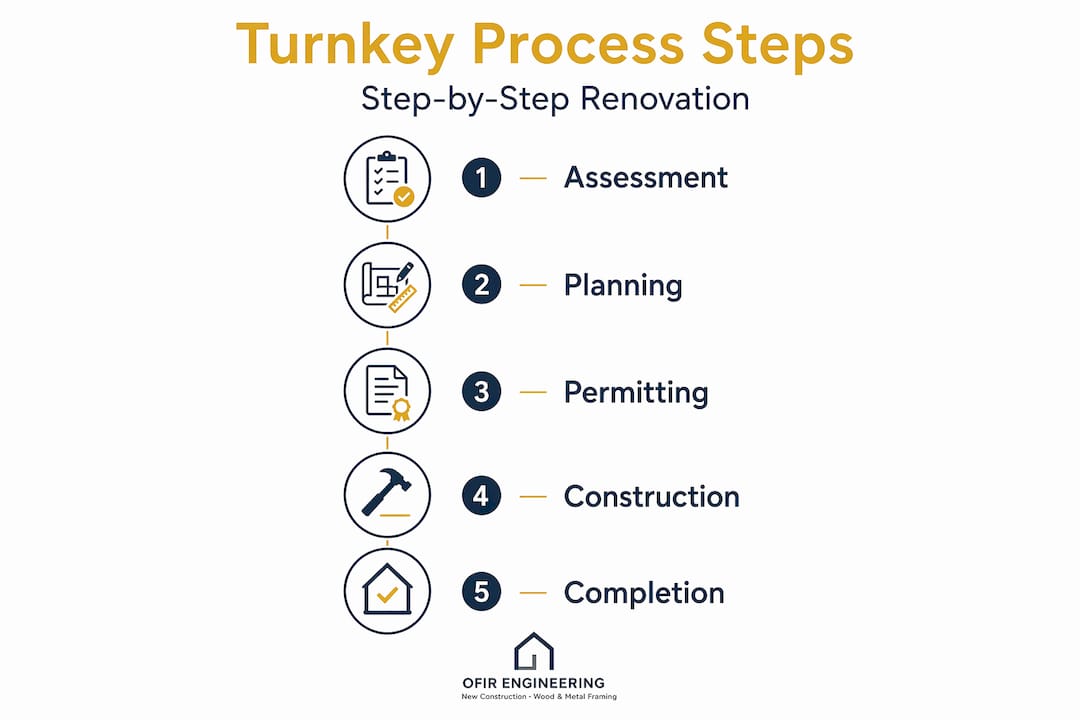
The turnkey renovation process, step by step
A complete turnkey renovation follows a disciplined sequence. Understanding that sequence reduces uncertainty and establishes realistic expectations for every stakeholder involved.
-
Initial consultation and discovery. The turnkey team conducts a detailed site visit, reviews the client's goals, and documents existing conditions. Clear communication at this stage directly determines the accuracy of the scope of work and the project budget.
-
Design concept and material selection. Architects or designers develop schematic drawings based on the discovery findings. Material selections, fixture specifications, and finish palettes are finalized before construction begins. This front-loaded approach prevents costly change orders mid-project.
-
Pre-construction planning. The turnkey firm handles permit applications, subcontractor scheduling, and material procurement. Proper electrical safety checks and advance planning for future needs, including smart home integration and panel capacity, are addressed during this phase.
-
Construction execution. Trades are sequenced to maximize efficiency. Structural work precedes mechanical systems, which precede finishes. The turnkey firm's project manager coordinates daily activity on site and maintains the master schedule.
-
Final walkthrough and punch list. Once construction is substantially complete, the client and project manager conduct a formal walkthrough. Every outstanding item is documented in a punch list and resolved before the project closes.
-
Project closeout and handover. The property is cleaned, staged if applicable, and handed over with all permit closeout documentation, warranty information, and as-built drawings.
Pro Tip: Request a written punch list with completion deadlines during the final walkthrough. Verbal agreements about finishing details are difficult to enforce once the project is formally closed.
| Phase | Primary Responsibility | Client Involvement |
|---|---|---|
| Discovery and scoping | Turnkey firm | High |
| Design and material selection | Turnkey firm and client | High |
| Permitting and procurement | Turnkey firm | Low |
| Construction | Turnkey firm | Low |
| Final walkthrough | Both parties | High |
| Project closeout | Turnkey firm | Medium |
Comprehensive turnkey renovation projects typically require 3 to 9 months depending on scope and complexity. Clients who understand this timeline upfront avoid the frustration of unrealistic scheduling expectations.
Common mistakes to avoid during turnkey renovations
Even with a capable turnkey provider, projects can go sideways when clients or contractors make avoidable errors. Knowing where projects typically fail allows you to build safeguards into the process before problems arise.
-
Underestimating hidden maintenance issues. Properties that have not been maintained consistently carry concealed deficiencies: corroded pipes, outdated wiring, moisture-damaged framing. A pre-construction inspection addresses this before it becomes a mid-project budget crisis.
-
Allowing scope creep. Changes requested after construction begins are the single most reliable source of budget overruns. Every scope change should go through a formal written change order with an updated cost and schedule impact.
-
Choosing providers on price alone. The lowest bid rarely reflects the best value. Licensing, insurance, track record, and project management capability matter far more than the initial quote.
-
Neglecting communication protocols. Weekly progress reports and dedicated contact points enhance the client experience and prevent the information gaps that lead to disputes.
-
Skipping the final inspection. A licensed inspector reviewing completed work before project closeout catches workmanship issues while the contractor is still on site and still accountable.
The best turnkey renovation contracts define not only what will be built, but how progress will be communicated, how changes will be handled, and what dispute resolution processes apply if expectations are not met.
Understanding guide to turnkey renovation contract terms before signing protects both parties and establishes a foundation for a productive working relationship throughout the project.
Pro Tip: Ask every turnkey candidate for references from projects of similar scope and request permission to visit a completed project in person. Finished work speaks more clearly than a portfolio photograph.
Maximizing property value and ROI
Turnkey renovations create value most effectively when the scope of work reflects the market the property sits in. Not all improvements deliver equal financial returns, and the guide to turnkey home upgrades for investors must account for this distinction.
The data is instructive. Minor kitchen remodels costing $20,000 to $28,000 return approximately 96% ROI, while major gut renovations in the $75,000 to $150,000 range yield 38% to 59%. This does not mean major renovations lack merit. It means that scope should be calibrated to the property's market position and the investor's financial objectives. You can explore Jacksonville-specific renovation ROI to understand which improvements resonate most in the local market.
| Renovation Type | Approximate Cost | Expected ROI |
|---|---|---|
| Minor kitchen remodel | $20,000 to $28,000 | ~96% |
| Bathroom refresh | $10,000 to $20,000 | 70% to 80% |
| Major kitchen gut renovation | $75,000 to $150,000+ | 38% to 59% |
| Exterior paint and curb appeal | $5,000 to $15,000 | 55% to 75% |
| Full home renovation | $150,000+ | Varies by market |
Several renovation categories consistently add measurable value in Jacksonville and comparable Southeast markets:
- Kitchen updates focused on countertops, cabinetry hardware, and appliances without full gut work
- Bathroom modernization with updated fixtures, lighting, and tile
- Exterior improvements including paint, landscaping, and entry door replacement
- HVAC system replacement, which buyers and tenants factor heavily into offers and lease decisions
- Flooring replacement with durable, market-appropriate materials
Ofirengineering's approach to maximizing renovation returns centers on matching the renovation scope to the property's market segment, avoiding over-improvement relative to neighborhood comparables, and maintaining professional project oversight throughout construction to protect finish quality.
My perspective on turnkey renovation's real value
I have worked with enough renovation projects to say with confidence that turnkey renovation is not just a convenience. It is a structural solution to a fundamental problem: most renovation failures trace back to fragmented accountability, not bad materials or incompetent tradespeople.
What I have seen repeatedly is that integrated project teams, those who carry design through construction under one roof, eliminate the finger-pointing that defines so many conventional renovation disputes. When the designer, the contractor, and the project manager are the same entity, the design vision survives into execution with far fewer compromises.
That said, turnkey renovation is not infallible. The label does not automatically guarantee quality, and I have seen clients learn that lesson the hard way when they chose a provider based on price rather than verified capability. Even turnkey properties require due diligence; unseen structural defects can exist despite polished cosmetic work. The discipline of independent inspection applies regardless of how experienced your provider claims to be.
My honest view is that turnkey renovation is especially valuable for busy professionals and investors who cannot dedicate significant personal time to managing multi-contractor projects. But the value is only realized when you select a provider with the systems, the licensing, and the demonstrated track record to back up the turnkey promise. Plan meticulously, verify credentials, and hold the provider accountable to the contract terms you negotiated before construction began.
— Owen
How Ofirengineering delivers turnkey renovation results

Ofirengineering brings over 15 years of licensed residential construction and renovation experience to every project in Jacksonville and the surrounding area. As a single-source turnkey provider, the firm manages design coordination, permitting, construction execution, and project closeout under one contract and one point of accountability. Clients never chase down subcontractors for status updates or resolve disputes between competing trade teams.
For homeowners and investors ready to act, Ofirengineering's step-by-step renovation guide provides a property-specific starting point, and the firm's construction project management process keeps every phase on schedule and within budget. Projects are backed by quality workmanship commitments and ongoing client support after closeout. Contact Ofirengineering to discuss your renovation objectives and receive a project assessment tailored to your property and investment goals.
FAQ
What is turnkey remodeling?
Turnkey remodeling is a project delivery model where a single firm manages design, permitting, construction, and finishing from start to completion. The client receives a fully renovated, move-in-ready property under one contract.
How long does a turnkey renovation typically take?
Most turnkey renovation projects take 3 to 9 months depending on scope, permitting timelines, and construction complexity. Smaller projects with focused scopes typically complete in the lower range of that window.
Do I still need an independent inspection for a turnkey renovation?
Yes. Turnkey status reflects move-in readiness and cosmetic completion, not necessarily the condition of structural or mechanical systems. An independent inspection before project closeout protects you from inheriting defects the renovation did not address.
What renovations produce the highest ROI in turnkey projects?
Minor kitchen remodels return approximately 96% of their cost, making targeted kitchen and bathroom updates among the highest-value investments in most residential markets.
How do I choose the right turnkey renovation contractor?
Verify the contractor's license and insurance, review completed projects of similar scope, check client references, and confirm that the firm handles permitting and project management in-house rather than outsourcing those functions to third parties.