

Value engineering in construction is defined as a systematic, team-based methodology that maximizes required project functions at the lowest life-cycle cost without compromising quality, safety, or performance. Formally aligned with SAVE International standards, the discipline applies the formula Value = Function / Cost, meaning improvements come from increasing functional output, reducing cost, or both simultaneously. This is not budget slashing. It is a structured analytical process that construction professionals, project managers, and building industry stakeholders use to make deliberate, defensible decisions about where project dollars deliver the most return. Ofirengineering applies these principles across residential construction and renovation projects in Jacksonville, FL, drawing on over 15 years of field experience to help clients achieve measurable value without sacrificing the outcomes they expect.
What is value engineering in construction projects?
Value engineering is defined by the DoD SD-24 VE Guidebook as the analysis of systems and products to accomplish essential functions at the lowest life-cycle cost consistent with required quality and safety. That definition carries two critical implications. First, the focus is on essential functions, not features, finishes, or preferences. Second, cost is measured across the full asset life, not just the construction contract price.
The distinction between value engineering and simple cost-cutting is not semantic. Cost-cutting removes scope or reduces specification without analyzing whether those elements serve a required function. Value engineering, by contrast, maps every function against its cost contribution and asks whether an alternative approach can deliver the same or better functional output at lower total expense. A residential project that substitutes a lower-grade roofing membrane to save money upfront is cost-cutting. A project that evaluates two roofing systems using life-cycle cost analysis, selects the one with lower 30-year total ownership cost, and documents the functional equivalence is practicing value engineering.

Ofirengineering consistently applies this distinction on new construction and renovation projects, particularly when clients face budget pressure during the design phase. The goal is always to protect function and performance while identifying where cost reductions are structurally sound.
What are the key benefits of value engineering in construction?
Properly implemented VE reduces project costs by 5 to 15% while maintaining or improving functionality and quality. That range reflects projects where VE was applied early and systematically, not as a last-minute value-cut exercise. The savings are real, but they depend on process discipline and timing.
The core benefits construction professionals and project managers should understand include the following:
- Cost reduction without scope loss. VE identifies redundant or over-specified elements and replaces them with functionally equivalent alternatives, preserving deliverables while reducing expenditure.
- Improved project quality and reliability. By focusing on function definitions rather than assumed solutions, VE teams often identify higher-performing alternatives that were not in the original design.
- Avoidance of late-stage rework. Early VE application during planning and conceptual design reduces the probability of costly changes during construction, when modifications carry schedule and procurement penalties.
- Stakeholder alignment. Cross-disciplinary VE workshops bring designers, contractors, estimators, and owners into a shared analytical process, surfacing conflicting assumptions before they become field problems.
- Long-term savings through life-cycle analysis. Many VE savings come from operations, maintenance, refurbishment, and disposal costs that never appear in the construction contract but significantly affect total ownership cost.
Pro Tip: Frame VE recommendations to clients and stakeholders as performance and value assurance, not cost reduction. Projects where VE is presented as a quality improvement process consistently achieve stronger buy-in and smoother implementation than those where it is introduced as a budget exercise.
The collaborative dimension of VE is particularly valuable on complex residential and commercial projects. Cross-disciplinary alignment between designers, builders, and estimators surfaces constructability issues and cost drivers early, reducing risks and surprises during procurement and construction. Ofirengineering structures its project planning process to incorporate this alignment from the earliest design conversations.
What are the common value engineering methods and techniques?
Value engineering methods fall into two broad categories: analytical tools that decompose and map functions, and evaluative tools that compare alternatives against cost and risk criteria.
Function Analysis System Technique (FAST) diagrams
FAST diagrams are the foundational analytical tool in VE practice. They map project functions graphically, organizing them in a hierarchy from higher-order objectives down to supporting functions. The diagram forces the team to ask "How?" and "Why?" for every function, which separates essential functions from those that exist because of design habit or assumed requirements. On a residential construction project, a FAST diagram might reveal that a structural element is performing two functions, one of which can be achieved more economically through a different system configuration.
Life-cycle cost analysis
Life-cycle cost analysis (LCCA) compares alternatives based on total cost of ownership over the full asset life, including construction, operations, maintenance, refurbishment, and disposal. AACE International's RP 138R-25 provides the current recommended practice framework for LCCA in construction. The analysis gives decision-makers a defensible basis for choosing between alternatives that have different upfront and ongoing cost profiles. A Light Gauge Steel framing system, for example, may carry a higher material cost than wood framing but deliver lower life-cycle cost through reduced maintenance, superior dimensional stability, and longer service life.
Comparison of primary VE techniques
| Technique | Primary purpose | Best applied at |
|---|---|---|
| FAST diagrams | Map and decompose project functions | Information and function analysis phases |
| Life-cycle cost analysis (LCCA) | Evaluate total ownership cost of alternatives | Evaluation and development phases |
| Brainstorming and creative sessions | Generate alternative solutions without constraint | Creative phase following function analysis |
| Cost-benefit and risk trade-off analysis | Prioritize alternatives by value and risk profile | Evaluation phase before recommendation |
| Value analysis (post-construction) | Review completed projects for future improvement | Post-implementation and verification phase |
Value analysis is the retrospective counterpart to value engineering. Where VE is applied prospectively during design and planning, value analysis reviews completed work to identify lessons that improve future projects. Both disciplines share the same function-to-cost framework, but their timing and outputs differ. Ofirengineering applies both, using post-project reviews to refine its VE approach on subsequent builds.
How does the structured value engineering process work?
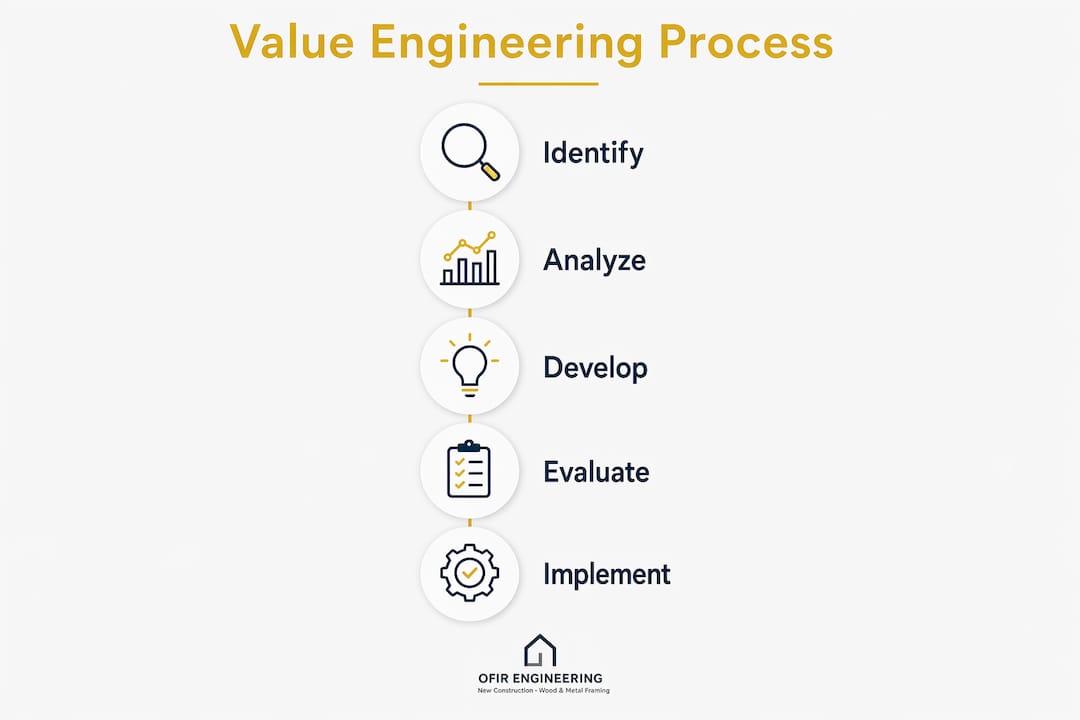
The VE job plan is a six-phase structured process that moves from information gathering through implementation and verification. Each phase has defined inputs, outputs, and team responsibilities. Skipping phases or compressing the process reduces the reliability of recommendations and increases the risk of unintended consequences.
The standard phases are as follows:
- Information gathering. The team collects project documents, drawings, specifications, cost estimates, and schedule data. The objective is to establish a complete picture of what the project is required to deliver and at what cost.
- Function analysis. Using FAST diagrams and structured questioning, the team identifies every function the project must perform, assigns a cost to each function, and identifies where cost is disproportionate to functional value.
- Creative brainstorming. The team generates alternative approaches to high-cost functions without filtering or evaluating ideas. The discipline here is to separate idea generation from judgment, which produces a broader solution set.
- Evaluation. Alternatives are assessed against functional requirements, cost, risk, schedule, and constructability criteria. Cost-benefit and risk trade-off analyses prioritize the most promising options.
- Development and presentation. Selected alternatives are developed into formal recommendations with supporting cost estimates, technical justifications, and implementation plans. These are presented to the project owner and design team for decision.
- Implementation and verification. Approved recommendations are integrated into project plans, specifications, and procurement documents. Follow-up verification confirms that expected savings were achieved and that performance and quality remain intact.
Timing is the single most important variable in VE effectiveness. Early application during planning and conceptual design maximizes the team's ability to shape the project efficiently. Changes made during design cost a fraction of changes made during construction. For residential projects in Jacksonville, Ofirengineering integrates VE review into its pre-construction planning workflow, which is documented in its construction project management process.
Pro Tip: Assign a dedicated VE facilitator who is not the project designer. Designers are invested in their solutions, which creates a natural bias against alternatives. An independent facilitator keeps the function analysis objective and the brainstorming phase genuinely open.
Multi-disciplinary team composition is equally critical. Effective VE teams include estimators, structural designers, mechanical and electrical engineers where applicable, the general contractor, and the owner's representative. Each discipline brings a different cost and constructability perspective, and the intersections between those perspectives are where the most significant value opportunities typically appear.
How does value engineering balance function, quality, and cost?
VE is not cost-cutting. It focuses on improving the function-to-cost ratio while preserving or enhancing quality, safety, and performance. That distinction matters practically because it defines what is and is not a legitimate VE recommendation.
A legitimate VE recommendation must satisfy all of the following conditions:
- The proposed alternative performs the required function at the same or higher level as the original design.
- The life-cycle cost of the alternative is lower than the original when operations, maintenance, and disposal costs are included.
- Quality and safety standards are maintained or improved, not compromised.
- The recommendation accounts for downstream impacts on schedule, procurement lead times, and system interfaces.
Scope and change-control management are critical to implementing VE recommendations without creating rework or schedule impacts. VE recommendations that are approved but not formally integrated into contract documents, procurement schedules, and construction plans frequently result in coordination failures that erode or eliminate the projected savings. Managing this integration is a project controls discipline, not just a design task.
Life-cycle cost analysis is the tool that most clearly separates value optimization from cost reduction. A project that selects a lower-cost roofing system without LCCA may save money on the construction contract while incurring higher maintenance and replacement costs over the building's service life. A project that applies LCCA selects the system with the lowest total ownership cost, which may or may not be the lowest initial cost option. Ofirengineering uses LCCA as a standard evaluation tool when comparing structural systems, envelope assemblies, and mechanical configurations on both new construction and renovation projects.
Key takeaways
Value engineering in construction delivers measurable cost savings and quality improvements only when applied as a structured, function-focused process from the earliest project stages, not as a reactive budget reduction exercise.
| Point | Details |
|---|---|
| VE is function-focused, not cost-focused | Savings come from analyzing essential functions, not removing scope or reducing specification. |
| Early application maximizes impact | VE applied during planning and design avoids costly rework and schedule penalties in construction. |
| 5 to 15% cost savings are achievable | Properly implemented VE reduces project costs within this range while maintaining functional performance. |
| LCCA is the core evaluation tool | Life-cycle cost analysis compares total ownership cost, not just construction contract price, to identify true value. |
| Verification closes the loop | Follow-up after implementation confirms savings were achieved and turns VE into a continuous improvement process. |
Value engineering in practice: what the process actually demands
The most common failure mode in value engineering is not a flawed technique. It is premature solutioning. Teams arrive at VE workshops with preferred alternatives already in mind and use the function analysis phase to justify decisions already made. The result is a process that looks like VE but produces the cost-cutting outcomes VE is specifically designed to avoid.
The discipline that separates effective VE from performative VE is the commitment to completing function analysis before generating alternatives. Clarifying functions first and decomposing each element into essential versus discretionary functions is the step that most teams compress under schedule pressure. That compression is where value is lost.
From working on residential construction and renovation projects in Jacksonville, the pattern is consistent. Projects where the VE process is given adequate time in the pre-construction phase produce recommendations that hold up through procurement and construction. Projects where VE is compressed into a single meeting late in design produce recommendations that create coordination problems and rarely deliver the projected savings.
The verification phase deserves more attention than it typically receives. Confirming savings after implementation is not administrative housekeeping. It is the feedback loop that makes VE a learning system rather than a one-time exercise. Teams that track actual versus projected savings build a body of evidence that improves the accuracy of future VE recommendations and strengthens the case for early VE investment on subsequent projects.
Ofirengineering's approach to VE reflects these priorities: structured function analysis, cross-discipline alignment early in the project lifecycle, formal integration of recommendations into project controls, and verification against projected outcomes. The goal is not to reduce budgets. It is to ensure that every dollar spent on a project is delivering the function and performance the client requires.
— Owen
How Ofirengineering applies value engineering to your project

Ofirengineering brings over 15 years of licensed construction experience in Jacksonville to every value engineering engagement, applying structured VE methods to new construction and residential renovation projects from the earliest planning stages. The team conducts function analysis, life-cycle cost comparisons, and cross-discipline coordination reviews as part of its standard pre-construction process, ensuring that cost reductions are grounded in functional analysis rather than arbitrary specification changes. Whether you are planning a new build using Light Gauge Steel or Wood Frame systems, or managing a full-home renovation, Ofirengineering's new construction services are structured to deliver measurable value at every project stage. Contact Ofirengineering to discuss how a structured VE review can improve the cost and performance outcomes of your next project.
FAQ
What is value engineering in construction?
Value engineering in construction is a systematic, team-based process that analyzes project functions to achieve required performance at the lowest life-cycle cost without compromising quality or safety. It applies the formula Value = Function / Cost and is aligned with SAVE International and DoD VE guidance.
How does value engineering differ from cost-cutting?
Value engineering preserves or improves functional performance while reducing cost through structured analysis. Cost-cutting removes scope or reduces specification without evaluating functional impact, which can compromise quality, safety, and long-term performance.
When should value engineering be applied in a construction project?
VE delivers the greatest benefit when applied during the planning and conceptual design phases, before design decisions are locked and procurement begins. Early application reduces the cost of implementing recommendations and minimizes schedule impacts.
What are the most common value engineering techniques?
The most widely used VE techniques are FAST diagrams for function mapping, life-cycle cost analysis for evaluating total ownership cost, brainstorming sessions for generating alternatives, and cost-benefit and risk trade-off analyses for prioritizing recommendations.
How much can value engineering save on a construction project?
Properly implemented VE reduces project costs by 5 to 15% while maintaining or improving functionality and quality. Actual savings depend on project complexity, timing of VE application, and the rigor of the process followed.