

Turnkey construction is a project delivery method where a single contractor manages every phase of a build, from initial planning through final commissioning, handing the owner a fully operational facility ready for immediate use. The term comes from the idea that the client only needs to "turn the key" to begin operations. This approach concentrates all responsibility, including design, permitting, procurement, and construction, under one contract and one point of accountability. Ofirengineering, a licensed Jacksonville contractor with over 15 years of residential construction experience, delivers this model for homeowners, property investors, and real estate developers who want a complete build without managing multiple vendors.
What is turnkey construction and how does it work?
Turnkey construction is defined as a single-entity delivery model where the contractor assumes full responsibility for the entire project lifecycle, from the first consultation to the final handover of a ready-to-use building. The client does not coordinate architects, engineers, subcontractors, or permit agents separately. One contractor handles all of it under a single contract.
The industry also refers to this model as design-build or integrated project delivery, depending on the contract structure. Both terms describe the same core principle: the owner defines the outcome, and the contractor delivers it. Turnkey is the most client-facing term because it emphasizes the end result rather than the process.

This model is common in residential renovations, new home construction, commercial fit-outs, and industrial facilities. For a Jacksonville homeowner planning a full-home renovation, a turnkey contractor handles everything from architectural drawings to the final coat of paint, with the owner receiving a finished, code-compliant home.
What are the steps in a turnkey construction project?
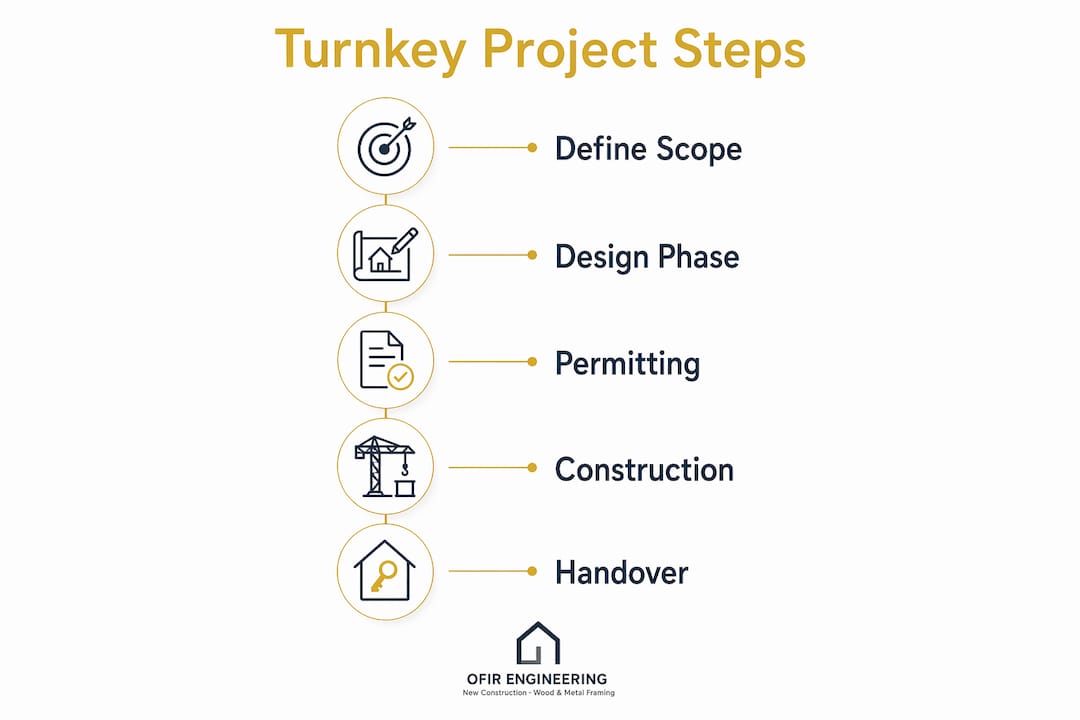
The turnkey construction process follows a defined sequence of phases, each with clear deliverables and client touchpoints.
-
Initial consultation and scope definition. The contractor meets with the owner to document project goals, budget parameters, site conditions, and desired outcomes. This phase sets the foundation for every decision that follows.
-
Contract signing. The contract outlines the full scope of work, fixed price or agreed budget, project timeline, warranty terms, and the contractor's responsibilities for permits and design. Reviewing this document carefully before signing protects both parties.
-
Design finalization and permit acquisition. The contractor's design team produces construction drawings and submits permit applications to the relevant local authority. In Jacksonville, this includes Florida Building Code compliance reviews. The owner approves final designs before construction begins.
-
Construction phase with progress reporting. The contractor manages all subcontractors, material procurement, and site supervision. The owner receives regular progress updates, typically weekly reports or scheduled site visits, without needing to manage day-to-day operations.
-
Final handover. The contractor delivers completion certificates, as-built drawings, warranty documentation, and a fully operational facility. Final payment is due upon formal handover of the ready-to-use building.
The client's role shifts significantly compared to traditional construction. Active involvement is concentrated in phases one and three. After design approval, the owner's primary responsibility is timely decision-making when the contractor requests input.
Pro Tip: Define your project objectives in writing before the first contractor meeting. A written scope, including preferred materials, finishes, and non-negotiable requirements, prevents costly change orders and keeps the project aligned with your vision from day one.
Turnkey vs traditional construction: which approach fits your project?
The core difference between turnkey and traditional construction is where responsibility sits. In a traditional model, the owner contracts separately with an architect, a general contractor, and often multiple specialty subcontractors. Coordinating those relationships, managing schedule conflicts, and resolving disputes between vendors falls on the owner. In a turnkey model, risk transfers from the client to the contractor, concentrating accountability in one place.
The table below summarizes the key differences.
| Factor | Turnkey construction | Traditional construction |
|---|---|---|
| Accountability | Single contractor responsible for all phases | Owner coordinates multiple vendors |
| Risk | Contractor assumes design and build risk | Risk shared or retained by owner |
| Timeline | Design and build phases can overlap, reducing delays | Sequential phases often extend total duration |
| Budget certainty | Fixed-price contract limits cost surprises | Cost overruns more common with multiple contracts |
| Client involvement | High at start, low during build | High throughout all phases |
| Flexibility | Mid-project changes are costly | Easier to adjust scope during design phase |
| Quality control | Consistent standards under one team | Quality depends on each vendor's standards |
Integrated design-build allows overlapping phases, which reduces project delays significantly compared to traditional sequential delivery. That time efficiency translates directly into lower carrying costs for property investors and faster occupancy for homeowners.
Traditional construction suits owners who want maximum control over each vendor selection and are comfortable managing a multi-party project. Turnkey suits owners who prioritize schedule reliability, budget certainty, and reduced daily involvement.
What are the benefits and challenges of turnkey construction?
Key benefits for project owners
The benefits of turnkey construction services are most visible in three areas: budget control, schedule reliability, and reduced coordination burden.
- Budget certainty. A fixed-price turnkey contract limits exposure to cost overruns. The contractor absorbs cost increases from material price changes or subcontractor disputes, not the owner.
- Single point of contact. One contractor manages all communications, reducing the number of calls, emails, and meetings the owner must attend.
- Faster delivery. Overlapping design and construction phases compresses the overall timeline compared to sequential traditional delivery.
- Risk transfer. Contractual risk transfer shifts liability for design errors, permit delays, and construction defects to the contractor.
- Simplified contracts. One contract replaces multiple agreements with architects, engineers, and subcontractors.
Challenges to plan for
Turnkey projects are better suited for owners who prioritize schedule and budget certainty over flexibility. Mid-project changes are costly and difficult under a fixed-price contract. An owner who decides to change the floor plan after framing begins will face significant change order costs and schedule delays.
A common misconception is that turnkey means no client decisions. The contractor manages execution, but the owner must still make timely decisions on finishes, fixtures, and design approvals. Contractors make operational decisions to maintain schedule when clients do not respond promptly, and those decisions may not match the owner's preferences.
Pro Tip: Stay actively engaged during the consultation and design phases. Clients who define clear objectives early in the pre-construction phase are more satisfied with final outcomes than those who disengage and expect the contractor to fill in the gaps.
How to select and work with a turnkey contractor effectively
Selecting the right contractor is the single most consequential decision in a turnkey project. The contractor's capability determines whether the model delivers its promised benefits or creates new problems.
Start by verifying the full scope of the contractor's turnkey offering. True turnkey contracts include responsibility for permits, final design, procurement, and commissioning. Some contractors use the term loosely when they require the client to provide prior design approvals or handle permitting independently. Ask directly: does the contract include permit acquisition, design finalization, and commissioning?
When evaluating turnkey construction companies, consider the following criteria:
- License and insurance verification. Confirm the contractor holds a valid state license and carries general liability and workers' compensation insurance. Ofirengineering holds license CHC1540016 in Florida.
- Portfolio of completed projects. Review finished projects similar in scope and type to yours. Residential renovations, new construction, and commercial fit-outs each require different expertise.
- References from recent clients. Speak with past clients about schedule adherence, communication quality, and how the contractor handled unexpected issues.
- Clarity of the contract. The contract should specify every deliverable, the payment schedule tied to milestones, warranty terms, and the process for handling change orders.
- Communication systems. Ask how the contractor delivers progress updates and who your primary contact will be throughout the project.
Projects well suited to turnkey delivery include full-home renovations, new residential construction, kitchen and bathroom remodels, and investment property upgrades. Ofirengineering's turnkey project management approach covers all of these project types for Jacksonville area clients, with a defined workflow from consultation through final handover. For a detailed breakdown of what to expect at each phase, the construction project lifecycle guide for Jacksonville homes provides phase-by-phase guidance.
Key Takeaways
Turnkey construction delivers the greatest value when the owner invests in clear scope definition upfront and selects a contractor with verified full-scope responsibility, including permits, design, and commissioning.
| Point | Details |
|---|---|
| Single-entity accountability | One contractor manages all phases, reducing owner coordination burden and dispute risk. |
| Front-loaded client engagement | Active owner involvement during consultation and design prevents costly mid-project misalignment. |
| Budget and schedule certainty | Fixed-price contracts and overlapping design-build phases reduce cost overruns and delays. |
| Verify full turnkey scope | Confirm the contractor handles permits, design, procurement, and commissioning before signing. |
| Best fit for defined projects | Turnkey suits owners with clear objectives; traditional methods suit those needing mid-project flexibility. |
Why early planning separates successful turnkey projects from frustrating ones
After working in and around construction projects for years, the pattern is consistent: the turnkey projects that go smoothly are the ones where the owner showed up to the first meeting with a written brief. Not a vague idea of what they wanted, but a document listing priorities, budget limits, preferred materials, and deal-breakers.
The projects that generate disputes almost always trace back to an underspecified scope at contract signing. The contractor builds what the contract describes. If the contract is vague, the contractor fills in the gaps with reasonable assumptions that may not match the owner's expectations. That gap between assumption and expectation is where change orders and frustration originate.
The other thing worth saying plainly: turnkey does not mean hands-off. The model reduces daily involvement, but it does not eliminate the owner's responsibility to make timely decisions. When a contractor sends a finish selection for approval and waits three weeks for a response, the schedule slips. The owner then blames the contractor for the delay. Staying engaged during key decision points is not optional; it is part of the contract.
Ofirengineering's approach to pre-construction planning reflects this directly. The consultation phase is structured to extract detailed client objectives before any design work begins. That investment in clarity at the start pays off at every subsequent phase.
Choose a turnkey contractor based on their process, not just their portfolio. A contractor who can explain exactly how they manage scope changes, permit delays, and subcontractor issues is a contractor who has dealt with those situations and learned from them.
— Owen
How Ofirengineering delivers turnkey construction in Jacksonville
Ofirengineering is a licensed Jacksonville construction company (CHC1540016) with over 15 years of experience delivering new construction and renovations under a full turnkey model. The firm handles every phase in-house, from initial design and permit acquisition through construction management and final handover, so clients receive a complete, code-compliant building without coordinating multiple vendors. Whether you are planning a full-home renovation, a new residential build using Light Gauge Steel or Wood Frame systems, or an investment property upgrade, Ofirengineering manages the entire process under one contract. Contact Ofirengineering to schedule a consultation and define the scope of your next project with a team that has the process, the license, and the track record to deliver.
FAQ
What does turnkey mean in construction?
Turnkey in construction means a single contractor manages the entire project from planning to final handover, delivering a fully operational building the owner can use immediately. The client does not coordinate separate architects, engineers, or subcontractors.
How does turnkey construction differ from design-build?
Turnkey and design-build are closely related delivery models. Turnkey emphasizes the complete, ready-to-use delivery to the client, while design-build specifically refers to the integrated contract structure combining design and construction under one firm.
What are the main benefits of turnkey construction?
The primary benefits of turnkey construction include a single point of accountability, fixed-price budget certainty, faster delivery through overlapping design and build phases, and contractual risk transfer from the owner to the contractor.
Can I make changes during a turnkey construction project?
Mid-project changes are possible but costly under a fixed-price turnkey contract. Changes after construction begins typically trigger formal change orders that affect both the budget and the schedule.
How do I verify a contractor offers true turnkey services?
Ask the contractor directly whether their contract includes permit acquisition, final design, procurement, and commissioning. True turnkey contracts cover all of these responsibilities; contracts that require the client to handle permits or pre-approve designs before signing are not fully turnkey.