
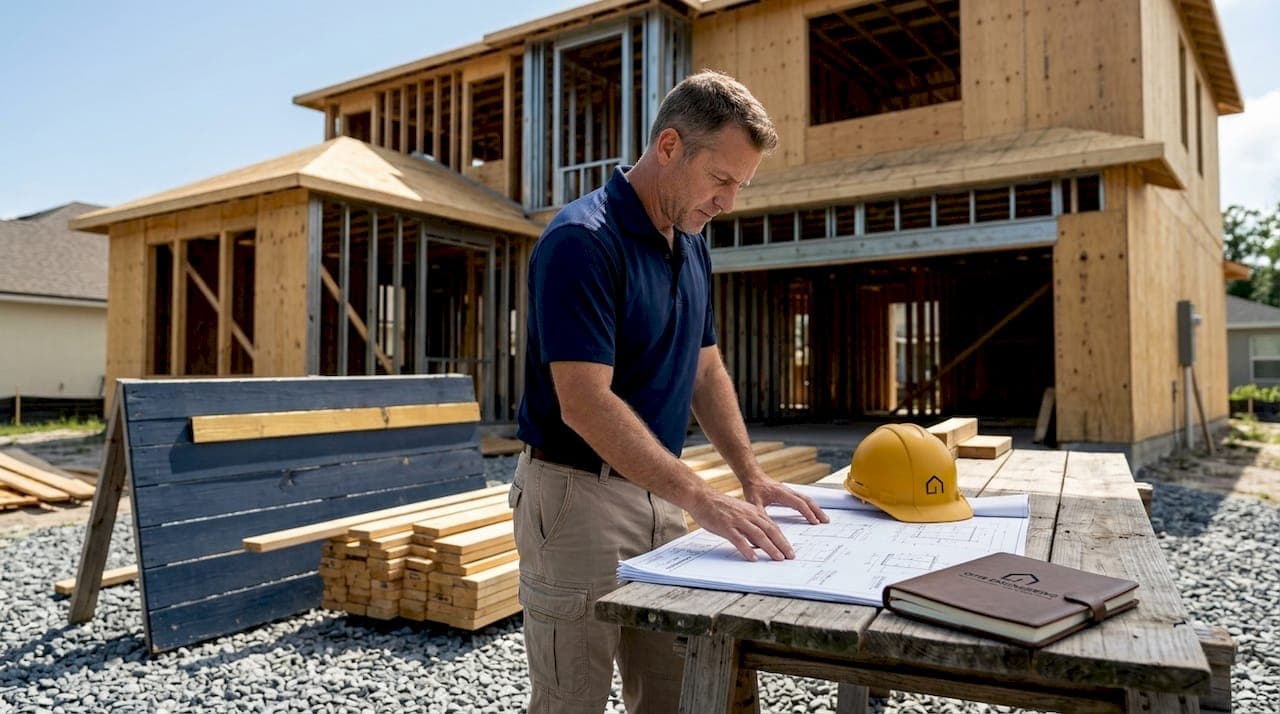
Residential construction is one of those terms that sounds straightforward until you're actually planning a project, and then the gaps in understanding start costing real money. Most homeowners and property investors in Jacksonville think of residential construction as simply building a new house. In practice, what is residential construction covers a much broader scope: it includes additions, full renovations, multifamily buildings, and structural modifications to existing homes designed for long-term living. Getting clear on that scope before you sign a contract or pull a permit is the difference between a project that stays on budget and one that stalls at the first inspection.
Table of Contents
- What is residential construction? Definitions and key concepts
- Types and approaches to residential construction in Jacksonville
- Key stages of residential construction and project workflow
- Understanding residential construction costs and budget considerations
- Energy efficiency and building codes: what Jacksonville homeowners must know
- Our perspective: the most costly mistake in residential construction happens before construction starts
- Ready to build or renovate in Jacksonville? Talk to Ofir Engineering
- Frequently asked questions
What is residential construction? Definitions and key concepts
The clearest place to start is with the official language. Residential construction is defined by the U.S. Department of Labor as projects involving the construction, alteration, or repair of single-family houses or apartment buildings of no more than four floors in height. That definition matters because it draws a direct legal and regulatory line between residential and commercial work, affecting which contractors can perform the work, which permits apply, and which safety standards govern the site.
For Jacksonville homeowners and investors, the practical implication is significant. A four-story apartment building and a single-family custom home fall under the same regulatory category for many purposes. Both are governed by residential building codes rather than the more demanding commercial standards that apply to office buildings or retail centers.
The residential construction services category is broader than most people realize. It includes:
- Single-family homes: Detached houses built on individual lots, whether custom-designed or built from a standard plan.
- Multifamily buildings: Duplexes, triplexes, and apartment buildings up to four stories, where multiple households share a structure but live in separate units.
- Townhouses and condominiums: Attached units that share walls or structural elements but are separately owned or leased.
- Renovations and additions: Structural alterations to existing homes, including room additions, garage conversions, and full-gut remodels.
- Repair and restoration projects: Work that restores a home's structural integrity or original function following damage or deterioration.
What distinguishes residential projects from commercial ones is not just height or use but the entire regulatory and engineering framework applied. Residential projects typically use lighter structural systems, shorter permit timelines, and design standards calibrated for habitability rather than high-occupancy public use.
Types and approaches to residential construction in Jacksonville
Understanding what residential construction includes is the first step. Choosing the right approach for your specific project is the next one. Residential types commonly include custom homes, production homes, and multifamily options such as apartments and townhouses, each with distinct cost profiles, timelines, and levels of homeowner involvement.
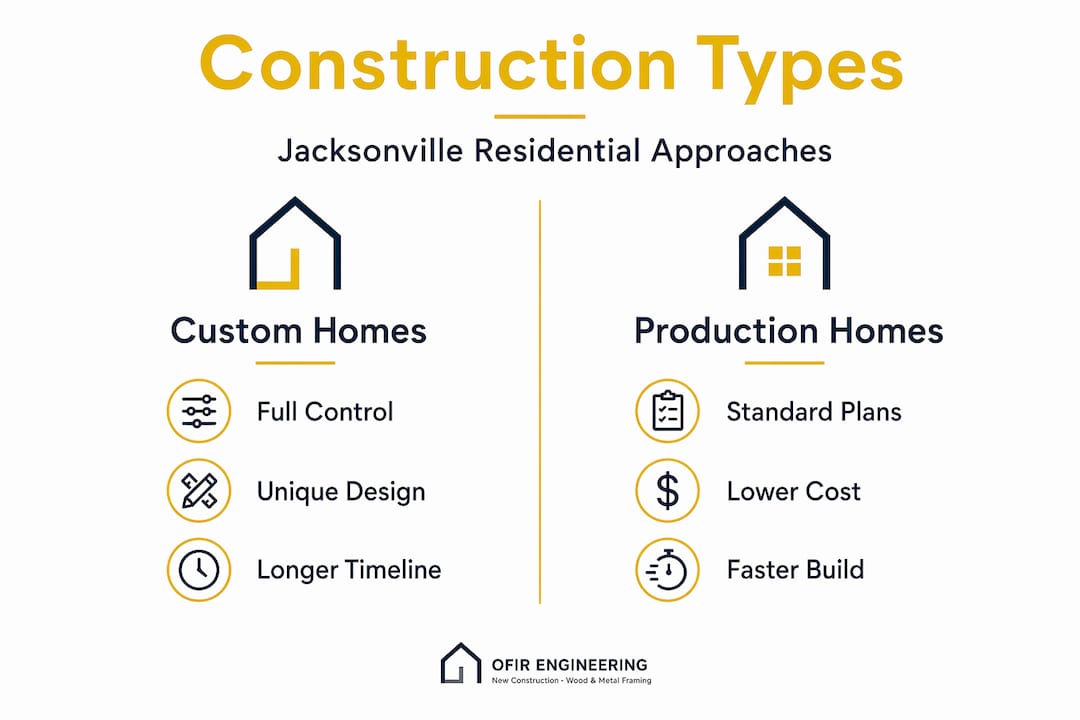
Here is a comparison of the primary construction approaches relevant to Jacksonville homeowners and investors:
| Construction type | Cost profile | Timeline | Design flexibility | Homeowner involvement |
|---|---|---|---|---|
| Custom home | Highest | 12 to 18 months | Full | High throughout |
| Production/spec home | Moderate | 6 to 9 months | Limited | Low to moderate |
| Modular/panelized | Moderate to low | 4 to 7 months | Moderate | Moderate |
| Renovation/remodel | Variable | 2 to 12 months | High within existing structure | High |
Custom home building gives the homeowner control over every detail, from floor plan layout to exterior cladding material. It takes longer and costs more per square foot, but it produces a home built precisely to specification. Production homes, built from pre-designed plans by volume builders, move faster because decisions are made in advance. Modular and panelized systems are fabricated off-site and assembled on location, reducing weather delays and labor inefficiency.
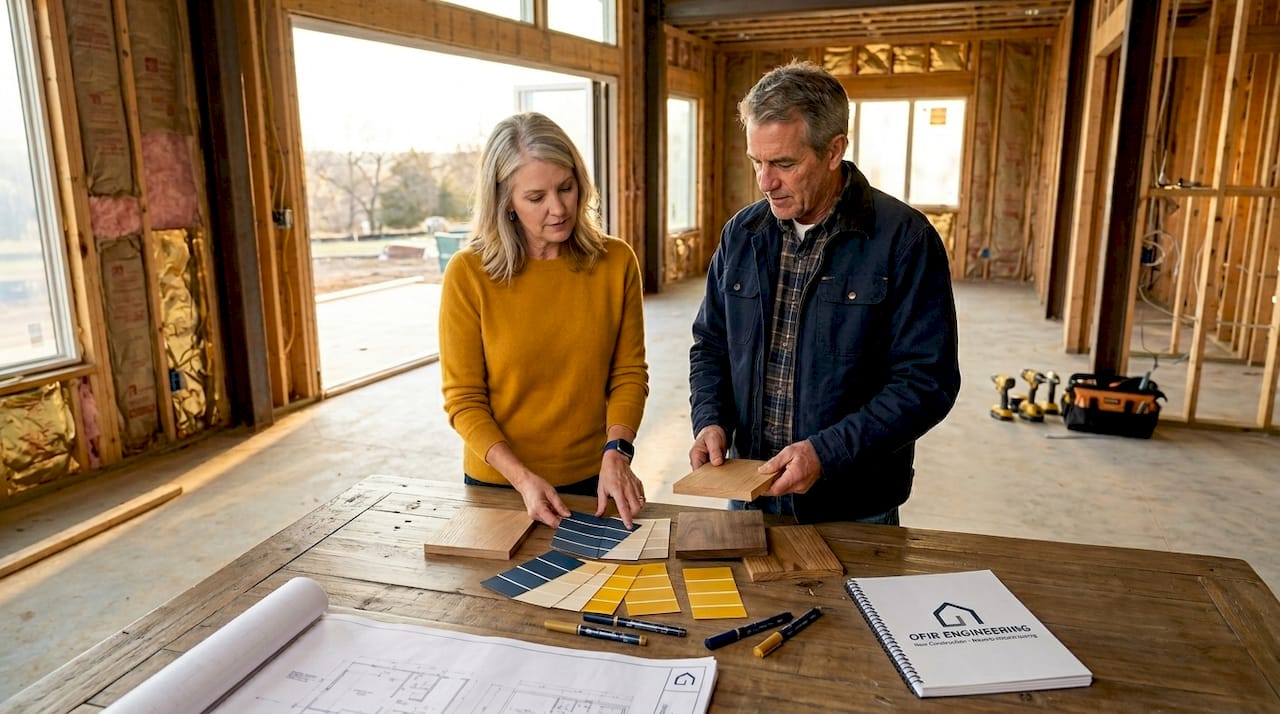
For property investors in Jacksonville, multifamily construction adds another layer of complexity. Duplexes and small apartment buildings require separate utility connections, fire separation between units, and egress configurations that single-family homes do not.
The general project approach follows a consistent sequence regardless of construction type:
- Define project scope and goals: Establish what you are building, why, and what your budget ceiling is.
- Select a construction method: Choose between custom, production, modular, or renovation based on your timeline, budget, and design needs.
- Engage your contractor and design team: Bring your builder in early so that design decisions are informed by real construction costs from the start.
- Secure permits and approvals: Submit drawings and applications to the City of Jacksonville Building Inspection Division and obtain all required permits before breaking ground.
- Execute construction in phases: Follow the structured workflow from site preparation through final inspection.
- Close out with final inspections and certificate of occupancy: Confirm that all work complies with applicable codes before occupying or leasing the property.
Pro Tip: Selecting your construction type before hiring a designer prevents expensive redesigns. A custom approach requires a different budget framework than a modular build, and discovering that late adds weeks of rework to the schedule.
Key stages of residential construction and project workflow
Once you have selected a construction type and secured your permits, the project moves through a defined set of stages. Common residential project stages include site preparation, foundation work, framing, roofing, electrical and plumbing rough-in, and finishing work such as painting and flooring. Each stage has a hold point where inspections must be passed before the next phase begins.
The full sequence for a ground-up residential build typically looks like this:
- Site preparation: Clearing vegetation, grading the land, and establishing drainage. In Jacksonville's low-elevation terrain, proper grading is particularly important to prevent water intrusion.
- Foundation work: Pouring concrete footings and slabs, or setting piers depending on soil conditions and design. Florida's sandy soils often require engineered foundation solutions.
- Framing: Erecting the structural skeleton of the home using wood frame or light gauge steel members. This stage defines the home's dimensions and load-bearing layout.
- Roofing and weather barrier: Installing roof sheathing, underlayment, and final roofing material to close the structure against weather.
- Mechanical rough-in: Running electrical wiring, plumbing lines, and HVAC ductwork through the framed cavities before walls are closed.
- Insulation: Installing thermal and air barrier systems to meet energy code requirements.
- Drywall and interior work: Closing walls, applying finishes, installing cabinetry, flooring, fixtures, and trim.
- Final inspections: Municipal inspectors verify that all systems meet code. A certificate of occupancy is issued upon passing.
Reviewing the full construction project stages guide before your project begins gives you a concrete framework for tracking progress and holding your contractor accountable. For renovations, the sequence compresses but the inspection requirements remain. Skipping a rough-in inspection, for example, can require opening finished walls for re-inspection.
Pro Tip: Request a written schedule from your contractor that maps each phase against a calendar date. Vague timelines are where cost overruns originate. When each stage has a defined start and expected completion date, delays become visible early, while they are still manageable.
Understanding residential construction costs and budget considerations
Managing a residential construction budget requires more than knowing the total number. Understanding what drives each cost category lets you ask better questions and negotiate from a position of knowledge rather than guesswork.
According to NAHB's 2024 construction cost survey, the average breakdown of a new single-family home's sales price is:
| Cost component | Percentage of sales price |
|---|---|
| Construction costs | 64.4% |
| Finished lot cost | 13.7% |
| Builder profit | 11.0% |
| Financing and overhead | 5.1% |
| Sales and marketing | 1.1% |
| Other costs | 4.7% |
Within the construction cost portion itself, the major categories include:
- Sitework: Grading, utilities connection, driveway, and landscaping.
- Framing and structural materials: Lumber or steel, sheathing, and connectors.
- Exterior finishes: Roofing, siding, windows, and doors.
- Mechanical systems: Electrical, plumbing, HVAC, and insulation.
- Interior finishes: Flooring, cabinetry, counters, fixtures, and paint.
- Labor: The largest variable cost, influenced by local market conditions and project complexity.
"Separating true construction costs from builder overhead and profit is essential for informed negotiation. Homeowners who request itemized budgets, rather than accepting lump-sum bids, identify where savings are actually possible." — NAHB Construction Economics
Effective residential construction budgeting starts before design begins. If you establish a hard budget limit and communicate it to your design and construction team from day one, decisions about materials and systems can be made with financial reality already in frame.
Pro Tip: Always ask your contractor for a line-item estimate broken down by trade and material category. A single lump-sum number tells you nothing about where you have flexibility and where costs are fixed.
Energy efficiency and building codes: what Jacksonville homeowners must know
Cost management and code compliance are not separate concerns. Energy codes directly affect the materials and systems specified in your project, which in turn affect your construction budget and long-term operating costs.
As of April 2024, HUD and USDA adopted the 2021 International Energy Conservation Code (IECC) as the minimum energy standard for new single-family and low-rise multifamily housing up to three stories. For mid-rise and high-rise multifamily buildings of four or more stories, the applicable standard is ASHRAE 90.1-2019. These standards apply to federally funded and federally assisted housing, and many jurisdictions, including Florida, align their local codes closely with these baselines.
For Jacksonville homeowners and investors, the practical energy efficiency requirements translate to specific design decisions:
- Insulation levels: Wall, ceiling, and foundation insulation must meet or exceed R-value minimums specified by climate zone.
- Window and door performance: Fenestration must meet U-factor and Solar Heat Gain Coefficient (SHGC) ratings appropriate for Florida's hot and humid climate.
- Air sealing: Maximum air leakage rates are tested and must be verified by blower door testing at project completion.
- HVAC efficiency: Heating and cooling systems must meet minimum efficiency ratings, typically expressed as SEER2 for cooling and HSPF2 for heat pump heating.
- Renewable energy readiness: Some code jurisdictions now require conduit or electrical panel capacity to support future solar installation.
Reviewing insulation and energy savings strategies specific to Florida's climate conditions will help you understand what compliance looks like in practice and how proper detailing reduces utility costs over the life of the home.
Non-compliance is expensive. Work that fails energy inspection requires correction and re-inspection, which adds both time and cost to the project. More importantly, homes that meet or exceed current energy standards are more comfortable, more durable, and more attractive to buyers or tenants.
Our perspective: the most costly mistake in residential construction happens before construction starts
After more than 15 years working on residential projects in Jacksonville, the pattern is consistent. The most expensive mistakes do not happen during framing or finishing. They happen during the planning phase, specifically when homeowners and investors make decisions about project scope without first understanding the full regulatory and cost framework.
A homeowner who selects a floor plan before confirming setback requirements may face a complete redesign after the permit application is rejected. An investor who budgets based on square-foot averages without accounting for Jacksonville's local labor rates, permit fees, and site-specific conditions routinely ends up 15 to 25 percent over their initial projection.
The practical implication is this: the benefits of residential construction planning, done thoroughly and early, outweigh the benefits of any single material upgrade or design feature you could add later. Understanding what involves residential building, from permitting to inspections to energy compliance, before the first drawing is finalized is not optional preparation. It is the single most reliable way to protect your investment and keep your project on schedule.
Informed clients produce better projects. That is not a preference. It is what the data from project outcomes consistently shows.
Ready to build or renovate in Jacksonville? Talk to Ofir Engineering
Whether you are planning a ground-up custom home, a full home renovation, or a multifamily investment property in Jacksonville, working with an experienced, licensed contractor changes the outcome of your project.
Ofir Engineering (license CHC1540016) brings over 15 years of residential construction experience to every project in Jacksonville. From Light Gauge Steel and Wood Frame new construction to full-home renovations and comprehensive project management, the team provides detailed planning, code-compliant execution, and clear communication at every stage. Explore the full range of residential construction services and take the first step toward a project built on solid planning and local expertise.
Frequently asked questions
What types of buildings qualify as residential construction?
Residential construction includes single-family homes and apartment buildings with up to four floors, covering houses, townhouses, condominiums, and low-rise apartment buildings. Structures above four stories fall under commercial or mid-rise building codes.
How long does a typical residential construction project take?
Most new residential builds span approximately seven months from site preparation through final inspections, though large custom homes or complex renovations may extend to 12 to 18 months depending on scope and permitting timelines.
What percentage of a home's price is attributed to construction costs?
According to the NAHB 2024 cost survey, construction costs account for approximately 64.4% of a new single-family home's sales price, with finished lot costs and builder profit comprising the next largest shares.
How do energy efficiency codes affect residential construction in Jacksonville?
HUD and USDA adopted the 2021 IECC as the minimum energy standard for new single-family and low-rise multifamily housing in 2024, requiring specific insulation levels, window performance ratings, air sealing verification, and HVAC efficiency minimums that apply directly to new Jacksonville residential projects.