
Florida's contractor licensing system is far more specific than most homeowners and property investors realize. The assumption that any contractor holding "a license" is qualified for any construction project is one of the most common and costly mistakes made across the state. What is licensed construction contracting, exactly, and why does the type of license matter as much as whether one exists at all? This guide breaks down Florida's regulatory framework, verification steps, hiring best practices, and the real risks of getting it wrong, so you can approach your next project with confidence.
Table of Contents
- Key Takeaways
- What licensed construction contracting means under Florida law
- Florida licensing requirements and the exam process
- How to verify a licensed contractor in Florida
- Benefits of hiring a licensed contractor and risks of unlicensed work
- Practical advice for Florida construction projects
- My perspective on Florida's licensing landscape
- Ofirengineering: licensed construction services in Jacksonville
- FAQ
Key Takeaways
| Point | Details |
|---|---|
| License type determines scope | A contractor's license class must match your specific project; an active license alone does not guarantee authorization. |
| Certified vs. registered matters | Certified licenses are valid statewide; registered licenses are restricted to the county or municipality that issued them. |
| Verification requires multiple checks | Confirm active status, license class, qualifier identity, and insurance before signing any contract. |
| Unlicensed work carries felony risk | In Florida, performing contracting work over $5,000 without a license is a third-degree felony with significant penalties. |
| Florida law sets the $2,500 threshold | Most construction projects valued above $2,500 legally require a licensed contractor under Florida Statute 489.103. |
What licensed construction contracting means under Florida law
Licensed construction contracting, as defined under Florida Statute 489.103, refers to the performance of construction work by individuals or businesses holding a valid contractor license issued by the state and overseen by the Construction Industry Licensing Board (CILB) within the Department of Business and Professional Regulation (DBPR). This is the recognized industry term: "licensed contracting" under DBPR jurisdiction. The phrase covers everything from large-scale general contracting to specialty trades, and the scope of authority varies by license class.
Florida uses two primary license designations that determine where a contractor can legally operate.
| License Type | Geographic Scope | Who Issues It |
|---|---|---|
| Certified | Statewide validity | DBPR / CILB |
| Registered | County or municipality only | Local jurisdiction |
A Certified General Contractor (license prefix "CGC") can work across Florida without seeking additional local approval. A Registered contractor, by contrast, is authorized only within the county or municipality where the license was issued. This distinction matters enormously when you hire a contractor from outside your immediate area.
Beyond the certified/registered split, DBPR recognizes multiple license classifications. The most common include Certified General Contractor, Certified Building Contractor, Certified Residential Contractor, and dozens of specialty trade categories covering electrical, plumbing, roofing, and mechanical work. Each classification carries its own scope of allowable work, examination requirements, and continuing education obligations. A licensed contractor definition under Florida law, therefore, is not a single uniform credential. It is a precise, class-specific authorization tied to a qualifying individual.
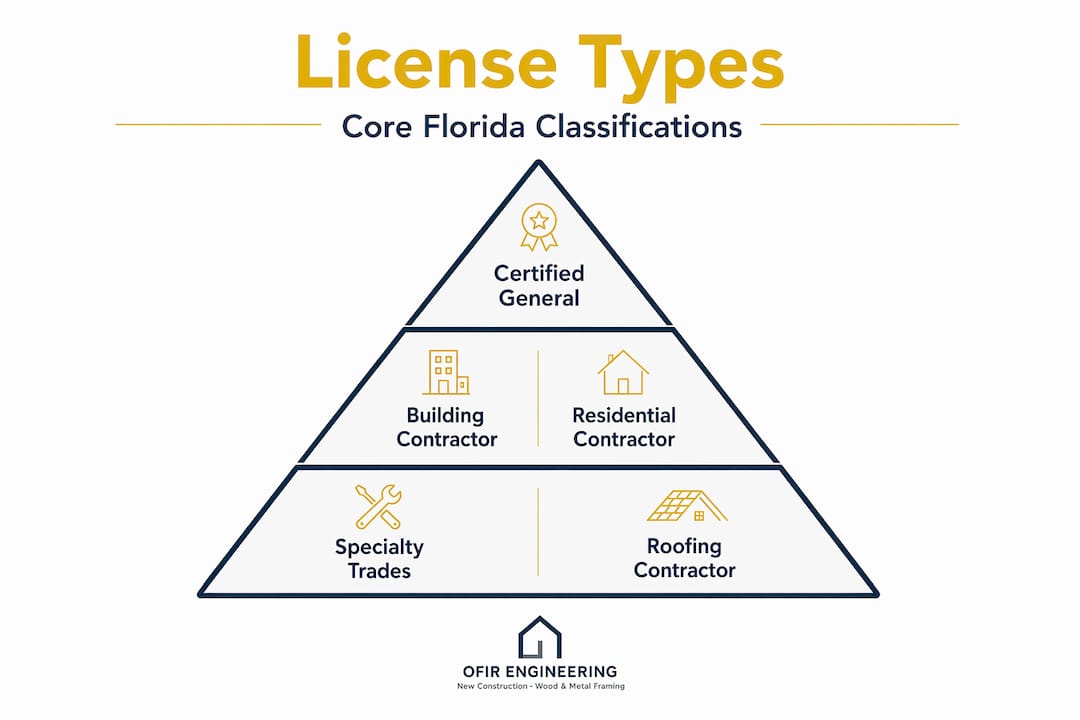
Pro Tip: When reviewing a contractor's license, look at the prefix letters in the license number. "CGC" indicates a Certified General Contractor, "CBC" a Certified Building Contractor, and "CRC" a Certified Residential Contractor. Mismatched prefixes and project types are a leading cause of compliance problems.
Florida licensing requirements and the exam process
Understanding how to become a licensed contractor in Florida clarifies why the credential carries meaningful weight. The path to licensure is demanding by design, and rightfully so.
For a Certified General Contractor designation, candidates must demonstrate a minimum of four years of supervised experience in the trade, with at least one year in a supervisory role. Financial responsibility documentation is also required, and candidates must show they carry the capacity to meet contractual and financial obligations. This protects clients from contractors who lack the business infrastructure to complete a project.
The insurance requirements are non-negotiable. General liability and workers' compensation coverage must be maintained throughout the license period, or an exemption must be filed. These requirements are not formalities. They represent real financial protection for homeowners and workers if something goes wrong on a job site.
The examination itself covers four content areas, weighted as follows:
- Preconstruction activities: Approximately 27% of exam content, covering project planning, estimating, and site evaluation
- Contract administration: The largest section at 40%, addressing contract law, subcontractor agreements, and dispute resolution
- Permits and inspections: Around 20%, requiring knowledge of Florida Building Code requirements and the permitting process
- Construction operations: The remaining 13%, covering field supervision, safety compliance, and quality control
The breadth of the exam reflects a critical insight: passing Florida's contractor exam requires competency well beyond construction methods. Contractors must understand contracts, finances, and regulatory compliance. This is precisely why the licensed contractor vs general contractor distinction matters when comparing Florida credentials to other states or informal arrangements.
Pro Tip: Continuing education is required for license renewal in Florida. A contractor who stays current on code changes and business law updates is not just satisfying a bureaucratic requirement — they are actively reducing your project risk.
How to verify a licensed contractor in Florida
Verifying a contractor's license sounds straightforward. In practice, it requires checking several interconnected data points, and stopping at just the first one is where most hiring errors occur.
The official verification tool is the DBPR MyFloridaLicense portal at myfloridalicense.com. The steps below represent best practice for any Florida construction project:
- Search by license number or name on the DBPR portal and confirm the status reads "Current, Active." An expired or suspended license means the contractor cannot legally work.
- Confirm the license class matches the scope of your project. A Certified Residential Contractor is not authorized for all commercial work, and a specialty trade license does not cover general construction management.
- Identify the qualifier. Licensed contracting is legally tied to a specific individual, called the qualifying agent. The person named on the license must be the one overseeing your project. Confirm that this individual's name appears on your contract, not just a business name or marketing brand.
- Cross-reference the business entity. Check that the company name on your contract matches the entity registered with the qualifier through DBPR and confirmed in Florida's Sunbiz business registry. Mismatches between DBPR records and contract names are among the most common sources of hiring disputes.
- Request certificates of insurance directly. Ask for current general liability and workers' compensation certificates and verify they are issued to the same business entity named in the contract.
Common mistakes include treating a business tax receipt as proof of a contractor license, accepting verbal assurances of insurance coverage, and failing to confirm whether a registered license covers your specific county.
Pro Tip: Third-party tools like LicensedCheck provide an additional layer of verification and can surface license history, complaints, and disciplinary actions that are not always visible at a glance in the DBPR portal.
Benefits of hiring a licensed contractor and risks of unlicensed work
The practical benefits of licensed contractors go beyond legal compliance. A licensed contractor has demonstrated minimum competency through examination, documented experience, and financial accountability requirements. That baseline protects you before a single nail is driven.
The protections include:
- Competency assurance. Licensing ensures minimum competency and accountability standards that unlicensed operators have not met.
- Insurance coverage. Workers injured on your property are covered under the contractor's workers' compensation policy, not your homeowner's insurance, when the contractor is properly licensed and insured.
- Code compliance. Licensed contractors are responsible for pulling permits and passing inspections, which verifies that work meets Florida Building Code standards. Unpermitted work can trigger costly remediation when you sell or refinance a property.
- Recourse mechanisms. If disputes arise, licensed contractors can be reported to DBPR, which has enforcement authority including license suspension and revocation.
The risks of unlicensed work are severe in Florida. Unlicensed contracting on projects over $5,000 is classified as a third-degree felony, carrying potential fines and imprisonment. DBPR actively investigates and prosecutes unlicensed activity. Beyond criminal exposure for the contractor, homeowners who knowingly hire unlicensed workers may face permit denial, insurance claim rejection, and difficulty selling the property later.
The difference between licensed and unlicensed contractors is not simply a matter of paperwork. It is a legal and financial distinction with consequences that can follow a property for years.
Practical advice for Florida construction projects
Applying licensing knowledge to an actual project requires translating regulatory details into hiring decisions. Florida law requires a licensed contractor for most construction work valued above $2,500, with limited exemptions for casual, minor, or inconsequential work. Most meaningful renovation, remodeling, or new construction projects fall well above that threshold.
Before you hire, consider these factors:
- Certified vs. registered for your location. If your project is in Jacksonville, Duval County, a certified contractor offers broader statewide authorization and typically more project experience. A registered contractor must be verified as covering your specific county before work begins.
- Permit requirements by project type. Structural work, electrical, plumbing, and mechanical systems almost always require permits. Reviewing permit requirements in Florida before selecting a contractor helps you confirm the scope of work and required credentials.
- Contract documentation. Your contract should identify the license number, the qualifying agent by name, the scope of work, payment schedule, and insurance certificates. This is not excessive formality. It is basic protection.
- Match work scope to license class. A roofing contractor cannot legally manage your kitchen remodel. An unlicensed subcontractor working under a general contractor must also comply with applicable trade licensing requirements.
For Jacksonville-area homeowners and investors, hiring a general contractor with a certified license and demonstrated local project history is the most reliable path to a compliant, well-executed project. Ofirengineering, licensed under CHC1540016, operates with certified credentials and comprehensive project management experience across residential new construction and renovation work throughout the Jacksonville area.
My perspective on Florida's licensing landscape
I've worked in Florida construction long enough to see how the same licensing mistakes repeat themselves across property types and project sizes. The most common one is not hiring an unlicensed contractor outright. It's hiring a licensed contractor whose license class doesn't actually cover the work being performed.
In my experience, a homeowner or investor who does a quick DBPR lookup, sees "Active," and moves forward has done about 30% of the necessary verification. The qualifier's name needs to match the contract. The license prefix needs to match the project. The insurance certificates need to name the right entity. These are not technicalities. They are the details that determine whether you have recourse if something goes wrong.
I've also seen how licensing requirements reflect genuine industry complexity. The exam's heavy weighting on contract administration and business law is there for a reason. A contractor who cannot manage subcontractors, interpret a lien waiver, or understand Florida Building Code obligations is a financial liability regardless of their hands-on skills.
What I've found actually works: treat license verification like a checklist, not a single query. And ask contractors directly how they handle permit applications, inspection scheduling, and scope changes. Their answers tell you more than a license number alone.
— Owen
Ofirengineering: licensed construction services in Jacksonville

Ofirengineering brings over 15 years of licensed construction experience to residential and commercial projects across Jacksonville. As a DBPR-certified contractor under license CHC1540016, Ofirengineering operates with full compliance at every project stage, from initial permitting to final inspection. Their services cover new construction builds using Light Gauge Steel and Wood Frame systems, full-home renovations, and turnkey remodeling projects. For homeowners, property investors, and developers who want a licensed partner with deep local regulatory knowledge, Ofirengineering provides the accountability and precision that Florida's licensing system is designed to require. Explore their home remodeling services or contact the team to discuss your project.
FAQ
What is licensed construction contracting in Florida?
Licensed construction contracting in Florida refers to performing construction work under a DBPR-issued contractor license overseen by the CILB, with specific license classes authorizing different types and scopes of work.
What is the difference between a certified and registered contractor?
A certified contractor holds a statewide license valid anywhere in Florida, while a registered contractor is limited to the county or municipality where the license was issued.
What does a licensed contractor do that an unlicensed one cannot?
A licensed contractor can legally pull permits, pass inspections under their name, and take financial responsibility for code compliance. Unlicensed contractors lack this authority and expose both parties to legal penalties.
How do you verify a contractor's license in Florida?
Use the DBPR MyFloridaLicense portal to confirm active status, check that the license class matches your project scope, and verify the qualifying agent's name matches the signed contract.
What are the penalties for unlicensed contracting in Florida?
Performing contracting work valued over $5,000 without a license in Florida is a third-degree felony, with potential fines, criminal prosecution, and DBPR enforcement action.