

A construction timeline is defined as a structured schedule that maps every task, phase, milestone, and responsibility across a building project from groundbreaking to final inspection. In the construction industry, this document is more formally called a construction program or construction schedule, and understanding both terms helps you communicate clearly with contractors and engineers. A well-built schedule answers three questions for every activity: what work needs to be done, when it must happen, and who is accountable. For homeowners and property developers in Jacksonville and beyond, knowing what is a construction timeline means knowing how to hold your project team to measurable outcomes rather than vague promises.
What is a construction timeline and why does it matter?
A construction timeline is more than a list of tasks. Schedules serve as roadmaps that keep contractors, engineers, subcontractors, and owners coordinated from the first permit application to the final walkthrough. Without one, decisions get made in isolation, materials arrive late, and inspections get missed.

The schedule also creates accountability. When every task has an assigned owner and a finish date, there is no ambiguity about who is responsible for a delay. This matters especially on residential projects where a two-week slip in framing can push back electrical rough-in, drywall, and final inspections by a month or more.
Ofirengineering builds every project around a detailed construction schedule because precision planning is the foundation of on-time, on-budget delivery. With over 15 years of experience in Jacksonville residential construction, the team treats the schedule as a contract with the client, not just an internal planning tool.
What are the typical phases and milestones in a residential timeline?
A typical residential construction timeline breaks into six time-phased stages, each with defined entry and exit criteria. Understanding these phases sets realistic expectations before you sign a contract.
| Phase | Key Milestone | Approximate Duration |
|---|---|---|
| Pre-construction | Permits issued, plans approved | 4–8 weeks |
| Foundation | Foundation inspection passed | 2–4 weeks |
| Structural framing | Frame inspection passed, lock-up achieved | 3–6 weeks |
| MEP rough-in | Rough-in inspections passed | 3–5 weeks |
| Interior finishes | Drywall, flooring, fixtures complete | 4–8 weeks |
| Commissioning | Certificate of occupancy issued | 1–2 weeks |
Milestones represent verifiable outcomes, not just elapsed time. A milestone like "foundation inspection passed" is binary: it either happened or it did not. This distinction matters because milestones control when subsequent work can legally and logically begin. You cannot frame walls on a foundation that has not been inspected and approved.
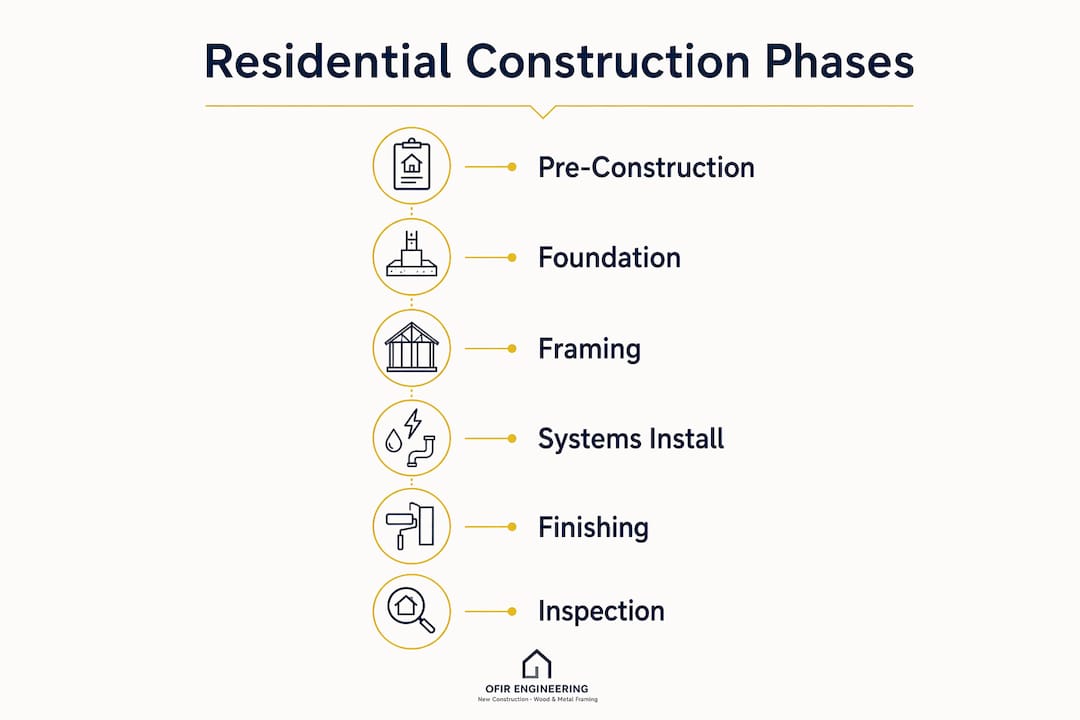
Milestones also differ from tasks in a practical way. A task is an activity with a duration, such as pouring the slab. A milestone is the confirmation that the activity met its required standard. Procore's construction milestone guidance describes milestones as evidence points for contractual and schedule management, not mere checkpoints on a to-do list.
For a deeper breakdown of how these phases connect to each other, the construction project phases guide from Ofirengineering covers each stage in detail for 2026 projects.
Pro Tip: Expect phase durations to vary by 20–30% depending on local permitting speed, weather, and project complexity. In Jacksonville, hurricane season and soil conditions can affect foundation and framing timelines specifically.
How do task sequencing and the critical path shape your schedule?
Simple phase lists do not protect you from delays. Sequencing tasks with dependencies and managing the critical path is what determines the minimum achievable project duration. This is the technical core of any reliable construction schedule.
A task dependency means one activity cannot start until another finishes. Electrical rough-in cannot begin until framing is complete. Insulation cannot go in until rough-in inspections pass. These relationships chain tasks together into a logical sequence that reflects how construction actually works.
The critical path method (CPM) identifies the longest chain of dependent activities in the schedule. That chain sets the earliest possible finish date for the entire project. Delays on critical path tasks push the finish date back by exactly the same amount. A three-day delay in foundation work on the critical path means a three-day delay in project completion, with no way to recover without adding resources.
Non-critical tasks have float, which is the amount of time they can slip without affecting the finish date. Painting an interior room may have five days of float. Installing the main electrical panel likely has none.
Key facts about critical path management:
- The critical path is recalculated every time the schedule is updated.
- Float on non-critical tasks gives you flexibility to reallocate labor and equipment.
- Most residential projects have 8–15 tasks on the critical path at any given time.
- Identifying float tasks lets project managers shift resources to protect critical activities.
- CPM is recognized by the Project Management Institute (PMI) as the standard method for schedule control.
Pro Tip: Focus your management attention on critical path tasks, not on tasks with float. Trying to accelerate a non-critical task rarely saves time but always costs money.
What tools and practices help create and maintain effective timelines?
Gantt charts visually display task start and finish dates across a horizontal timeline, giving every stakeholder a clear view of the full project at a glance. They are the most widely used visualization format in residential construction scheduling and are supported by most modern project management software.
Beyond visualization, the schedule must function as a living document. Construction schedules updated regularly, typically weekly, reflect real progress and catch delays before they compound. An outdated schedule is often worse than no schedule at all because it creates false confidence in a plan that no longer matches reality.
Experienced teams maintain two schedule views simultaneously. The first is the master schedule, which covers the full project duration and serves as the baseline for contracts and owner reporting. The second is the lookahead schedule, a 2–6 week rolling window focused on near-term readiness: are materials on site, are permits in hand, is the right labor crew available? Lookahead scheduling prevents the most common source of productivity loss, which is showing up to work when the conditions to work are not yet in place.
Common tools used for construction scheduling include:
- Microsoft Project: Industry-standard CPM scheduling with Gantt chart output.
- Procore: Cloud-based platform integrating schedule, RFIs, and inspections in one system.
- Buildertrend: Designed specifically for residential builders and remodelers.
- ProjectManager.com: Web-based Gantt and lookahead scheduling with team collaboration features.
- PlanGrid (now Autodesk Build): Field-focused tool connecting drawings to schedule tasks.
- BIM 360: Integrates Building Information Modeling with schedule data for clash detection and phasing.
Ofirengineering uses integrated scheduling tools on every Jacksonville project to maintain schedule accuracy and give clients real-time visibility into project progress. For more on how professional project management connects to schedule performance, the residential construction project management guide covers the full workflow.
How to create a realistic construction timeline: step-by-step
Building a reliable schedule requires more than filling in dates on a calendar. The steps below reflect construction timeline best practices used by licensed contractors and project managers on residential builds.
-
Define project scope and objectives. Document exactly what is being built, including square footage, structural system (Light Gauge Steel or Wood Frame), and finish specifications. Scope gaps at this stage create schedule gaps later.
-
Break work into phases and tasks using a Work Breakdown Structure (WBS). A WBS decomposes the project into manageable work packages. For a new home, this means separating site work, foundation, framing, MEP, finishes, and commissioning into individual task lists.
-
Assign realistic durations and confirm resource availability. Duration estimates must account for crew size, equipment availability, and material lead times. A framing crew of four workers completes work faster than a crew of two, and the schedule must reflect the actual crew planned.
-
Identify dependencies and establish the critical path. Map which tasks must finish before others can start. Use CPM analysis to identify the critical chain and calculate float for all other activities.
-
Set milestones tied to inspections and approvals. Every phase transition should have a milestone linked to a verifiable outcome: permit issued, inspection passed, or owner sign-off received. The home construction timeline guide from Ofirengineering details the specific milestones that apply to Jacksonville residential projects.
-
Use scheduling software to visualize and adjust. Enter all tasks, durations, and dependencies into a Gantt-based tool. Run the CPM calculation and review the resulting finish date against your target. Adjust resources or sequencing as needed.
-
Update the schedule weekly with actual progress. Compare planned versus actual completion for every task. Recalculate the critical path after each update. Communicate changes to all stakeholders before the next work week begins.
For a broader view of how planning connects to project success, the new construction planning steps guide provides a homeowner-focused walkthrough of the full process.
Pro Tip: Consult a licensed contractor like Ofirengineering before finalizing your schedule. Accurate duration estimates require local knowledge of permitting timelines, subcontractor availability, and site conditions that no generic template can provide.
Key takeaways
A construction timeline is only as reliable as the dependencies, milestones, and update discipline built into it from day one.
| Point | Details |
|---|---|
| Define milestones as verifiable outcomes | Tie every milestone to an inspection, approval, or sign-off, not just a date. |
| Manage the critical path actively | Focus resources on critical path tasks to protect the project finish date. |
| Use lookahead schedules for near-term control | A 2–6 week rolling schedule prevents productivity loss from unready conditions. |
| Update the schedule weekly | Regular updates catch delays early and keep all stakeholders aligned on reality. |
| Consult professionals before finalizing durations | Local contractors provide accurate estimates that generic templates cannot match. |
Why most construction timelines fail before the foundation is poured
After working on residential construction projects for years, the pattern is consistent: most schedule failures are not caused by bad weather or difficult subcontractors. They are caused by a timeline that was optimistic from the start and never updated after week two.
The most common mistake is treating the master schedule as a fixed document. Owners receive a Gantt chart at the project kickoff, file it away, and assume the contractor is following it. By the time a delay surfaces, it has already compounded through three or four dependent tasks. The project is four weeks behind, and no one noticed because no one was tracking.
The second mistake is confusing activity with progress. A crew showing up on site every day looks like progress. But if they are waiting on a material delivery or a failed inspection, the schedule is slipping regardless of how busy the site appears. Lookahead scheduling exists specifically to prevent this. It forces the team to confirm readiness before work is scheduled, not after the crew arrives.
The third mistake is setting milestones at arbitrary dates rather than tying them to verifiable outcomes. A milestone that reads "framing complete by week eight" is not a control point. A milestone that reads "frame inspection passed, lock-up achieved" is. The difference determines whether you have a schedule or just a wish list.
Ofirengineering addresses these risks by maintaining both a baseline master schedule and a rolling lookahead for every project. Clients receive weekly schedule updates with clear variance reporting so there are no surprises at the end of a phase.
— Owen
Plan your jacksonville build with ofirengineering's scheduling expertise
Ofirengineering brings over 15 years of licensed residential construction experience to every project in the Jacksonville area. The team builds detailed, CPM-based construction schedules for new homes, full renovations, and remodeling projects, using both Light Gauge Steel and Wood Frame systems.

Every Ofirengineering project starts with a realistic schedule built around your specific site, permitting timeline, and finish goals. The team maintains weekly schedule updates and lookahead planning to keep your project on track from permit to certificate of occupancy. If you are planning a new build or major renovation in Jacksonville, explore new construction services to see how professional scheduling translates into on-time, on-budget delivery.
FAQ
What is a construction timeline in simple terms?
A construction timeline is a structured schedule listing every task, phase, and milestone in a building project, with assigned durations and responsibilities. It tells the project team what to build, when to build it, and who is accountable.
How long does a typical residential construction timeline take?
A standard new home build in Jacksonville typically runs 9–14 months from permit approval to certificate of occupancy, depending on project size, structural system, and local permitting speed.
What is the difference between a milestone and a task?
A task is an activity with a duration, such as pouring a concrete slab. A milestone is a verifiable completion point, such as a foundation inspection passed, that confirms the task met its required standard before the next phase begins.
What is the critical path in a construction schedule?
The critical path is the longest chain of dependent tasks in the schedule. Delays on this path extend the project finish date by the same amount, making it the primary focus of schedule management.
What should a construction timeline include?
A complete construction schedule includes task names, durations, start and finish dates, assigned responsibilities, task dependencies, milestones tied to inspections or approvals, and a mechanism for weekly progress updates.