

Renovation projects in Jacksonville carry real financial weight. Whole-home renovations routinely run $250,000 to $400,000 or more, and even mid-range projects average around $244,000 when all trades, materials, and permits are factored in. Yet many homeowners enter these projects without a clear picture of what their contractor is actually responsible for, which creates costly gaps in accountability, scheduling failures, and disputes that could have been prevented. This guide defines the contractor's role precisely, explains how they create measurable value, and gives you the tools to choose, manage, and work effectively with your contractor from the first meeting through final inspection.
Table of Contents
- What is a contractor's real role in a renovation?
- How contractors add value: From planning to completion
- Managing delays, disputes, and edge cases: The contractor's crucial interventions
- Choosing and managing your contractor: Contracts, fees, and oversight
- The uncomfortable truth: Why contractor partnerships, not just contracts, drive renovation success
- Partner with experts for your Jacksonville renovation
- Frequently asked questions
Key Takeaways
| Point | Details |
|---|---|
| Contractors are project leaders | They coordinate trades, scheduling, and quality standards to deliver successful renovations. |
| Their expertise protects your investment | Skilled contractors reduce risk, prevent costly delays, and maximize your project's ROI. |
| Plan for the unexpected | Include a 10–20 percent contingency in your budget for surprises and disruptions. |
| Choose and manage wisely | Vetting, detailed contracts, and regular oversight are essential for a smooth renovation. |
What is a contractor's real role in a renovation?
The term "contractor" gets used loosely, and that imprecision causes real problems on job sites. A general contractor (GC) is not simply someone who builds things with their hands. Their core function is to coordinate and manage all the moving parts of a complex, multi-trade renovation: hiring and supervising subcontractors, sequencing trades so work flows without conflict, keeping schedules on track, managing material procurement, and ensuring that every phase of construction meets local building code requirements.
This role is fundamentally different from a project manager, even though the two are often confused. As general contractor responsibilities clarify, a GC physically builds and assumes direct financial and legal responsibility for the work, while a project manager typically oversees a project on behalf of an owner without taking on that same liability. In a fixed-price contract, the GC absorbs cost overruns and schedule risk, which is precisely why their management skills directly affect your final outcome.
| Role | Core function | Financial responsibility | Best suited for |
|---|---|---|---|
| General contractor | Builds, hires subs, manages site | Assumes risk in fixed contracts | Full renovations, multi-trade projects |
| Project manager | Oversees progress, reports to owner | No direct construction liability | Complex scheduling, owner-representative roles |
| DIY owner | Performs own work | Bears all cost and liability | Minor repairs, cosmetic upgrades |
The practical implication is clear: for any renovation that involves plumbing, electrical, framing, roofing, or a combination of trades, a licensed GC is not optional. The coordination alone, ensuring the electrician is not working in the same wall cavity the plumber needs next week, requires full-time professional oversight.
Key responsibilities a qualified GC handles on every project include:
- Licensing and permit acquisition: Pulling the correct permits through the City of Jacksonville before work begins, which protects you legally and ensures inspections occur at the right phases.
- Subcontractor verification: Hiring licensed, insured tradespeople and maintaining documentation of their credentials to protect the homeowner from liability.
- Budget management: Tracking material costs, labor invoices, and change orders in real time to keep spending aligned with the original scope.
- Code compliance: Ensuring every element of construction meets Florida Building Code requirements, from structural framing to electrical panel upgrades.
- Problem-solving on site: Identifying unforeseen conditions, like outdated wiring behind walls or inadequate structural support, before they become expensive surprises.
Pro Tip: Before signing any agreement, verify your contractor's Florida license through the Department of Business and Professional Regulation, confirm their general liability and workers' compensation insurance are current, and require that all subcontractors carry the same coverage. Review the construction services overview to understand the scope of tasks a qualified contractor should manage.
How contractors add value: From planning to completion
Understanding what a contractor does is useful. Understanding the specific, measurable value they deliver is what separates successful projects from costly failures. A skilled GC orchestrates multiple interdependent trades so that each phase of work feeds cleanly into the next, eliminating the delays and rework that occur when trades operate in silos.
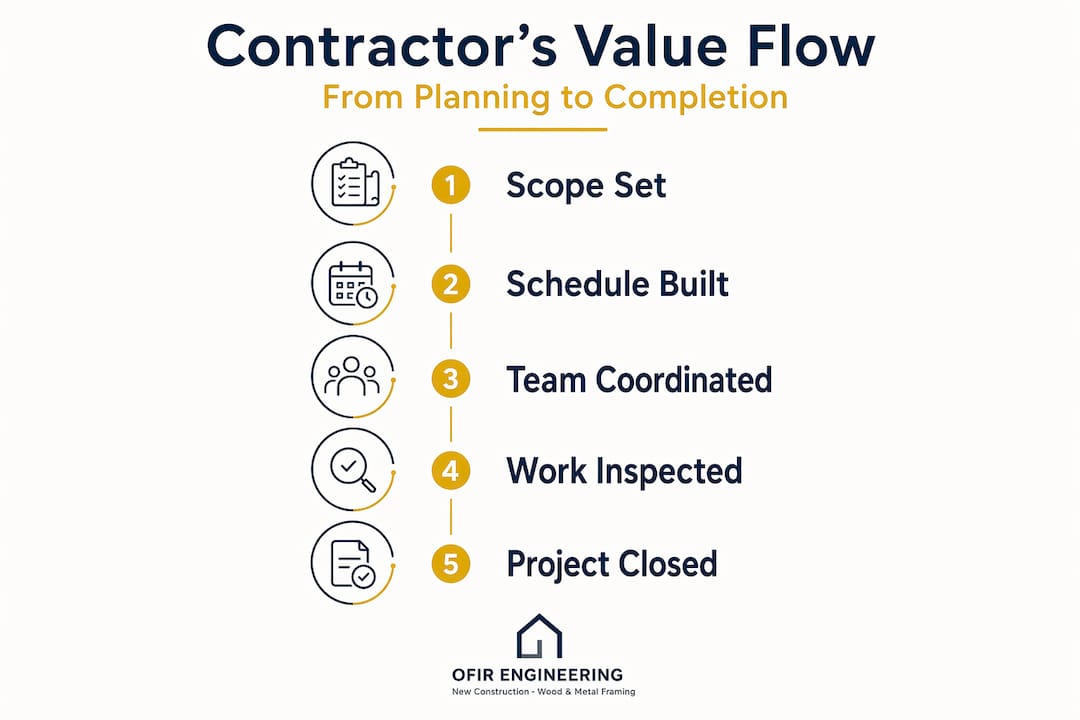
Jacksonville remodeling benchmarks show startup costs ranging from $84,000 to $623,000 depending on project scope, with a midpoint near $244,000 and a recommended contingency of 10% to 20% above the base contract. That contingency budget exists precisely because experienced contractors know conditions will change: a concrete slab that needs reinforcement, a window rough opening that does not match the specified unit, or a material lead time that has extended since the original bid. A GC's role is to absorb and manage that variability so it does not derail the project.
| Project type | Typical Jacksonville cost range | Expected ROI |
|---|---|---|
| Kitchen remodel | $40,000 – $120,000 | High (60%–80% resale return) |
| Bathroom renovation | $15,000 – $60,000 | High (70%+ resale return) |
| Whole-home renovation | $250,000 – $400,000+ | Moderate to high depending on scope |
| New addition | $80,000 – $200,000+ | Moderate |

For homeowners focused on return on investment, the data is consistent: kitchen and bath renovations consistently deliver the strongest resale premiums in the Jacksonville market. A contractor who understands local real estate dynamics will guide scope and specification decisions accordingly, helping you allocate your budget where it generates the most value.
Concrete problems that experienced contractors prevent or resolve:
- Permit failures: Unpermitted work can void homeowners' insurance, trigger stop-work orders, and complicate future sales. A GC ensures all work is properly permitted and inspected.
- Code violations: Florida's wind and flood requirements are specific and frequently updated. A GC tracks current code and applies it correctly throughout the project.
- Material waste: Precise quantity takeoffs and phased ordering reduce material overages, which in large projects can represent thousands of dollars.
- Subcontractor conflicts: When two trades need access to the same space simultaneously, a GC resolves the conflict before it becomes a delay.
- Safety management: OSHA site safety requirements apply to residential construction, and a licensed GC maintains the protocols that protect workers and reduce liability.
For a structured approach to maximizing renovation ROI, the planning phase where the contractor establishes scope, schedule, and budget is where the most value is either captured or lost. The complete renovation guide offers a detailed framework for this process.
Managing delays, disputes, and edge cases: The contractor's crucial interventions
Even well-planned projects encounter disruptions. Supply chain volatility remains a significant factor: cabinet lead times alone can run 6 to 12 weeks, and weather events, subcontractor no-shows, and material substitutions create cascading delays that compound quickly without active management. The contractor's response to these disruptions determines whether the project recovers cleanly or devolves into disputes.
"Disputes over defective work require proper documentation and, when necessary, formal demand letters. Quality standards are measured against International Building Code benchmarks, and any deviation from those standards gives the homeowner legal standing to require corrections or seek remedy."
When delays or quality issues arise, the process a qualified contractor follows is structured and documented. Log every delay and issue daily, enforce contract terms with the agreed penalties, and use a tiered resolution approach: direct negotiation first, then the state licensing board, and finally legal action only if earlier steps fail.
Step-by-step process for handling renovation disputes:
- Document the issue in writing immediately. Photograph the defective work or delay evidence and note the date, trade responsible, and impact on the schedule.
- Notify the contractor formally. A written notice, email or certified letter, creates a record and triggers the contractor's obligation to respond within the contract's specified timeframe.
- Issue a Notice to Cure if the contractor does not correct the issue within the stated period. This formal document specifies the deficiency and the deadline for correction, and it is a prerequisite for escalation.
- Escalate to the Florida Department of Business and Professional Regulation if the contractor is unresponsive or disputes the claim. Filing a complaint against a licensed contractor's bond provides a formal resolution mechanism.
- Pursue mediation or legal action as a final step, supported by the documentation collected throughout the project. Courts and arbitrators weigh contemporaneous records heavily.
The remodeling project checklist provides a practical framework for maintaining the level of documentation that makes this process effective. Homeowners who track progress consistently are in a far stronger position than those who rely on memory or verbal agreements when disputes arise.
Pro Tip: Keep a daily project log, even a brief mobile note with date, work completed, workers on site, and any issues observed. This record costs nothing to maintain and can be worth thousands in the event of a dispute or an insurance claim.
For projects where innovation-driven renovation outcomes are a priority, contractors who use digital project management tools provide real-time visibility into schedule status, inspection results, and budget consumption, reducing the information gaps that tend to escalate into disputes.
Choosing and managing your contractor: Contracts, fees, and oversight
The decision of which contractor to hire is the single most consequential choice in a renovation. Price is a factor, but a GC's fee structure typically runs 10% to 20% of the total project cost, and that margin covers something concrete: financial risk management, subcontractor coordination, code compliance oversight, and the organizational burden of managing a complex project to completion. Choosing solely on the lowest bid often shifts those costs onto the homeowner in the form of rework, delays, and disputes.
Steps for selecting a qualified contractor in Jacksonville:
- Verify the contractor's Florida license (license type CHC for residential construction) through the DBPR online portal before any further evaluation.
- Confirm active general liability insurance and workers' compensation coverage. Request certificates directly from the insurer, not just a copy from the contractor.
- Review three to five completed projects of similar scope and complexity, and speak directly with the homeowners about schedule adherence, communication quality, and how issues were handled.
- Obtain a minimum of three competitive bids on a standardized scope document so comparisons are meaningful.
- Evaluate the contractor's subcontractor network. A GC with established, vetted subcontractors will manage trade quality far more reliably than one who hires day-of through informal channels.
Contract types matter significantly for budget certainty:
- Fixed-price contract: The GC assumes cost overrun risk. Best suited to well-defined scopes where drawings and specifications are complete. Provides the homeowner with budget certainty but may include contingency padding in the bid.
- Cost-plus contract: The homeowner pays actual costs plus a management fee. More transparent but requires active oversight of invoices and change orders. Better suited to complex or phased projects where scope is likely to evolve.
Must-have clauses in any Jacksonville renovation contract include: a detailed scope of work with specific material specifications, a payment schedule tied to completion milestones rather than calendar dates, delay penalty provisions, a change order process with written approval required before scope changes begin, and a clear lien waiver process protecting the homeowner from subcontractor claims.
The Jacksonville renovation steps outline the full sequence from pre-construction through closeout, while understanding the distinction between remodeling vs. renovation helps homeowners define their scope accurately before soliciting bids. The construction upgrade guide provides additional context on how specification decisions affect both cost and long-term durability.
The uncomfortable truth: Why contractor partnerships, not just contracts, drive renovation success
Contracts are necessary. They establish accountability, define scope, and provide legal remedies when things go wrong. But the homeowners who consistently achieve the best renovation outcomes are not the ones with the most aggressive penalty clauses. They are the ones who build genuine working relationships with their contractors, based on clear communication, realistic expectations, and mutual accountability.
The most common project failures observed in residential construction do not start during construction. They start before the first permit is pulled, when a homeowner selects a contractor primarily on price, provides incomplete or ambiguous plans, and avoids difficult conversations about budget constraints or timeline expectations. By the time the framing is up and the problems emerge, the project is already in a reactive posture that is expensive to correct.
Maximizing renovation success requires a different posture from the beginning. Ask tough questions during the selection process. How does this contractor handle supply chain delays? What happens when a subcontractor's work does not pass inspection? How often will you receive written progress updates? A contractor who answers these questions directly and specifically is demonstrating the organizational competency that protects your investment. One who deflects or offers vague reassurances is showing you exactly how they will respond when problems arise on your job site.
Micromanagement is also a trap. Daily interference with trade sequencing decisions, material substitutions, or subcontractor work methods undermines the GC's authority on site and often produces worse outcomes than trusting a qualified professional to manage within the agreed scope. The homeowner's role post-signing is to track milestones against the schedule, review invoices against the contract, document observations without directing trades, and escalate concerns formally through the GC rather than directly to subcontractors.
The most durable renovation projects are built on a foundation of genuine partnership: a homeowner who communicates clearly and respects professional judgment, and a contractor who maintains transparency, documents everything, and takes ownership of outcomes rather than deflecting responsibility.
Partner with experts for your Jacksonville renovation
When you are ready to move from planning to execution on a renovation that meets Jacksonville's specific code requirements and delivers lasting value, working with an experienced local contractor makes the difference between a project that runs smoothly and one that costs you more than it should.

Ofir Engineering (license CHC1540016) brings over 15 years of residential construction experience in Jacksonville, offering full-service project management, new construction using Light Gauge Steel and Wood Frame systems, and complete renovation services. Whether you are starting with a Jacksonville renovation guide to clarify your scope or need a detailed project management checklist to keep your project on track, Ofir Engineering provides the structured guidance and hands-on expertise to deliver reliable outcomes. Explore new construction services or contact the team directly to discuss your project.
Frequently asked questions
What is the main job of a contractor during a renovation?
The main job is to coordinate trades, materials, scheduling, and ensure the work meets code so your project is completed on time and within budget. As general contractor responsibilities confirm, GCs manage the full complexity of multi-trade projects that individual homeowners cannot efficiently self-coordinate.
How do I know if I need a general contractor or just a project manager?
If your renovation involves multiple specialties like plumbing, electrical, and framing, hire a general contractor, since a GC builds and assumes financial risk while a project manager only oversees without that direct liability.
What should be in a renovation contract?
A solid contract includes a detailed scope, milestone-based payment schedule, penalties for delays, and requirements that all workers carry verified licenses and insurance before setting foot on site.
How do contractors in Jacksonville handle renovation delays?
Experienced contractors use documented schedule adjustments and formal notices, including the Notice to Cure, to resolve delays caused by supply chain shortages, weather events, or subcontractor no-shows.
What percentage of my renovation budget should I assign as a contingency?
Set aside 10% to 20% of your total renovation budget as a contingency reserve to cover unforeseen conditions, material price changes, and scope adjustments that arise during construction.