
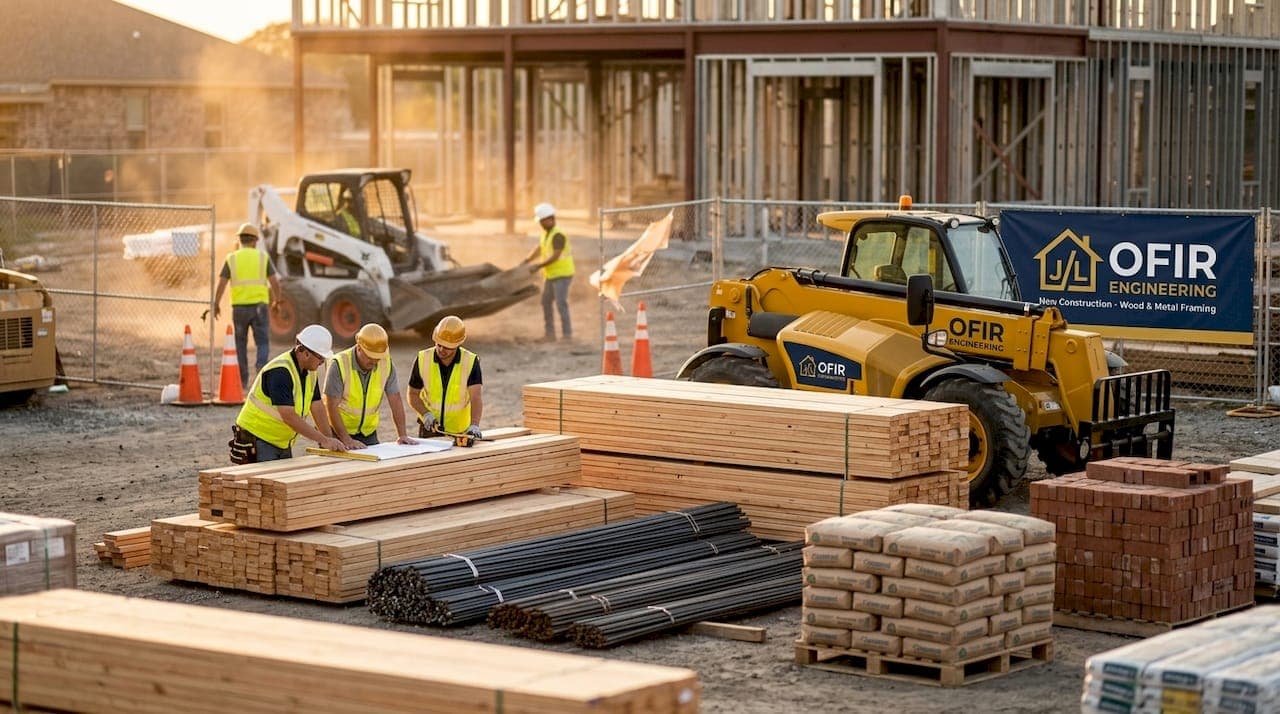
Types of building materials are categorized primarily by their role in construction stages: foundation materials, structural materials, and finishing materials. Each category demands specific physical and chemical properties, and selecting the wrong material for a given stage creates failures that are costly to correct. Building materials span cement, sand, aggregates, steel reinforcement bars, tiles, paint, plaster, doors, and windows, with each serving a defined purpose at a defined phase. Ofirengineering, a licensed Jacksonville construction company with over 15 years of residential and renovation experience, uses this stage-based framework to guide every project from ground-up new construction to full-home remodeling.
1. What are the main types of building materials by construction stage?
The three primary construction stages each require a distinct set of materials. Foundation materials must resist compression, moisture, and soil movement. Structural materials must carry loads across beams, columns, slabs, and walls. Finishing materials must perform against weather, wear, and aesthetic expectations.
Understanding this hierarchy prevents a common planning error: specifying finishing-grade materials for structural applications or vice versa. A homeowner who selects standard drywall compound as an exterior coating, for example, will face failure within one wet season. The stage-based approach that Ofirengineering applies to every Jacksonville project eliminates that risk by matching material specifications to application demands before procurement begins.
2. What are the essential foundation materials?
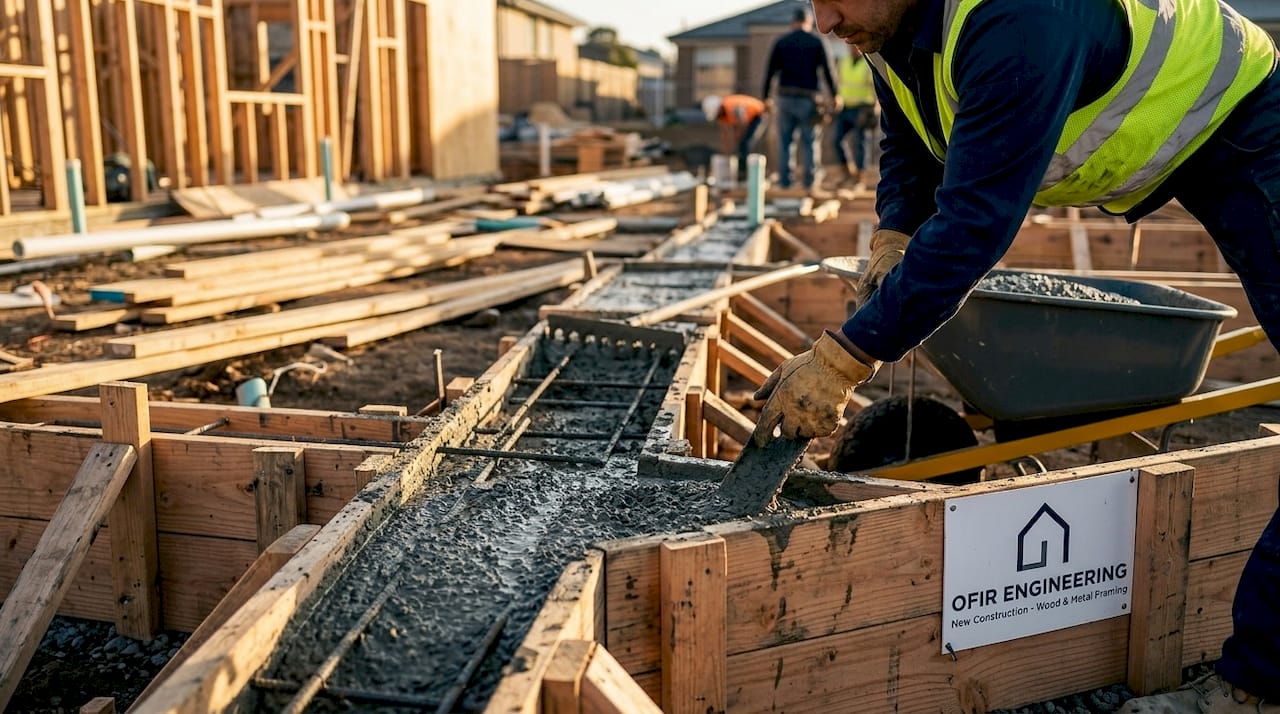
Foundation construction relies on a core set of common building materials that work together to transfer structural loads into the ground safely. The primary materials include:
- Portland cement and blended cement: The binding agent in concrete mixes. Type II Portland cement, which meets ASTM C150 standards, offers moderate sulfate resistance and is widely used in residential foundations in regions with reactive soils.
- Sand and coarse aggregates: These form the bulk of concrete volume. Aggregate gradation directly affects compressive strength and workability.
- Steel reinforcement bars (rebar): Placed within concrete to resist tensile forces. Concrete handles compression well but cracks under tension without steel reinforcement.
- Bricks and AAC blocks: Used in foundation walls and stem walls. Autoclaved Aerated Concrete (AAC) blocks offer thermal insulation alongside structural support.
- Waterproofing membranes: Applied to below-grade surfaces to prevent moisture intrusion. Crystalline waterproofing and sheet-applied membranes are the two most common systems.
The quality of foundation materials determines the lifespan of everything built above them. Cutting costs at this stage by using lower-grade aggregates or skipping waterproofing creates structural and moisture problems that surface years later and require extensive remediation.
Pro Tip: Source aggregates from suppliers who provide certified gradation reports. Aggregate quality varies significantly by region, and uncertified material can reduce concrete compressive strength by 15 to 20 percent compared to specification-grade material.
3. Which materials form the structural framework?
Structural materials carry the loads of a building and transfer them to the foundation. The selection of these materials affects cost, construction speed, long-term durability, and environmental impact. The four primary structural material categories are concrete, steel, wood, and masonry.
Pro Tip: When switching from standard Portland cement to a blended cement in a structural mix, trial batches and submittals are required before full-scale production. Blended cements cure differently and can affect construction schedules if not tested in advance.
The table below compares the key properties and typical applications of the most common structural materials:
| Material | Key properties | Common structural uses |
|---|---|---|
| Portland cement concrete (Type I/II) | High compressive strength, fire resistance | Slabs, footings, columns, beams |
| Blended cement concrete (ASTM C595) | Reduced heat of hydration, sulfate resistance | Mass pours, marine environments |
| Structural steel (hot-rolled) | High tensile and compressive strength | Beams, columns, moment frames |
| Light Gauge Steel (cold-formed) | Dimensional stability, non-combustible | Wall framing, floor joists, roof trusses |
| Dimensional lumber (wood frame) | Workable, cost-effective, renewable | Wall studs, rafters, floor framing |
| Concrete masonry units (CMU) | Compressive strength, fire resistance | Load-bearing walls, retaining walls |
| Fired clay brick | Durability, aesthetic versatility | Veneer walls, load-bearing walls |
Portland and blended cements carry ASTM C150 and ASTM C595 classifications respectively, with each type engineered for specific performance conditions including heat of hydration, early strength gain, and sulfate resistance. Selecting cement type based on project conditions rather than brand preference is a foundational principle that Ofirengineering applies across all commercial and residential structural work.
Steel deserves particular attention in Jacksonville's high-wind environment. Light Gauge Steel framing, which Ofirengineering uses in new construction projects, does not rot, warp, or shrink. It holds dimensional tolerances that wood framing cannot match over time, and it performs predictably in the humid subtropical climate that accelerates wood degradation in Northeast Florida.
Masonry units like bricks are classified by manufacturing method: un-fired, fired, chemically set, and compressed earth blocks. Each classification produces different compressive strength values and suitability for load-bearing versus veneer applications.
4. What finishing materials enhance aesthetics and functionality?
Finishing materials are the final layer of a building's performance system. They protect structural components from weather and wear, regulate interior comfort, and define the visual character of a space. The best materials for construction finishes combine durability with energy performance.
Key finishing material categories include:
- Tiles: Ceramic, porcelain, and natural stone tiles serve floors, walls, and wet areas. Porcelain tiles with a PEI rating of 4 or 5 are appropriate for high-traffic floors. Understanding tile finish options before specifying prevents costly replacements caused by surface wear or slip hazards.
- Paint and wall coatings: Exterior paints must carry elastomeric or acrylic formulations rated for UV and moisture exposure. Interior paints are selected by sheen level and VOC content.
- Wall putty and plaster: Applied before paint to create a smooth, bonded substrate. Gypsum plaster provides a harder, more crack-resistant finish than standard drywall compound.
- Gypsum board (drywall): The standard interior wall substrate in residential construction. Moisture-resistant and fire-rated variants serve bathrooms, kitchens, and fire-separation assemblies.
- Doors and windows: Material choices include wood, aluminum, vinyl, and fiberglass. In Jacksonville's climate, fiberglass and aluminum frames with thermally broken profiles outperform vinyl in long-term dimensional stability and impact resistance.
Ofirengineering's approach to weather-resistant finishing materials in Jacksonville prioritizes coatings and cladding systems rated for high humidity and wind-driven rain. A finish that performs in a mild northern climate may fail within two to three years in Northeast Florida without proper specification.
5. What are the specialized materials for plumbing and electrical systems?
Mechanical, electrical, and plumbing (MEP) systems rely on material choices that are often invisible once construction is complete, yet they determine system longevity and code compliance. Matching the right material to the right service application is the single most important factor in plumbing system durability.
- PVC pipe: Handles water below 140°F and is the standard material for drain, waste, and vent (DWV) systems. PVC is not rated for hot water supply lines.
- CPVC pipe: Rated for service up to 200°F, making it suitable for hot water distribution in residential buildings.
- Copper pipe: Carries a multi-decade service life and is compatible with both hot and cold supply. Copper is the benchmark material for water quality and longevity, though material costs are higher than plastic alternatives.
- PEX tubing: Cross-linked polyethylene tubing used for hot and cold supply runs. PEX is flexible, freeze-resistant, and faster to install than rigid pipe systems.
- Electrical conduit: EMT (electrical metallic tubing) and PVC conduit protect wiring in exposed or underground installations. The conduit material is selected based on exposure conditions and local code requirements.
- Wiring: Copper conductors remain the standard for residential wiring. Aluminum wiring, used in some older construction, requires specific connectors and devices rated for aluminum compatibility.
Pro Tip: Plumbing material failures most often result from using PVC where CPVC or copper is required. Always verify temperature and pressure ratings before specifying any pipe material for hot water service.
6. How do eco-friendly and innovative materials impact modern construction?
Sustainable and low-carbon materials are no longer niche options. They represent a growing segment of the construction material market, driven by both environmental regulation and measurable cost savings over a building's lifecycle. Concrete contributes roughly 8% of global CO2 emissions, which means material substitution at the concrete specification stage has the largest single impact on a project's carbon footprint.
Key eco-friendly building options and emerging materials include:
- Supplementary cementitious materials (SCMs): Fly ash, slag cement, and silica fume replace a portion of Portland cement clinker. Using SCMs and mix optimization reduces concrete carbon intensity by 30 to 60 percent while maintaining structural performance.
- Electric arc furnace (EAF) steel: Produced using recycled scrap metal and electricity rather than virgin ore and coal. EAF steel carries a significantly lower embodied carbon footprint than blast furnace steel.
- Mass timber: Cross-laminated timber (CLT) and glulam beams store biogenic carbon and can replace concrete and steel in mid-rise structural applications. Mass timber also offers faster on-site assembly.
- Bio-based finishes: Natural oil paints, clay plasters, and cork flooring reduce VOC emissions and synthetic material use in interior finishing.
- Self-healing concrete: Incorporates bacteria or chemical agents that activate when cracks form, sealing the crack and extending service life without maintenance intervention.
- Transparent wood: A research-stage material produced by removing lignin from wood and infusing it with a polymer. It offers structural capacity alongside light transmission, with potential applications in windows and facades.
- Natural stone: Natural stone in sustainable design offers durability, low maintenance, and a lower lifecycle carbon footprint than many manufactured alternatives when sourced regionally.
Embodied carbon impact is determined primarily by early material choices. Designers and contractors who specify low-carbon mix options at the schematic design stage lock in carbon reductions that cannot be recovered later in the project.
Key takeaways
Selecting the right construction material variety for each stage of a project is the single most consequential decision a builder or homeowner makes, because material mismatches at the foundation or structural level cannot be corrected without demolition.
| Point | Details |
|---|---|
| Stage-based selection | Match materials to their construction stage: foundation, structural, or finishing. |
| Cement type matters | Choose Portland or blended cement based on ASTM classification and project conditions, not brand. |
| Plumbing material matching | Use CPVC or copper for hot water lines; PVC is rated only for cold water and DWV systems. |
| Carbon reduction starts early | Specifying SCMs and EAF steel at design stage reduces embodied carbon by 30 to 60 percent. |
| Finishing performance | In high-humidity climates like Jacksonville, specify weather-rated coatings and thermally broken window frames. |
What material selection actually looks like in practice
After 15 years of residential construction and renovation work in Jacksonville, the pattern I see most often is this: homeowners and even some contractors treat material selection as a procurement task rather than an engineering decision. They compare prices on cement bags or lumber bundles without first confirming that the specification matches the application.
The most overlooked factor is the relationship between material performance and local climate. Jacksonville sits in an ASCE 7 high-wind zone with sustained humidity that accelerates corrosion, wood rot, and coating failure. A material that performs adequately in a dry inland climate may fail in three to five years here without the right specification. That is not a product failure. It is a selection failure.
The second misconception I encounter regularly is that sustainable materials cost more. In most cases, SCM-blended concrete costs the same or less than standard Portland cement mixes, and the long-term maintenance savings on mass timber and EAF steel structures are measurable. The cost premium for eco-friendly building options is shrinking as supply chains mature.
My practical advice: make material decisions in the design phase, not at the supply house. By the time a project reaches procurement, the structural system is fixed and the opportunity to specify low-carbon alternatives has often passed. Collaboration with a contractor who understands both the technical specifications and the local environment is the most reliable way to get material selection right from the start.
— Owen
Build with confidence: Ofirengineering's construction expertise
Ofirengineering brings over 15 years of licensed residential construction experience to every project in Jacksonville, from new construction homes built with Light Gauge Steel and Wood Frame systems to full-home renovations that require precise material specification at every stage.
Whether you are planning a ground-up build or a complete home renovation, the material decisions made early in the project determine long-term performance, maintenance costs, and structural integrity. Ofirengineering provides tailored guidance on construction material varieties, sustainable options, and durable building material types suited to Northeast Florida's climate and code requirements. Contact Ofirengineering directly to discuss your project and receive a material specification plan grounded in 15 years of local construction experience.
FAQ
What are the main types of building materials?
Building materials are categorized into foundation materials (cement, aggregates, rebar, waterproofing), structural materials (concrete, steel, wood, masonry), and finishing materials (tiles, paint, plaster, doors, windows). Each category serves a distinct construction stage with specific performance requirements.
Which building material is the most durable?
Concrete and steel are the most durable common building materials for structural applications, with properly specified concrete achieving compressive strengths above 4,000 psi and structural steel offering tensile strength that concrete alone cannot provide. Light Gauge Steel framing does not rot, warp, or corrode under normal residential conditions.
What is the most eco-friendly building material?
Mass timber and SCM-blended concrete are among the most practical eco-friendly building options currently available. Using supplementary cementitious materials in concrete mixes reduces carbon intensity by 30 to 60 percent, and mass timber stores biogenic carbon for the life of the structure.
How do I select the right plumbing pipe material?
Select plumbing pipe material based on service temperature and application: PVC for cold water and drain systems, CPVC for hot water supply up to 200°F, copper for long-term hot and cold supply, and PEX for flexible hot and cold distribution runs. Using the wrong material for the temperature rating is the leading cause of premature plumbing failure.
Does cement type affect structural performance?
Yes. Portland cement types classified under ASTM C150 (Type I through V) differ in heat of hydration, sulfate resistance, and early strength gain. Selecting the wrong type for site conditions, such as using Type I in sulfate-rich soil, can lead to long-term concrete degradation.