
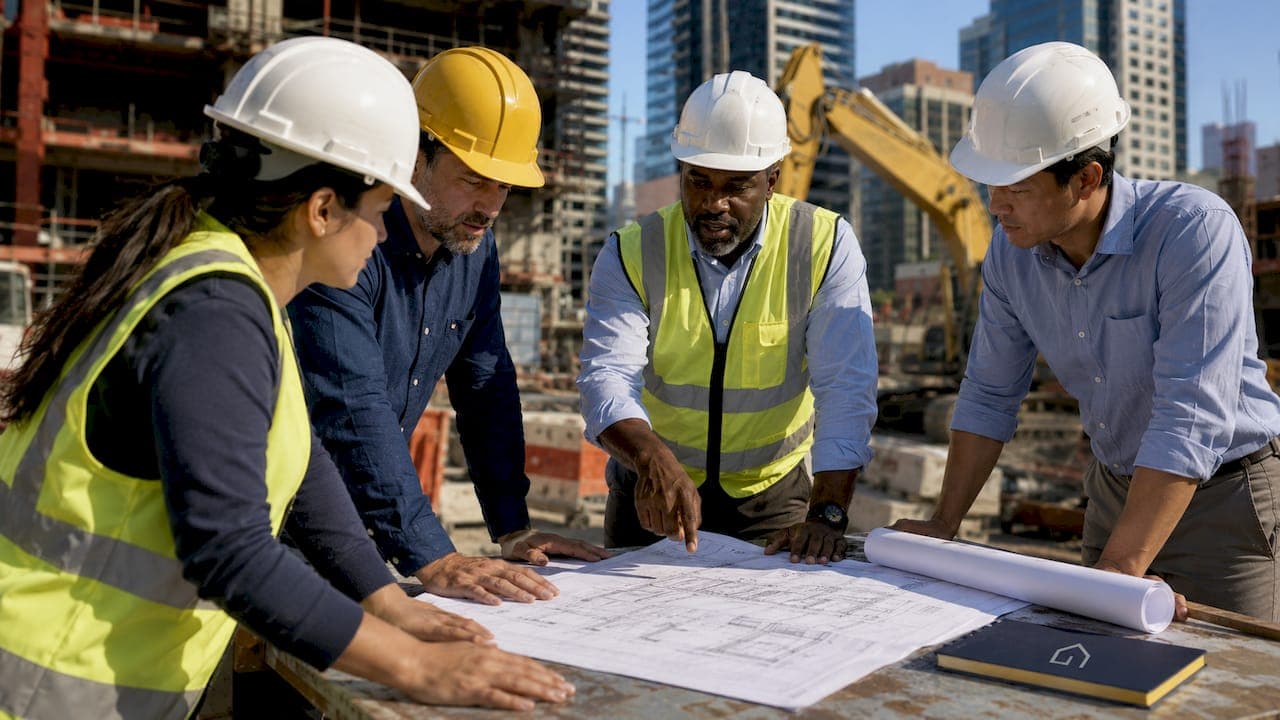
Construction partnerships are defined as structured collaborative relationships between owners, contractors, architects, and suppliers that align goals, distribute risk, and maintain open communication to drive successful project delivery. The role of partnerships in construction extends far beyond contractual obligation. It shapes how teams communicate, how risk is absorbed, and ultimately whether a project finishes on time and within budget. Organizations like the American Institute of Architects (AIA), the Associated General Contractors of America (AGC), and Caltrans have each documented the measurable impact that formal partnering frameworks produce on project outcomes. For residential construction professionals and project managers, understanding how to build and sustain these alliances is one of the most practical investments in long-term project performance.
How do construction partnerships enhance collaboration and reduce project risks?
Construction partnerships reduce project risk by replacing adversarial contracting dynamics with structured, trust-based communication frameworks. Unresolved adversarial relationships in construction result in tens of billions of dollars annually in project interest and legal costs. That figure reflects the real price of misaligned incentives, poor communication, and disputes that escalate rather than resolve.
The AIA-AGC 2026 joint framework identifies early alignment on shared goals, clearly defined roles, and open communication between architects and contractors as the foundation of stronger project teams. This framework moves away from the traditional model where design and construction operate in separate silos, and toward a team-based approach that uses digital coordination tools to track decisions, flag conflicts, and maintain transparency. The practical result is fewer change orders, reduced schedule slippage, and better cost control.
The Caltrans Field Guide to Partnering specifies that mandatory, recurring partnering sessions with structured issue tracking create a proactive mechanism for steering projects before problems compound. Monthly feedback surveys within this model have been used to rescue underperforming projects by surfacing issues early rather than waiting for formal dispute processes. For construction professionals managing residential projects in Jacksonville and similar markets, adopting even a simplified version of this feedback loop produces measurable gains in team alignment.
- Establish a communication charter at project kickoff that defines who owns each decision category
- Schedule recurring partnering sessions at defined project milestones, not just at the start
- Use digital platforms such as Procore or Autodesk Construction Cloud to centralize issue tracking and document approvals
- Assign a neutral facilitator for early partnering workshops to prevent positional bargaining
Pro Tip: Set up a shared issue log accessible to all key stakeholders from day one. Teams that track open items in a single, visible system resolve conflicts an average of 40% faster than those relying on email chains.
What are the common types of partnerships used in construction projects?
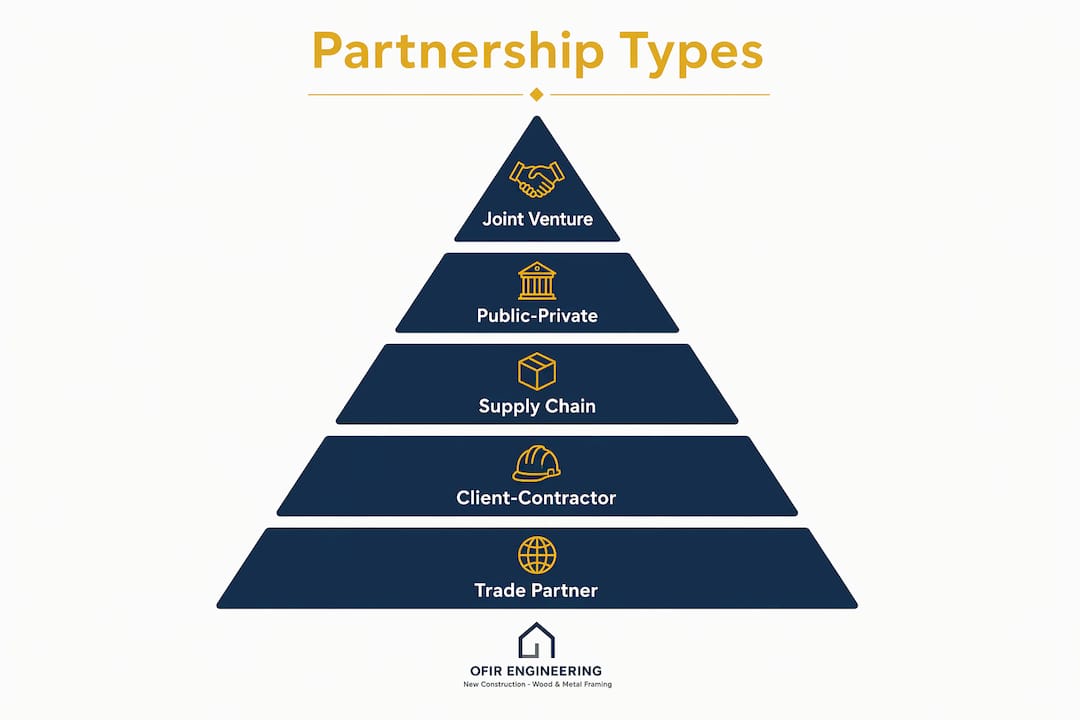
Construction industry alliances take several distinct structural forms, each suited to different project scales, risk profiles, and capital requirements. Understanding which model fits a given project is a prerequisite for structuring the relationship correctly from the outset.

Joint ventures (JVs) are the most recognized form of construction partnership. In a JV, two or more parties combine resources, expertise, and risk exposure to deliver a project neither could execute alone. A recent example is the Barratt Redrow joint venture structured to deliver 8,500 homes in a garden town scheme, combining a major housebuilder's construction capacity with a community management partner's operational expertise. That scale of delivery would be impractical for either party independently. In residential construction, JVs are equally relevant at smaller scales, including multiplex developments where a licensed builder partners with a capital investor to share both financial exposure and project leadership.
Public-private partnerships (PPPs) introduce a government or public agency as a stakeholder alongside private developers and contractors. In affordable housing and infrastructure projects, strategic architectural design in PPPs must align funding sources, permitting sequences, and construction phasing from project inception. Failing to integrate these elements early is the primary cause of costly delays in PPP projects.
Supply chain and trade partner alliances represent a third model that is often underutilized. Rather than treating subcontractors and suppliers as transactional vendors, leading construction firms engage them as ongoing collaborators. This approach is particularly effective during preconstruction, where early trade partner input surfaces sequencing conflicts before they become budget problems.
| Partnership Type | Primary Benefit | Typical Context |
|---|---|---|
| Joint venture | Shared risk and combined capacity | Large residential or mixed-use development |
| Public-private partnership | Access to public funding and permitting support | Affordable housing, infrastructure |
| Supply chain alliance | Early constructability input and cost optimization | Preconstruction and trade coordination |
| Client-contractor partnership | Aligned goals and reduced change orders | Residential renovation and new construction |
What financial and operational benefits do construction partnerships provide?
Construction partnerships produce quantifiable financial advantages when structured with clear incentive alignment. In regional multiplex joint ventures, preferred returns for capital partners typically approximate 8% before sponsor profit distribution. This benchmark matters because it establishes a transparent threshold that protects the capital partner's investment while motivating the operating partner to perform efficiently. Without this structure, profit-sharing disputes are common and often derail otherwise viable projects.
Equity distribution in JVs extends beyond cash contributions. Ownership and profit shares are negotiated based on contributions including technical expertise, licensing, local relationships, and bonding capacity. An experienced builder who brings a general contractor's license, established subcontractor relationships, and bonding capacity to a JV holds real equity value even without contributing capital. Recognizing and formalizing these non-cash contributions prevents disputes over profit allocation later in the project lifecycle.
Operationally, early trade partner engagement identifies constructability and sequencing conflicts before they force value engineering under budget pressure. Value engineering driven by budget shortfalls almost always compromises quality. When trade partners are engaged during preconstruction, the team optimizes cost and performance together rather than making reactive cuts during construction.
- Preferred return structures protect capital partners and align sponsor incentives
- Sweat equity provisions allow experienced builders to participate without full cash contribution
- Early trade engagement reduces rework costs and eliminates late-stage value engineering
- Joint stewardship of project budgets reduces cost overruns by distributing accountability across partners
Real estate development firms that prioritize long-term partner reliability over short-term speed consistently report better outcomes across multiple project cycles. Transparency and steady engagement through market and regulatory changes are the attributes that define a durable partner relationship, not just the ability to move quickly in favorable conditions.
How can construction professionals build and sustain successful partnerships?
Sustaining successful partnerships in building requires deliberate structure, not just goodwill. The following steps reflect best practices drawn from AIA-AGC guidance, Caltrans partnering protocols, and real estate development experience.
- Define roles and decision authority before mobilization. Every partner must know which decisions they own, which require joint approval, and which are delegated to project management. Ambiguity in decision authority is the single most common cause of partnership friction on active projects.
- Engage trade partners during preconstruction. Bringing mechanical, electrical, and plumbing contractors into design coordination meetings before construction documents are finalized surfaces conflicts that would otherwise appear as costly field changes.
- Implement a structured partnering session schedule. Following the Caltrans model, schedule formal partnering sessions at project kickoff, at each major phase transition, and monthly during active construction. Use a shared issue log to track open items between sessions.
- Use digital coordination tools consistently. Platforms like Autodesk Construction Cloud, Procore, and PlanGrid provide a single source of truth for drawings, RFIs, submittals, and change orders. Consistent use across all partners eliminates the version-control problems that generate disputes.
- Evaluate partners on reliability, not just price. Development firms that build durable construction industry alliances consistently select partners based on transparency and responsiveness through difficult conditions, not solely on initial bid competitiveness.
- Align on long-term outcomes from the first meeting. Partners who share a clear picture of the finished project, the target market, and the performance benchmarks are far less likely to diverge on priorities mid-project.
Pro Tip: When evaluating a potential partner, request references from projects that encountered significant regulatory or market disruptions. How a partner behaves under pressure reveals far more about compatibility than their performance on straightforward projects.
Ofirengineering applies these principles across its residential construction and project management work in Jacksonville, treating subcontractors, suppliers, and clients as integrated project stakeholders rather than transactional counterparties.
Key takeaways
Structured construction partnerships reduce cost overruns, resolve disputes faster, and produce better project outcomes when built on aligned incentives, defined roles, and consistent communication protocols.
| Point | Details |
|---|---|
| Define roles before mobilization | Ambiguity in decision authority is the leading cause of partnership friction on active projects. |
| Use structured partnering sessions | Recurring sessions with issue tracking proactively resolve conflicts before they escalate to legal disputes. |
| Engage trade partners early | Preconstruction trade involvement eliminates costly sequencing conflicts and prevents reactive value engineering. |
| Structure equity and returns clearly | Preferred return benchmarks and sweat equity provisions align incentives and prevent profit-sharing disputes. |
| Prioritize reliability over speed | Durable partnerships depend on transparency and steady engagement through regulatory and market changes. |
Why partnerships have changed how I think about construction project success
Over more than 15 years working in residential construction and project management, the most consistent predictor of a project finishing well is not the contract structure or the budget size. It is the quality of the working relationships between the key parties. Projects with adversarial dynamics between the general contractor and design team almost always produce change orders, delays, and cost overruns that could have been avoided with earlier alignment.
The shift I have observed most clearly is in how trade partners are treated during preconstruction. Firms that bring their mechanical, electrical, and plumbing contractors into design coordination early consistently avoid the field conflicts that derail schedules. The ones that treat subcontractors as interchangeable vendors until mobilization day pay for that approach in rework costs and schedule recovery.
What surprises most project managers is how little it takes to formalize a partnership. A clear issue log, a defined meeting cadence, and an honest conversation about decision authority at project kickoff are often sufficient to transform a transactional relationship into a genuinely collaborative one. The financial structures around preferred returns and equity distribution matter, but they only function well when the operational relationship is already built on trust and transparency.
At Ofirengineering, the approach to residential construction planning reflects this philosophy. Clients, trade partners, and project managers are aligned on goals and responsibilities before a single permit is filed. That alignment is what makes precision execution possible.
— Owen
Build your next project on a foundation of proven partnership
Ofirengineering brings over 15 years of licensed residential construction experience to every project in the Jacksonville area, with a project delivery model built on the partnership principles outlined in this article. From new construction using Light Gauge Steel and Wood Frame systems to full-home renovations, every engagement begins with clear role definition, early trade partner coordination, and transparent communication protocols.

Whether you are a homeowner, property investor, or real estate developer, Ofirengineering's approach to new construction in Jacksonville integrates the collaboration strategies that reduce risk and deliver quality results. The team also supports residential project management from preconstruction through final delivery, applying structured partnering practices at every phase.
FAQ
What is the role of partnerships in construction?
Construction partnerships are structured collaborative relationships that align goals, distribute risk, and maintain open communication among owners, contractors, architects, and suppliers. Their primary function is to replace adversarial contracting dynamics with team-based frameworks that reduce costs, resolve disputes faster, and improve project outcomes.
How do construction partnerships reduce project costs?
Partnerships reduce costs by enabling early trade partner engagement that surfaces constructability conflicts before construction begins, eliminating reactive value engineering. Structured partnering sessions with issue tracking also prevent disputes from escalating into legal proceedings, which cost the industry tens of billions annually.
What types of partnerships are most common in residential construction?
Joint ventures, client-contractor partnerships, and supply chain alliances are the most common forms in residential construction. Joint ventures are particularly effective for larger residential developments where two parties combine capital, expertise, and bonding capacity to share risk and increase delivery capacity.
How are equity and returns structured in a construction joint venture?
Equity in a construction JV is negotiated based on contributions including cash, technical expertise, licensing, and bonding capacity, not cash alone. Capital partners in regional multiplex JVs typically receive a preferred return of approximately 8% before sponsor profit distribution, establishing a clear incentive structure for both parties.
How do you sustain a construction partnership over a long project lifecycle?
Sustained partnerships depend on steady engagement, transparency, and responsiveness rather than short-term momentum. Development firms consistently prioritize partners who maintain consistent focus and communication as market and regulatory conditions shift, over those who perform well only in favorable circumstances.