

Stepping onto a construction site or reviewing a contractor's proposal for the first time exposes most homeowners and real estate investors to a dense layer of residential construction terminology explained through verbal shorthand and industry habit. Terms like "rough-in," "O.C. spacing," and "guaranteed maximum price" get used as if everyone already knows what they mean. They don't. And that knowledge gap costs real money. This article covers the home construction vocabulary that matters most, organized by project phase and trade, so you can communicate with confidence, ask sharper questions, and make better decisions on every project.
Table of Contents
- Key Takeaways
- Residential construction terminology explained by project phase
- Core structural and framing terms
- Building systems terminology: electrical, plumbing, and HVAC
- Contract and cost estimation terms you must know
- Avoiding costly terminology misunderstandings
- My perspective on learning construction language
- Start your Jacksonville construction project with clarity
- FAQ
Key Takeaways
| Point | Details |
|---|---|
| Phase-based terminology | Knowing which terms apply to each project phase prevents miscommunication between homeowners and contractors. |
| Framing terms save money | Understanding studs, headers, and O.C. spacing helps you evaluate bids and plans with accuracy. |
| Contract language is binding | Terms like "allowance" and "fixed price" directly affect your budget exposure on any project. |
| Rough-in means different things | The term "rough-in" means something different to framers, plumbers, and electricians, so always clarify by trade. |
| Expert guidance closes the gap | Working with a licensed contractor like Ofirengineering reduces the risk of costly terminology misunderstandings. |
Residential construction terminology explained by project phase
Construction phases include pre-construction, construction, commissioning, and closeout, each carrying its own vocabulary. When you understand which terms apply to which stage, you stop feeling like an outsider in your own project.
Pre-construction is where a project is designed, permitted, and budgeted before a single piece of material arrives on site. Key terms here include:
- Permit: A formal government authorization required before construction begins. In Jacksonville, permits are issued by the city or county authority and must be posted on site.
- Scope of work: A written description of all tasks the contractor is responsible for completing.
- Bid: A formal cost proposal submitted by a contractor in response to a set of plans and specifications.
- Specifications (specs): Detailed documents describing materials, finishes, and quality standards that accompany construction drawings.
Construction phase terms cover everything from breaking ground through the physical assembly of the structure. The lock up stage is a critical milestone in this phase, marking the point where windows, doors, and roofing are installed so the structure is secured from weather. Rough-in work for electrical, plumbing, and HVAC happens during this stage, before interior finishing begins.
Closeout phase terms include punch list, substantial completion, final inspection, and certificate of occupancy (CO). A punch list is a documented list of incomplete or deficient items that must be corrected before final payment is released. Substantial completion means the project is functional enough for its intended use, even if minor items remain.
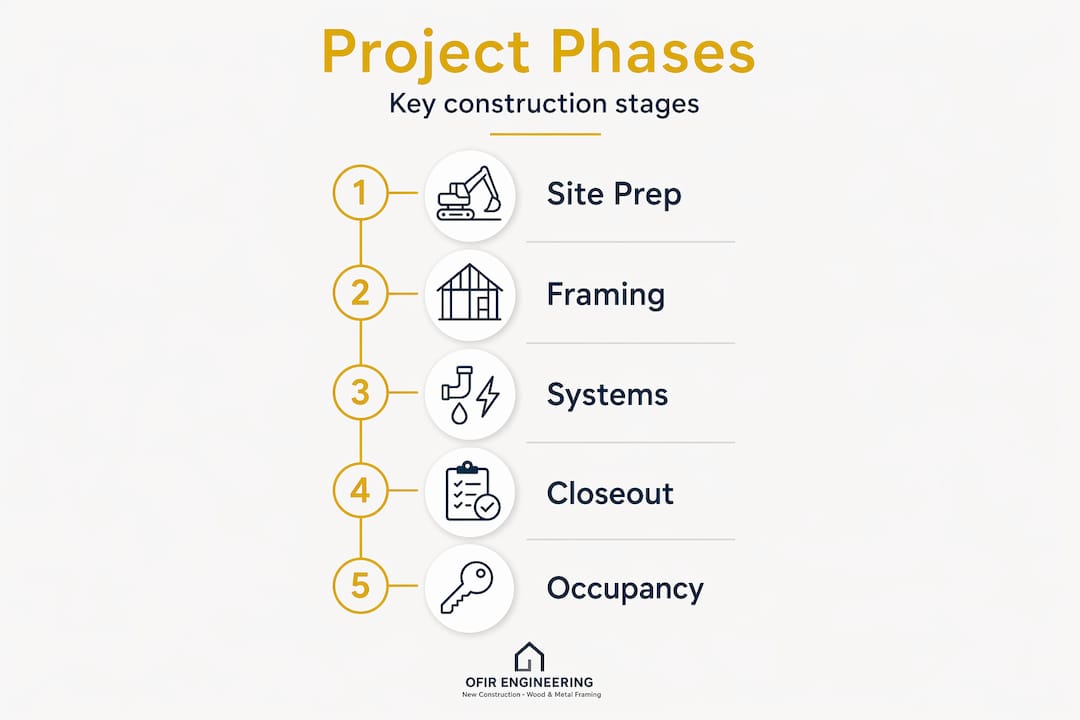
Pro Tip: Ask your contractor to provide a written project schedule organized by phase, with terminology defined for each milestone. This one document will prevent most scheduling misunderstandings before they start.
Core structural and framing terms
Understanding framing vocabulary helps you read construction drawings, evaluate contractor proposals, and catch discrepancies before they become expensive corrections. Here is a breakdown of the terms you will encounter most often on residential framing projects.
Studs are vertical framing members that form the walls of a structure. Standard stud spacing is either 16 inches or 24 inches on center (O.C.). The term "on center" refers to the distance measured from the center of one stud to the center of the next. A common misconception is that tighter spacing always means higher quality. 24 inches O.C. can support better insulation and energy efficiency than 16 inches O.C. when the framing is properly engineered, making it the standard in many modern energy-efficient builds.
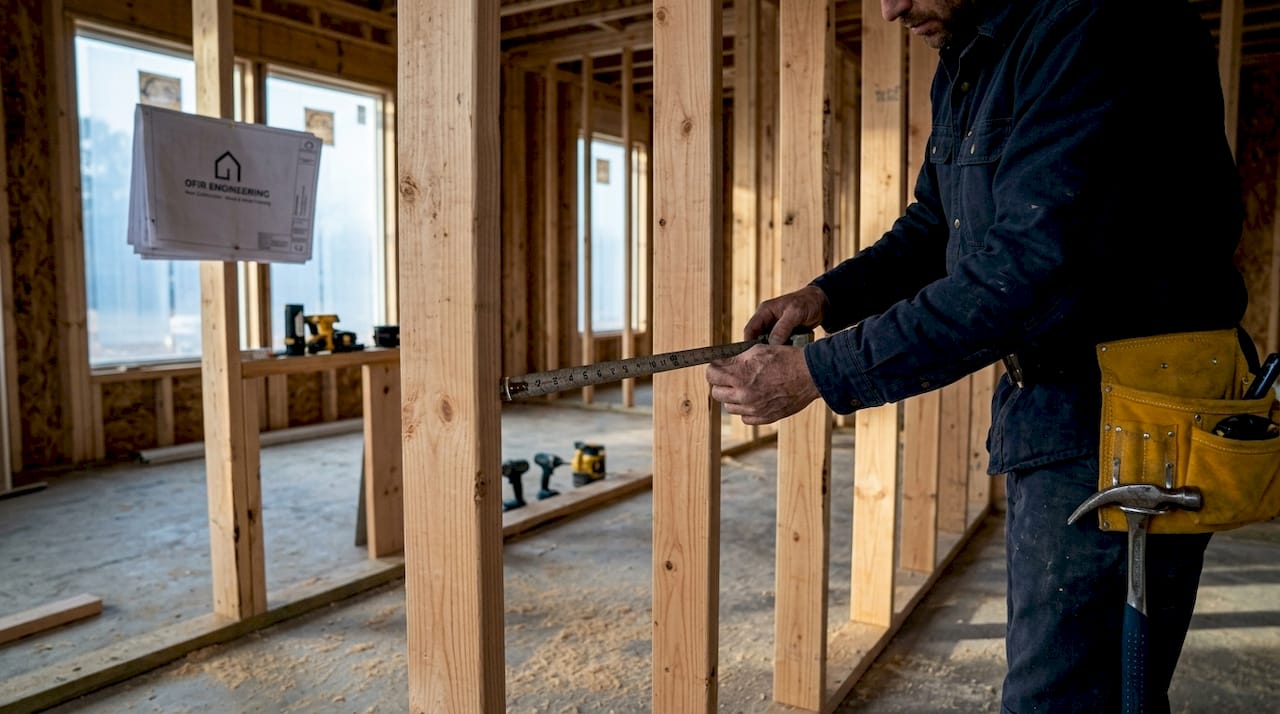
Joists are horizontal framing members that support floors and ceilings. Beams are larger horizontal structural members that carry the load of joists, walls, or roofs above them. Posts are vertical members, typically wood or steel, that transfer loads from beams down to the foundation.
| Term | Location | Primary function |
|---|---|---|
| Stud | Wall framing | Vertical support, attaches cladding and finishes |
| Joist | Floor and ceiling | Horizontal span support between beams |
| Beam | Roof, floor, or wall openings | Carries concentrated loads across longer spans |
| Post | Foundation to beam connections | Transfers vertical load downward |
| Header | Above doors and windows | Carries load across the opening |
Headers, trimmers, cripples, and sill plates are all part of the rough opening assembly around windows and doors. The header spans the opening horizontally and carries the weight above it. Trimmers are vertical studs on each side of the opening that support the header. Cripples are short studs above the header or below the sill. The sill plate is the horizontal framing member at the bottom of a window opening.
Material type also matters significantly. Dimensional lumber refers to standard sawn wood members sized to nominal dimensions like 2x4 or 2x6. Engineered lumber, such as LVL (laminated veneer lumber) or I-joists, is manufactured for greater strength and dimensional consistency. OSB (oriented strand board) and plywood are panel products used for sheathing walls, floors, and roofs. OSB is more cost-effective; plywood offers greater moisture resistance.
On steel-framed projects, material grade makes a real structural difference. Grade 60 steel has a yield strength of 60,000 psi versus 40,000 psi for Grade 40, allowing higher load-bearing capacity and better structural efficiency. Ofirengineering's steel frame construction work in Florida uses modern light gauge steel members that meet current code requirements for wind zone performance.
Pro Tip: When reviewing framing plans, always note whether the drawings specify the lumber grade and species. Generic specifications leave the door open for material substitutions that reduce structural performance.
Building systems terminology: electrical, plumbing, and HVAC
The mechanical, electrical, and plumbing trades each carry their own vocabulary, and the overlap can create confusion. Here are the key terms organized for clarity:
- Rough-in: The first stage of any trade installation, where pipes, conduit, ducts, and wiring are run through walls, floors, and ceilings before those surfaces are closed in with drywall. Rough-in means different things to framers, plumbers, and electricians, so always specify which trade you are referencing when scheduling inspections.
- Trim-out (or finish work): The second stage of trade installation, where fixtures, outlets, switches, faucets, and diffusers are installed after drywall and painting are complete.
- Load panel: The electrical distribution board that receives power from the utility and distributes it through circuit breakers to individual circuits in the home.
- HVAC: Stands for Heating, Ventilation, and Air Conditioning. In Florida, the HVAC system is one of the largest mechanical costs and must be sized correctly using a Manual J load calculation.
- DWV system: Drain, Waste, and Vent. The plumbing network that removes wastewater and vents sewer gases safely out of the building.
- Rough-in dimensions: Specific measurements from a finished wall or floor to the center of a pipe or outlet. Critical for tile setters, cabinetmakers, and fixture installers to have correct before finishing begins.
"Professional estimators use precise terminology for material takeoffs, cost control, and coordinating subcontractors across multiple building systems." — The Ultimate Construction Glossary for Estimators 2026
Scheduling inspections at the right stage of each trade is something most homeowners do not realize they need to coordinate. Ofirengineering manages this coordination as part of its project management services, reducing delays caused by missed inspection windows.
Contract and cost estimation terms you must know
Contract language is where most homeowners feel least prepared. A misread clause or misunderstood term at the proposal stage can translate into thousands of dollars of exposure by the time the project closes out.
Fixed price contracts set a single agreed amount for the defined scope of work. Any cost overruns within that scope are absorbed by the contractor. A Guaranteed Maximum Price (GMP) contract caps the total cost but allows some flexibility within that ceiling, typically sharing savings between owner and contractor if costs come in under the maximum.
The term allowance is one of the most misunderstood in residential construction. If actual cost exceeds the allowance, the homeowner pays the difference. If actual cost comes in under, the homeowner saves. Allowances are used for items not yet selected at the time of contract signing, such as tile, lighting fixtures, or appliances. A low allowance in a proposal can make a bid look attractive but result in significant overages once real selections are made.
- Takeoff: The process of quantifying all materials and labor from design documents. Professional estimators use takeoffs to form the basis of accurate project budgets and contractor bids.
- Change order: A formal written amendment to the contract that adjusts scope, cost, or schedule. No change order means no authorization. Never allow work outside the original scope without a signed change order.
- Punch list: A documented list of items to be corrected or completed before final payment. Both the owner and contractor sign off on the punch list as a record of what remains.
- Substantial completion: The point at which a project is sufficiently complete for its intended use, even if minor items remain. This date typically triggers the start of warranty periods.
- Retention (retainage): A percentage of each payment withheld by the owner until the project reaches substantial completion, protecting against incomplete work.
Pro Tip: Before signing any contract, ask your contractor to define every allowance line item in writing. Confirm whether the allowance figure includes installation labor or only materials. That single clarification prevents the most common source of residential budget disputes.
Avoiding costly terminology misunderstandings
Clear communication on a construction project depends on more than vocabulary. It requires the right structures and habits to prevent terms from meaning different things to different people on the same job.
- Set role expectations in writing at project kickoff so that each stakeholder understands which decisions belong to them and which belong to the contractor.
- Never assume a shared meaning for terms like "finish grade," "rough-in," or "substantial completion." Ask your contractor to define them specifically as they apply to your project and document the answers.
- Use a construction terms glossary specific to your project type to cross-check definitions when reviewing plans or proposals.
- Request that change orders use plain language descriptions alongside any technical terms, so that the scope adjustment is unambiguous before you sign.
- Work with contractors who prioritize client education. Terminology confusion is role-based by nature, and a contractor who takes time to explain terms is far less likely to produce costly misalignments later.
My perspective on learning construction language
In my experience working with homeowners and investors on residential projects in Jacksonville over many years, the biggest gap is never technical. It is communicative. I have seen homeowners approve scope changes they did not understand, accept allowances that were never realistic, and sign off on substantial completion before the punch list was actually cleared, all because the terminology felt too technical to question.
What I have learned is that confident terminology use does not require you to become an expert. It requires you to ask for clarity at the right moments. Homeowners who understand the difference between a fixed price and a GMP contract make fundamentally different decisions during contractor selection. Investors who know what a takeoff is can benchmark bids more effectively. That knowledge compounds across every phase of a project.
At Ofirengineering, we prioritize education at every client interaction. Our team explains each term as it becomes relevant, not after a problem has already developed. The Jacksonville market has its own code requirements and material considerations, and we believe every client deserves to understand the construction vocabulary that directly affects their investment.
— Owen
Start your Jacksonville construction project with clarity
Ofirengineering brings over 15 years of licensed residential construction experience to homeowners, investors, and developers across Jacksonville. Whether you are planning a full new construction home or a complete renovation, our team explains every phase, every contract term, and every material decision in language you can act on. We specialize in Light Gauge Steel and Wood Frame systems, comprehensive project management, and home remodeling services designed to meet your specific goals. Our project managers coordinate all trades, inspections, and documentation so that terminology confusion never delays your timeline or inflates your budget. Contact Ofirengineering today to get expert guidance from the pre-construction phase through final handover.
FAQ
What does "rough-in" mean in residential construction?
Rough-in refers to the first stage of trade installation, where pipes, wiring, or ducts are run through wall and floor cavities before surfaces are closed in. The term applies separately to plumbing, electrical, and HVAC work, so always specify which trade you mean.
What is the difference between fixed price and GMP contracts?
A fixed price contract sets a single non-negotiable cost for the defined scope, with the contractor absorbing overruns. A Guaranteed Maximum Price contract caps total cost but includes flexibility, and savings may be shared between owner and contractor.
What is an allowance in a construction contract?
An allowance is an estimated dollar amount included in a contract for items not yet fully specified, such as tile or fixtures. If the actual cost exceeds the allowance, the homeowner pays the difference, making realistic allowance amounts critical during budget planning.
What does "on center" (O.C.) mean in framing?
On center refers to the distance measured from the center of one framing member to the center of the next. Standard spacing is 16 or 24 inches O.C., and the right choice depends on structural loads, insulation strategy, and local code requirements.
What is a punch list in residential construction?
A punch list is a documented record of incomplete or deficient items that must be corrected before final payment is released. Both the homeowner and contractor review and sign off on the punch list to confirm all items are resolved.