
Choosing between remodeling and renovation might seem like a question of semantics, but for Jacksonville homeowners, the distinction carries real financial and legal weight. A kitchen refresh that keeps its original layout sits in an entirely different category from a project that removes walls to create an open floor plan, even if both feel like "fixing up the house." Getting the terminology right affects your budget, your permit requirements, and ultimately the return you see on your investment. This guide clarifies both terms with locally grounded examples, realistic cost ranges, and practical guidance to help you plan your next project with confidence.
Table of Contents
- What is renovation? Focus on surface updates
- What is remodeling? Structural and functional changes explained
- Renovation vs remodeling: Comparison table for clarity
- Edge cases and Jacksonville-specific scenarios
- How to choose: Which project fits your Jacksonville home?
- Our take: Why the difference matters more than you think
- Get expert help with your remodeling or renovation
- Frequently asked questions
Key Takeaways
| Point | Details |
|---|---|
| Surface changes vs structure | Renovation updates existing finishes while remodeling alters a room’s structure or layout. |
| Permitting and codes | Most remodels in Jacksonville require permits, but many basic renovations do not. |
| Budget and time impact | Renovations are generally quicker and cheaper than remodels, though large renovations can rival remodel costs. |
| Right project for your needs | Choosing the right approach depends on your goals, local codes, and tolerance for disruption. |
What is renovation? Focus on surface updates
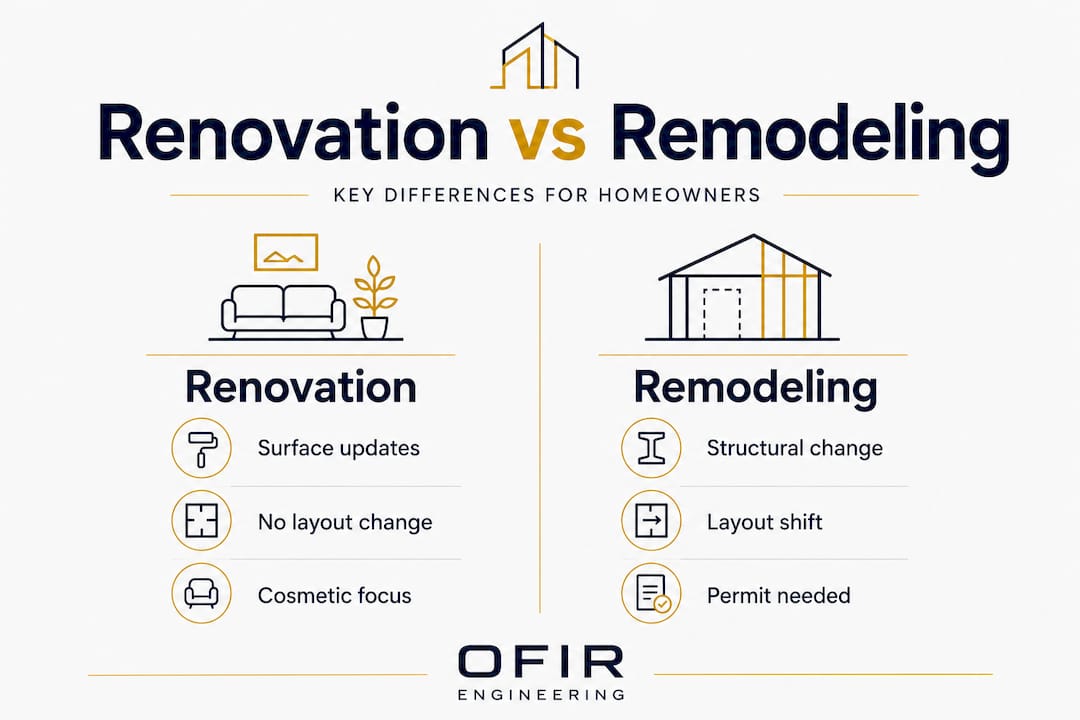
Renovation refers to the process of improving or refreshing a space while keeping its fundamental structure, layout, and intended purpose intact. The scope is deliberately contained: you are enhancing what already exists rather than reconfiguring it. Think of it as updating the surface layer of a room without disturbing its bones.
Renovation involves cosmetic updates and improvements to existing spaces without changing structure, layout, or purpose. Common examples include painting walls, installing new flooring, replacing light fixtures, swapping out cabinet doors, or updating countertops. The kitchen still functions as a kitchen, the bathroom still serves its original purpose, and no walls move in the process.
From a permitting standpoint, this is good news for homeowners. Renovations are typically less expensive, quicker, more DIY-friendly, and often do not require permits unless the work touches electrical wiring or plumbing lines. In Jacksonville, this means you can frequently refresh entire rooms without scheduling inspections or filing paperwork with the city, which compresses your timeline considerably.
Common renovation projects include:
- Repainting interior or exterior walls
- Replacing carpet, tile, or hardwood flooring
- Updating kitchen cabinet faces, hardware, or countertops
- Swapping plumbing fixtures like faucets and showerheads
- Installing new light fixtures or ceiling fans
- Refinishing hardwood floors or resurfacing bathroom tile
You can use our home renovation guide to map out a full project plan, and our step-by-step renovation guide walks you through the sequencing process so each phase flows into the next without costly delays.
Pro Tip: If you are refreshing a kitchen or bathroom and can accomplish your goals without moving plumbing lines or altering the structural layout, you are almost certainly looking at a renovation. That distinction alone can save you thousands in permit fees, inspection delays, and contractor overhead.
What is remodeling? Structural and functional changes explained
Remodeling occupies a fundamentally different category. Where renovation improves what is already there, remodeling changes what is there. This means altering the layout, the structure, or the intended purpose of a space. Removing a load-bearing wall to open a kitchen to the living room, converting a garage into a home office, adding a second bathroom where none existed, or raising ceiling heights all qualify as remodeling projects.
The scope expansion has direct consequences for planning and compliance. Major remodels in Jacksonville involve Florida building codes for permits on structural, plumbing, and electrical changes, and experienced contractors recommend a 10 to 20 percent contingency budget to absorb unexpected conditions discovered during construction. Older Jacksonville homes in particular often reveal outdated wiring, deteriorated framing, or non-compliant plumbing once walls are opened.
The contrast in complexity becomes clearest when you consider what a permit actually authorizes. A permit for structural work triggers inspections at multiple stages: framing, rough-in mechanical work, and final finish. Each stage must pass before the next begins, which extends project timelines compared to permit-free renovation work. Remodeling projects that skip this process expose homeowners to fines, mandatory demolition of unpermitted work, and complications when the property is eventually sold.
Structural remodeling projects commonly undertaken by Jacksonville homeowners include:
- Removing interior walls to create open-plan living spaces
- Converting garages, attics, or basements into livable square footage
- Adding rooms or building additions to expand the home's footprint
- Relocating kitchens or bathrooms, which moves plumbing stacks and drain lines
- Raising or lowering ceiling heights by altering roof or floor framing
- Replacing entire mechanical systems including HVAC, electrical panels, or main plumbing lines
Pro Tip: Before a single wall comes down, verify with the city of Jacksonville's Building Inspection Division whether a permit is required. Even when contractors feel confident about skipping the process, the liability rests with the homeowner if unpermitted work surfaces during a future sale or insurance claim.
Renovation vs remodeling: Comparison table for clarity
The following side-by-side comparison brings the most critical distinctions into direct focus. Renovations are typically less expensive and quicker than remodeling projects, while remodels carry higher costs and longer timelines due to structural complexity and permit requirements. Understanding where your project falls helps you budget accurately from the start.
| Factor | Renovation | Remodeling |
|---|---|---|
| Scope | Surface updates, no structural change | Structural, layout, or purpose changes |
| Permit required? | Rarely, unless electrical/plumbing touched | Almost always required |
| Typical cost range (Jacksonville) | $5,000 to $50,000+ | $30,000 to $150,000+ |
| Timeline | Days to a few weeks | Weeks to several months |
| Disruption level | Low to moderate | High |
| Examples | New flooring, paint, fixtures, cabinets | Open floor plan, room additions, full kitchen gut |
| DIY feasibility | Often possible for skilled homeowners | Rarely advisable due to code requirements |
| Impact on resale value | Improves curb appeal and marketability | Can significantly increase functional value |
For context, whole-home renovation costs in Jacksonville typically range from $250,000 to $300,000, while a luxury kitchen remodel can exceed $150,000 on its own. These figures reflect local labor rates, material costs, and the complexity of working within Florida's regulatory environment.
According to Houzz data cited by Forbes, kitchens are the most renovated room in American homes, with a median spend of $24,000. That figure represents projects that refresh the kitchen without restructuring it, which is consistent with the renovation definition. Projects at this price point typically cover new countertops, cabinet refacing, updated fixtures, and new flooring without moving any walls.
Understanding this comparison also clarifies the home value boost from remodeling versus renovation. Both improve marketability, but they do so in different ways and at different price points.
Edge cases and Jacksonville-specific scenarios
Even with clear definitions in hand, several common project types resist easy classification. Roof replacement is one of the most frequently misunderstood examples. Because no layout changes occur and the home's structure is being restored rather than altered, roof replacement is generally classified as a renovation. Yet a full roof replacement on a large Jacksonville home can easily reach $20,000 to $40,000, surpassing the cost of some room conversion remodels.
Replacing a roof or major mechanicals may be classified as renovation if no layout change occurs, but a full gut rehab that strips a space to the studs functions more like a remodel, even if the floor plan remains the same after completion. Insurance providers and permit offices tend to draw the line at whether the structural envelope is exposed during the work.
"Roof replacement is sometimes more expensive than a room conversion remodel, which means cost alone is never a reliable indicator of project classification."
The following numbered list outlines how Jacksonville homeowners should approach permit decisions for gray-area projects:
- Determine whether any structural element is being altered, removed, or added. If yes, a building permit is likely required regardless of how cosmetic the finished product appears.
- Assess whether plumbing or electrical work is involved. Even a renovation that requires a licensed electrician to add a circuit may trigger an electrical permit in Duval County.
- Contact the City of Jacksonville's Building Inspection Division directly. Permit requirements are jurisdiction-specific, and a five-minute phone call can prevent months of compliance issues.
- Check with your homeowner's insurance provider. Some gray-area projects affect coverage classifications, particularly work that involves mechanical systems or the building envelope.
- Review Florida Building Code Chapter 4 for residential alterations to confirm whether your project scope crosses into regulated territory.
The table below summarizes how common edge-case projects are typically classified in Jacksonville:
| Project | Classification | Permit typically required? |
|---|---|---|
| Roof replacement | Renovation | Yes (roofing permit) |
| Full gut to studs, same layout | Straddles both | Yes |
| HVAC system replacement | Renovation | Yes (mechanical permit) |
| Garage conversion to living space | Remodel | Yes (building + electrical) |
| Window replacement, same size | Renovation | Often yes |
| Adding a bedroom in existing footprint | Remodel | Yes |
For more clarity on how these terms are applied locally, our guide on Jacksonville construction terminology provides detailed definitions used by local permit offices and contractors.
How to choose: Which project fits your Jacksonville home?
Having worked through the definitions, comparisons, and edge cases, the practical question becomes: which path is right for your property and your goals? The answer depends on several factors that go beyond cost alone.
Use the following questions to guide your decision:
- What is your primary goal? If you want to refresh the appearance of a space without changing how it functions, renovation is the appropriate scope. If you need more square footage, better flow between rooms, or a fundamentally different use of a space, remodeling is necessary.
- What is your realistic budget, including contingency? Renovations are typically more budget-friendly and predictable. Remodels carry inherent cost variability because structural work often reveals conditions that were not visible during initial planning.
- How much disruption can your household absorb? Remodeling projects frequently render key areas of the home unusable for weeks or months. Families need to plan for temporary kitchen or bathroom arrangements when those rooms are undergoing structural work.
- Are you preparing the home for sale or for long-term use? Pre-sale renovations often focus on cosmetic appeal that photographs well and attracts buyers. Long-term homeowners benefit more from structural remodels that improve livability and functionality over years of use.
- What are the permit implications for your specific address? Properties in certain Jacksonville flood zones, historic districts, or deed-restricted communities carry additional regulatory layers that affect both renovation and remodeling projects.
Houzz data confirms that kitchens represent the most popular renovation target with a median spend of $24,000, which offers a useful benchmark when calibrating whether your scope aligns with renovation or crosses into remodeling territory. It also demonstrates that some remodels, particularly simple room conversions, can cost less than extensive renovations when compared on a project-by-project basis rather than by label alone.
Our construction planning tips resource walks Jacksonville homeowners through the decision criteria in greater detail, with local cost data and permit guidance specific to Duval County.
Our take: Why the difference matters more than you think
Most homeowners approach this question as a budgeting exercise. They search for costs, compare price ranges, and pick a category based on what they think they can afford. That approach is understandable, but it consistently leads to problems that are far more expensive than the original project.
The more consequential risk is unpermitted work. Jacksonville homeowners who proceed without proper permits because a contractor assured them it was "just a renovation" frequently discover the issue when they attempt to sell the property. Title companies, home inspectors, and buyers' agents routinely flag unpermitted structural, electrical, or plumbing work. Resolving those flags often requires opening walls, hiring a new contractor to bring the work into compliance, and re-inspecting before closing. The cost to remediate unpermitted work typically exceeds what the permit would have cost by a factor of three to five.
Jacksonville's climate adds another layer of complexity that out-of-state guides rarely address. High humidity, hurricane wind loads, and proximity to flood zones mean that work affecting the building envelope, including roof replacement, window installation, or exterior wall modifications, carries stricter standards than in many other markets. Florida's Building Code is one of the most rigorous in the country precisely because weather events regularly test residential structures.
The honest truth is that the renovation versus remodel distinction is not primarily about vocabulary. It is a framework for understanding scope, compliance, and risk. Homeowners who grasp this framework early make better decisions: they hire licensed contractors for the work that requires it, they budget accurately, and they avoid the inspection problems that surface years later.
Understanding the full project lifecycle for Jacksonville homes from initial planning through permit closeout gives homeowners a structural framework for managing any project size with confidence and compliance.
Pro Tip: Before signing any contract for work that involves walls, floors, roofs, or mechanical systems, ask your contractor to confirm in writing whether a permit is required. A reputable contractor will support this request. One who resists should raise an immediate red flag.
Get expert help with your remodeling or renovation
Deciding between renovation and remodeling is only the first step. Executing either type of project correctly, within Florida's regulatory framework, on budget, and on schedule, requires local expertise that goes well beyond a general contractor's basic skill set.
Ofir Engineering has served Jacksonville homeowners for over 15 years, handling projects across the full spectrum from targeted cosmetic renovations to complete structural remodels. Our team holds an active CHC1540016 general contractor license, which means every project we manage meets Florida Building Code requirements from the first permit application through final inspection sign-off. Whether you are refreshing a dated bathroom or converting an underutilized garage into a livable suite, our Jacksonville home remodeling services and structured approach to project management ensure that your investment is protected at every stage. Review our Jacksonville renovation guide to understand exactly what your project scope involves before breaking ground.
Frequently asked questions
Which requires more permits in Jacksonville: remodeling or renovation?
Remodeling projects, especially those involving structure, plumbing, or electrical, almost always need permits in Jacksonville under Florida Building Code requirements; most basic cosmetic renovations do not.
Does a kitchen update count as renovation or remodel?
If the layout and structure stay the same, it is a renovation; if the project moves plumbing, removes walls, or relocates appliances, it crosses into remodeling territory, as cosmetic updates without structural changes define the renovation category.
What's typically more expensive in Jacksonville: renovation or remodel?
Remodels usually cost significantly more due to structural changes and mandatory permitting, but some large renovations like roof replacements can exceed the cost of smaller remodels, given that whole-home renovations range from $250,000 to $300,000, while full gut rehabs and room conversions vary widely based on scope.
How does choosing between remodeling and renovation affect home value?
Both strategies improve marketability, but renovations primarily address cosmetic appeal while remodels can add new functional square footage or entirely new room categories that attract a broader buyer pool, with renovations typically offering faster, lower-cost value gains relative to their investment.