
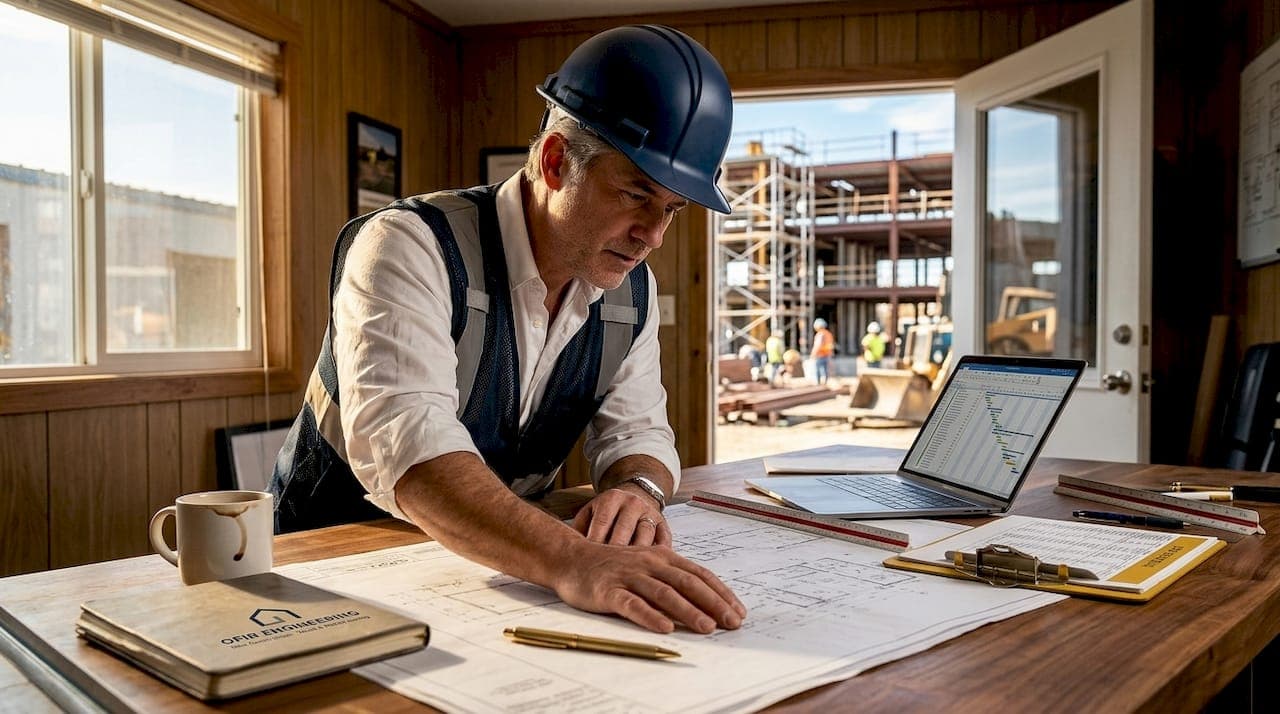
Project management strategies are deliberate, project-specific choices that align delivery methods with constraints, risks, and organizational context to produce consistent, repeatable results. In construction, where scope, budget, and schedule pressures converge simultaneously, selecting the right strategy separates projects that finish on time from those that spiral into costly overruns. The examples of project management strategies covered here draw from recognized frameworks including PMBOK 7, Critical Path Method (CPM), PRINCE2, and rolling-wave planning, each with direct application to residential and commercial construction environments. Ofirengineering applies these methodologies across new construction and renovation projects in Jacksonville, FL, with over 15 years of field-tested experience.
1. Examples of project management strategies used in construction
Construction projects demand structured delivery approaches because the cost of mid-project course corrections is high. The following strategies represent the most proven options available to project managers today.
Waterfall methodology sequences all phases linearly: design, permitting, procurement, construction, and closeout. This approach suits projects where scope is fully defined before breaking ground, such as new single-family homes built to a fixed plan. The predictability of waterfall makes it the default choice for residential construction with stable specifications.

Agile methodology breaks work into short, iterative cycles with frequent review points. While Agile originated in software development, its principles apply to renovation projects where scope evolves as walls open and hidden conditions emerge. Agile allows the team to reprioritize work packages without rewriting the entire schedule.
Hybrid methodology combines waterfall's phase structure with Agile's flexibility at the task level. Adapting hybrid methodologies is common in construction to balance governance requirements with the need to respond to field conditions. A hybrid approach is the most practical choice for complex renovations or multi-phase builds.
Critical Path Method (CPM) identifies the longest sequence of dependent tasks that determines the minimum project duration. CPM is especially useful when tasks and dependencies are well-defined, and delays on critical tasks delay the overall project completion date. Tools like Microsoft Project and Primavera P6 automate CPM calculations for construction schedules.
Rolling-wave planning elaborates near-term work in detail while keeping future phases at a summary level until more information is available. Planning horizons vary from 4 to 6 weeks of detailed tasks on smaller projects to 3 to 6 months on complex builds. This technique prevents wasted effort on planning work that depends on decisions not yet made.
Work Breakdown Structure (WBS) decomposes the full project scope into assignable, estimable work packages. Each Level 3 WBS element can be assigned to a responsible party, estimated for cost and duration, and verified objectively upon completion. In construction, a WBS typically separates site work, foundation, framing, MEP rough-in, enclosure, and finishes into discrete packages.
PRINCE2 stage control manages projects by stages with formal approval at each stage boundary. Stage-based control limits scope creep and enforces decision reviews at checkpoints, giving the project sponsor authority to redirect or halt work before committing to the next phase. This governance model is particularly effective on projects with multiple stakeholders or phased funding.
Structured stakeholder communication using digital Kanban or Gantt boards gives all parties real-time visibility into task ownership, status, and expected completion dates. Shared digital boards improve transparency, coordination, and decision clarity across construction teams. Weekly visual reporting replaces lengthy status meetings and surfaces problems before they escalate.
Pro Tip: Combine a WBS with CPM from the start of scheduling. The WBS defines what needs to be done; CPM defines the order and criticality. Together, they prevent both scope gaps and schedule surprises.
2. How rolling-wave planning and CPM manage uncertainty and dependencies
These two techniques address the two most persistent challenges in construction scheduling: incomplete information early in the project and the cascading effect of task dependencies.
Rolling-wave planning treats the schedule as a living document rather than a fixed contract. Near-term work receives full detail, with durations, resources, and predecessors defined. Work beyond the planning horizon is held at a summary level until design decisions, permit approvals, or procurement lead times are confirmed. The critical discipline here is maintaining planning events tied to lifecycle milestones. Rolling-wave planning must be sustained with regular elaboration triggers, or the schedule becomes stale and misleading, eroding team confidence in the plan.
CPM complements rolling-wave planning by identifying which tasks carry zero float. Zero-float tasks are the ones where any delay directly extends the project end date. CPM's greatest value is prioritizing resource focus on those zero-float tasks, helping teams react swiftly to delays before they compound. In a residential framing sequence, for example, the critical path typically runs through foundation cure, sill plate installation, floor system, and wall framing. A concrete pour delay of three days pushes every downstream task by the same amount unless corrective action is taken immediately.
The table below compares how each technique addresses specific construction scheduling challenges.
| Challenge | Rolling-wave planning | Critical Path Method |
|---|---|---|
| Incomplete early-phase information | Defers detailed planning until data is available | Requires defined tasks and dependencies to calculate |
| Task dependency management | Identifies near-term predecessors incrementally | Maps full dependency chain to find critical sequence |
| Resource prioritization | Focuses detail effort on imminent work | Directs resources to zero-float tasks first |
| Schedule accuracy over time | Improves as planning events are executed | Static until manually updated with actuals |
| Risk of plan becoming stale | High if elaboration triggers are not maintained | Moderate; requires regular progress updates |
"CPM breaks down when dependencies are overly optimistic. Practitioners use it to highlight critical sequencing and drive rapid corrective action rather than ignore resourcing realities." — Practical CPM use in construction
The most effective construction schedules use rolling-wave planning to maintain schedule relevance across the project lifecycle and CPM to enforce priority discipline within each planning wave. Neither technique works well in isolation. For a detailed walkthrough of how these methods fit into a full construction workflow, the construction project management workflow guide from Ofirengineering covers team-level application in depth.
3. Governance and communication strategies that improve collaboration
Governance is not administrative overhead. It is the mechanism that prevents scope drift, budget overruns, and decision paralysis on construction projects.
PRINCE2's stage-gate model creates explicit decision points where the project sponsor reviews progress, approves the next stage plan, and confirms that the business case still holds. Stage gate approvals enable early correction or stop decisions before the project commits additional resources to a flawed direction. On a multi-phase renovation, for example, a stage gate between demolition and rough-in gives the owner a formal opportunity to adjust scope based on what was uncovered during demo.
Governance roles must be clearly defined to function. The steering committee sets strategic direction and resolves escalations beyond the project manager's authority. The project sponsor owns the business case and approves stage boundaries. The project manager controls day-to-day delivery within the approved stage plan. When these roles overlap or remain undefined, decision-making stalls and scope creep accelerates.
Communication strategy determines whether governance decisions reach the field. The following practices produce the most reliable results on construction projects:
- Publish a weekly one-page status report tailored to the audience. Owners receive budget and milestone status; subcontractors receive task-level schedules and RFI logs.
- Use a shared digital Gantt or Kanban board with named task owners and due dates visible to all parties.
- Establish a documented escalation path so field supervisors know exactly when and how to raise issues that exceed their authority.
- Hold brief daily stand-ups at the site level to surface blockers before they affect the critical path.
- Log all scope change requests formally, with cost and schedule impact assessed before approval.
Pro Tip: Tailor your reporting format to the decision-maker, not to what is easiest to produce. A project sponsor needs trend data and risk flags. A subcontractor foreman needs tomorrow's task list and material delivery confirmation.
The project management tips for leaders in 2026 published by Ofirengineering expand on these communication practices with specific examples from residential construction projects in Jacksonville.
4. How to choose and adapt strategies for your construction project
No single methodology or technique fits every project. Strategy selection depends on project-specific constraints, risks, and organizational readiness rather than on generic best-practice frameworks. A project manager who applies PRINCE2 stage control to a two-week bathroom renovation creates unnecessary overhead. One who uses pure Agile on a permitted new construction build risks violating the linear dependencies that permitting and inspections impose.
The comparison below provides a practical selection guide based on project characteristics.
| Project characteristic | Recommended strategy | Reason |
|---|---|---|
| Fixed scope, stable design | Waterfall with CPM | Predictable sequencing; CPM optimizes schedule |
| Evolving scope, phased discovery | Hybrid or rolling-wave planning | Defers detail until information is confirmed |
| Multiple stakeholders, phased funding | PRINCE2 stage control | Governance checkpoints protect investment |
| Large scope, many subcontractors | WBS with structured communication | Ownership clarity reduces coordination failures |
| High schedule risk, tight deadline | CPM with daily critical path review | Zero-float visibility drives corrective action |
Organizational readiness matters as much as project characteristics. A team unfamiliar with CPM software will produce an inaccurate critical path that misleads rather than guides. A client who has never participated in a stage gate review may interpret the checkpoint as a sign of project trouble rather than planned governance. Introducing new techniques requires a brief orientation for all stakeholders before the project begins.
Hybrid approaches are the most common solution for mid-complexity residential construction. The overall project follows a waterfall phase structure for permitting, inspections, and procurement. Within each phase, rolling-wave planning manages the detailed schedule, and CPM identifies which tasks require immediate attention. This combination provides the predictability that lenders and inspectors require while preserving the flexibility that field conditions demand. For a step-by-step view of how contractors structure this approach, the project planning guide for contractors offers a practical framework aligned with these principles.
Common pitfalls to avoid include selecting a methodology based on familiarity rather than fit, failing to update the schedule after each planning wave, and treating governance checkpoints as formalities rather than genuine decision points. Each of these errors produces the same outcome: a project that drifts from its baseline until the gap becomes unrecoverable.
Key takeaways
Effective project management in construction requires matching the right strategy to the project's specific constraints, dependencies, and stakeholder structure rather than defaulting to a single methodology.
| Point | Details |
|---|---|
| Match strategy to project type | Waterfall suits fixed-scope builds; hybrid approaches work best for complex or phased projects. |
| Use CPM for schedule priority | Focus resources on zero-float tasks to prevent delays from compounding across the project. |
| Treat rolling-wave planning as ongoing | Maintain elaboration triggers at lifecycle milestones to keep the schedule accurate and trusted. |
| Governance enables delivery | PRINCE2 stage gates give sponsors control without micromanaging day-to-day execution. |
| Communication must be tailored | Separate reporting formats for owners, subcontractors, and field supervisors reduce decision lag. |
What 15 years of construction projects taught me about strategy selection
After working across dozens of residential builds and full-home renovations, the pattern I see most often is not a failure of technique. It is a failure of ownership at the work package level. Teams adopt CPM or rolling-wave planning, produce a credible schedule, and then allow task ownership to remain ambiguous. When a delay occurs, no one is clearly accountable, and the corrective action conversation starts three days too late.
The strategies that consistently produce results share one characteristic: every work package has a named owner, a defined completion criterion, and a place on the shared schedule that everyone can see. WBS decomposition is not a documentation exercise. It is the mechanism that makes accountability possible. When Ofirengineering applies WBS to a new construction project, the goal is not to produce a chart. The goal is to eliminate the phrase "I thought someone else was handling that."
Rolling-wave planning is the technique I find most underused on residential projects. Most teams plan the full project in detail at the start, then watch the schedule become fiction by week four. A living schedule that elaborates detail only when the information is reliable is more useful than a precise schedule built on assumptions. The residential construction planning guide from Ofirengineering explains how this applies specifically to homeowner-facing projects.
Governance is the strategy most often dismissed as bureaucracy. In practice, a 30-minute stage gate review between demolition and rough-in has saved more projects from scope overruns than any scheduling tool. The review forces the question: does the plan still reflect reality? If the answer is no, the cost of adjusting at that point is a fraction of what it will be at closeout.
— Owen
How Ofirengineering supports your project management strategy in Jacksonville
Ofirengineering brings over 15 years of licensed construction experience (CHC1540016) to every project in Jacksonville, FL, applying proven project management techniques from initial planning through final delivery.
Whether you are planning a new construction home using Light Gauge Steel or Wood Frame systems, or managing a full-home renovation with complex phasing requirements, Ofirengineering structures each project with a defined WBS, a CPM-driven schedule, and transparent digital reporting that keeps all stakeholders aligned. The team selects and adapts methodologies based on your project's specific constraints, not a generic template. Contact Ofirengineering to discuss how the right project management strategy can improve efficiency, reduce risk, and deliver your project on schedule.
FAQ
What are the most common project management strategies in construction?
The most widely used strategies in construction are the Critical Path Method, Work Breakdown Structure, rolling-wave planning, and PRINCE2 stage control. Each addresses a specific delivery challenge, from scheduling dependencies to scope governance.
How does rolling-wave planning differ from traditional scheduling?
Rolling-wave planning elaborates near-term work in full detail while keeping future phases at a summary level until more information is confirmed. Traditional scheduling attempts to detail the entire project upfront, which produces inaccurate estimates for work that depends on decisions not yet made.
When should a construction project use a hybrid methodology?
A hybrid methodology is appropriate when the project has a fixed overall phase structure, such as permitting and inspections, but contains phases where scope or conditions are uncertain. It combines waterfall's governance structure with Agile or rolling-wave flexibility at the task level.
What is the role of WBS in construction project management?
A Work Breakdown Structure decomposes the full project scope into assignable work packages, each with a named owner, cost estimate, and objective completion criterion. This decomposition eliminates ambiguity in scheduling, procurement, and subcontractor coordination.
How does PRINCE2 stage control prevent scope creep?
PRINCE2 requires formal approval at each stage boundary before work on the next phase begins. This checkpoint forces the project sponsor to confirm that the scope, budget, and business case remain valid, preventing unauthorized work from accumulating between reviews.