
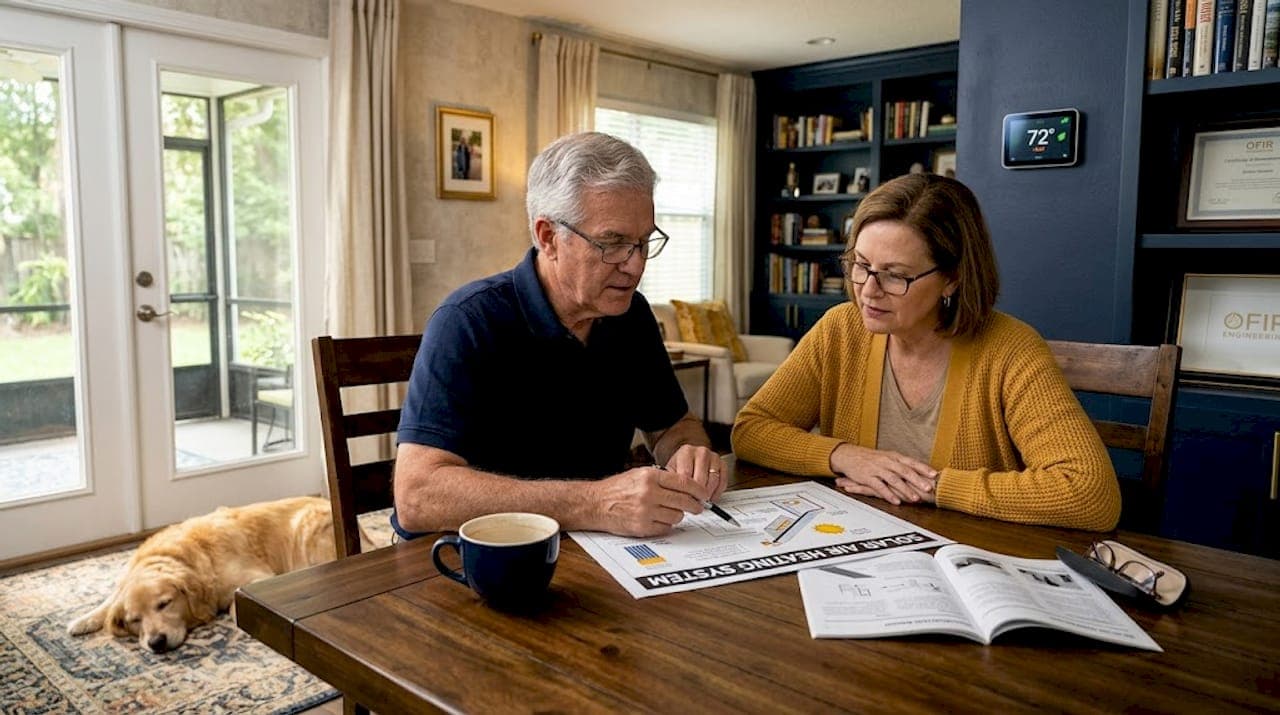
Solar air heating is widely associated with cold northern climates, yet Jacksonville homeowners and property investors are discovering that properly integrated systems can deliver meaningful energy savings even in Florida's warm, humid conditions. The key is understanding how these systems interact with local solar availability, building envelope performance, and existing HVAC infrastructure. Many renovators overlook critical factors like duct losses and room-level air distribution, which can quietly erode the efficiency gains they expect. This guide provides a clear, evidence-based framework for evaluating, sizing, and integrating solar air heating into Jacksonville residential renovations.
Table of Contents
- How solar air heating systems work: Components and functionality
- Key factors that shape performance and efficiency
- Pitfalls and practical limitations for Jacksonville homes
- Cost-effectiveness and smart integration strategies
- Why delivered heat — not just efficiency ratings — matters most in Jacksonville
- Ready to integrate solar air heating into your Jacksonville renovation?
- Frequently asked questions
Key Takeaways
| Point | Details |
|---|---|
| System design matters | Collector area, airflow, and integration with existing HVAC are critical for reliable performance. |
| Supplemental heat source | Solar air heating usually assists and rarely replaces conventional heating in Jacksonville. |
| Efficiency vs delivered heat | The real measure of success is useful heat in living spaces, not just high collector temperatures or lab efficiency. |
| Smart investment | Payback depends on climate, home efficiency, and displaced fuel—expect 5–15 years in Florida homes. |
How solar air heating systems work: Components and functionality
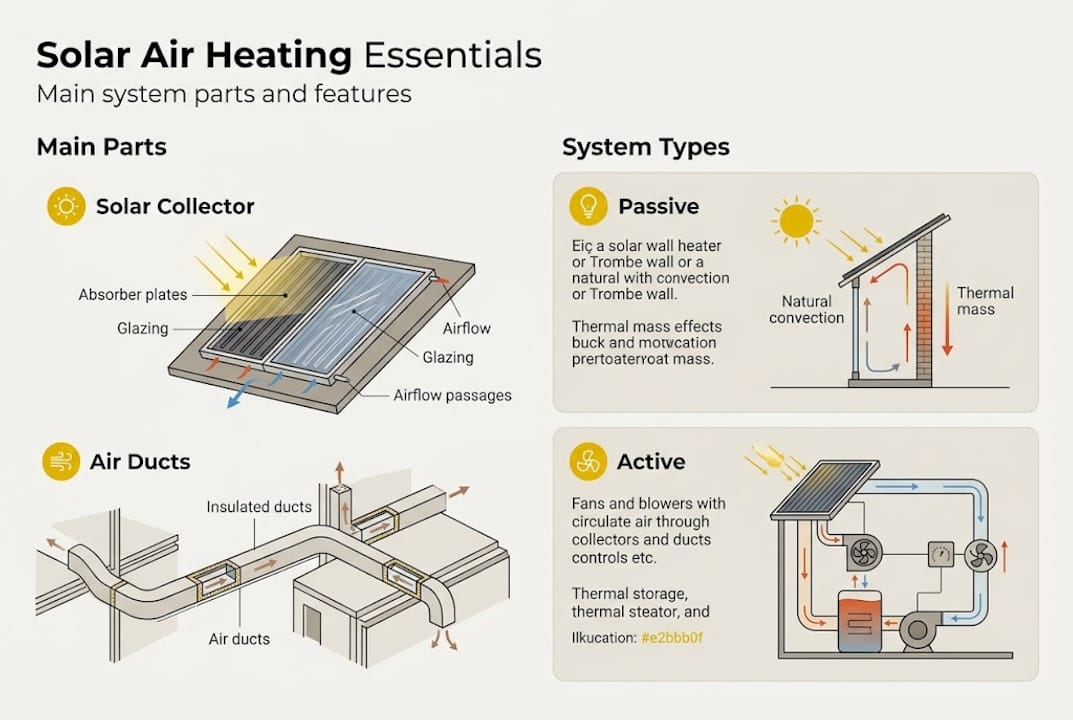
Solar air heating systems capture energy from sunlight and transfer it directly to air, which is then distributed through a building's living spaces. The process relies on a few core components working together: an absorber plate that converts solar radiation into heat, an insulated collector housing that minimizes heat loss to the exterior, and a transparent cover (typically tempered glass or polycarbonate) that allows sunlight in while trapping the resulting heat.
Solar air heating systems transfer solar heat to air via an absorber plate in an insulated collector with a transparent cover; air is moved either by forced convection using fans or blowers, or by natural convection in passive thermosyphon configurations. The distinction between active and passive systems matters significantly for renovation planning.
Key components and their roles include:
- Absorber plate: The core heat-exchange surface, typically a dark-coated metal sheet that absorbs solar radiation and heats the air passing over or through it.
- Insulated collector housing: Reduces conductive and convective heat loss from the back and sides of the collector, protecting thermal gains.
- Transparent cover: Allows shortwave solar radiation to enter while limiting longwave heat loss, commonly called the greenhouse effect at a small scale.
- Fans or blowers (active systems): Force air through the collector at controlled flow rates, enabling better system management and higher heat delivery.
- Controls and dampers: Regulate airflow, prevent reverse thermosyphon at night, and allow integration with thermostat-driven HVAC systems.
Active systems with fans and electronic controls give homeowners and investors far more flexibility during renovations. They can be connected to existing ductwork, zoned for specific rooms, and programmed to operate only when the collector temperature exceeds a set threshold. Passive systems are simpler and lower cost, but they offer less control and are more sensitive to building orientation and roof geometry. Thoughtful construction planning tips for Jacksonville homes should account for both system type and roof orientation from the earliest design stages.
Key factors that shape performance and efficiency
Understanding what drives solar air heating performance is essential before committing to a system size or configuration. In Jacksonville, the combination of high annual solar insolation (roughly 5.0 to 5.5 peak sun hours per day) and mild winters creates a favorable environment for solar heat collection, but the relatively short heating season limits total annual energy displacement.
Sizing methodology for solar air heaters is fundamentally driven by building heat load, collector area, expected solar fraction, local solar insolation, and system efficiency; duct airflow rate measured in CFM (cubic feet per minute) strongly affects results. Starting with an accurate Manual J heat-load calculation for the specific home is non-negotiable before selecting collector area.
Performance comparison: passive vs. active solar air heating systems
| Factor | Passive (natural convection) | Active (forced convection) |
|---|---|---|
| Airflow control | Limited, weather-dependent | Precise, fan-regulated |
| Installation complexity | Lower | Moderate to high |
| Integration with HVAC | Difficult | Feasible with proper design |
| Typical collector efficiency | 13% to 40% | 35% to 72%+ |
| Best application | Small supplemental zones | Whole-home or zoned systems |
Performance varies strongly with airflow rate and collector/absorber configuration; experimental results show outlet air temperature and efficiency change as mass flow rate and absorber geometry change. Flat-plate absorbers are the most common choice for residential retrofits due to lower cost, while evacuated-tube designs achieve higher outlet temperatures in conditions with lower ambient temperatures or diffuse radiation.
Empirical benchmarking from peer-reviewed literature shows a wide range of achievable thermal efficiencies for solar air collectors, depending on design and operating conditions, with values spanning from roughly 13% to above 72%. This range underscores why generic efficiency claims from product marketing rarely translate directly to real-world home performance.
Additional factors that influence system output in Jacksonville include:
- Roof pitch and orientation: South-facing collectors at a tilt angle close to the local latitude (approximately 30 degrees for Jacksonville) maximize annual solar capture.
- Shading analysis: Even partial shading from trees or adjacent structures can reduce collector output by 20% to 40%.
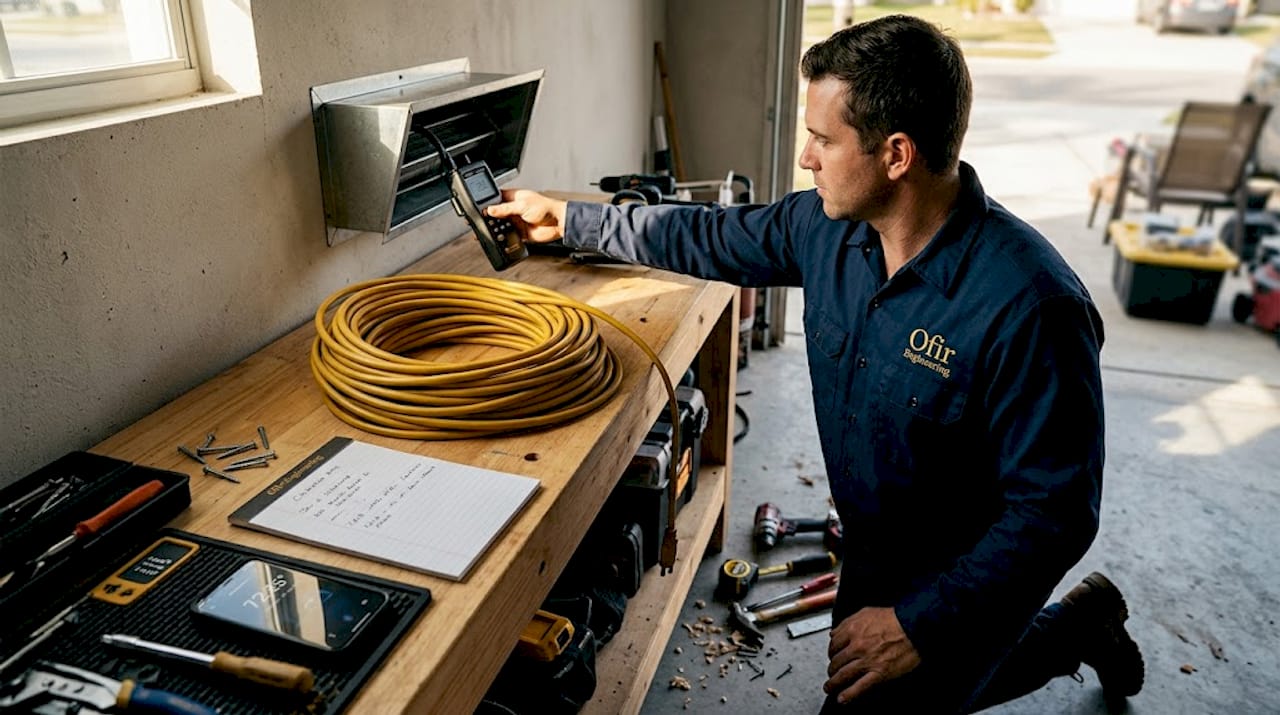
- Duct length and insulation: Longer duct runs between the collector and living spaces increase heat loss before air reaches occupants.
- Building airtightness: Leaky envelopes reduce the effective benefit of any supplemental heating source.
Pro Tip: Before selecting a collector size, have a licensed contractor perform a blower door test on your home. Addressing air sealing and insulation and energy savings first will reduce the heat load your solar system needs to cover, improving both payback period and comfort.
Pitfalls and practical limitations for Jacksonville homes
Even well-designed solar air heating systems face real-world limitations that are easy to underestimate during the planning phase. Jacksonville's climate introduces specific challenges that differ from the northern U.S. contexts where much of the published solar heating research originates.
Edge cases for homeowners and investors include duct losses, stratification and mixing problems, and the fact that solar air heating is primarily a daytime, solar-dependent heat source; these factors can reduce delivered heat even when collector outlet temperatures appear high. A collector producing 120°F outlet air means little if that heat dissipates in poorly insulated ductwork before reaching the living room.
The most common pitfalls to avoid during renovation planning include:
- Overestimating annual heat displacement. Jacksonville's heating season spans roughly November through February, limiting the number of days when solar heating provides meaningful benefit compared to northern climates.
- Ignoring duct heat loss. Ductwork running through unconditioned attic spaces, which is common in Florida homes, can lose 25% to 40% of collector heat gain before it reaches occupied rooms.
- Neglecting stratification. Warm air rises. Without proper distribution fans or mixing strategies, heated air can pool near the ceiling while occupants at floor level remain uncomfortable.
- Assuming year-round benefit. In Jacksonville's long cooling season, an improperly controlled solar air heating system can inadvertently add heat load to a home that is already fighting high outdoor temperatures.
"When evaluating a solar air heating retrofit, treat delivered heat to living space as the KPI, accounting for duct heat loss and room mixing, not just collector outlet air temperature."
For homeowners in hot and humid climates like Jacksonville, solar-assisted HVAC design should prioritize avoiding unintended drafts and maintaining indoor air conditions; system design should account for humidity management and thermostat integration to prevent comfort conflicts during shoulder seasons when both heating and cooling loads can occur within the same week.
Comparison of common integration challenges
| Challenge | Impact on performance | Mitigation strategy |
|---|---|---|
| Duct heat loss in attic | High, 25% to 40% loss possible | Insulate ducts, minimize run length |
| Air stratification | Moderate, uneven room comfort | Add ceiling fans or mixing dampers |
| Reverse thermosyphon at night | Low to moderate, heat loss after sunset | Install back-draft dampers |
| Humidity interaction | Variable, risk of comfort issues | Integrate with ERV or HRV system |
Pro Tip: Review the mistakes to avoid when planning any major renovation in Jacksonville. Many of the structural and envelope decisions made during a remodel directly affect how well a solar air heating system will perform for the life of the building.
Cost-effectiveness and smart integration strategies
The financial case for solar air heating in Jacksonville is real, but it requires honest assessment rather than optimistic projections. Payback periods typically range from 5 to 15 years, depending on the cost of the heat source being displaced, the home's envelope performance, and how well the system is integrated with existing HVAC equipment.
Solar air heater economics depend on climate, home envelope performance, system type, and the heat source being displaced; payback can vary widely. A homeowner displacing expensive electric resistance heating will see a faster return than one whose primary heat source is already a high-efficiency heat pump operating at a coefficient of performance above 3.0.
In Florida renovation contexts, solar-assisted HVAC approaches focus on pairing solar with conventional heating and cooling equipment; solar thermal collectors can pre-condition or support HVAC-related loops, but this remains an integration design problem rather than a standalone space heating solution. The most cost-effective applications in Jacksonville tend to be targeted and specific rather than whole-home replacements.
Best practices for maximizing cost-effectiveness and comfort include:
- Target daytime occupancy zones first. Home offices, sunrooms, and living areas used during daylight hours benefit most from solar air heating because the system is producing heat exactly when those spaces need it.
- Pre-condition fresh air intake. Routing outdoor air through a solar collector before it enters the HVAC system reduces the conditioning load on the primary equipment, improving overall system efficiency.
- Size conservatively and expand later. Starting with a smaller, well-integrated system and adding collector area after monitoring real-world performance reduces financial risk.
- Verify code compliance early. Florida Building Code requirements and local Jacksonville permitting rules apply to mechanical system modifications; confirm compliance before installation begins.
- Pair with envelope improvements. A tighter, better-insulated home amplifies the benefit of every BTU the solar system delivers. Reviewing a thorough home renovation guide before finalizing scope helps ensure solar integration fits within a broader efficiency strategy.
- Consider net-zero goals. For investors and homeowners pursuing high-performance builds, solar air heating can be one component of a broader zero net building strategy that combines passive design, efficient mechanical systems, and renewable energy generation.
The most important financial discipline is tracking actual energy bills before and after installation. Without measured data, it is impossible to confirm whether the system is performing as designed or whether duct losses and integration issues are quietly consuming the expected savings.
Why delivered heat — not just efficiency ratings — matters most in Jacksonville
There is a persistent gap between how solar air heating systems are marketed and how they actually perform in occupied homes. Efficiency ratings published by manufacturers or cited in product literature typically reflect controlled laboratory or outdoor test conditions, not the complex real-world environment of a Jacksonville home with attic ductwork, variable occupancy, and humidity management demands.
Treating delivered heat to living space as the key performance indicator, accounting for duct heat loss and room mixing rather than just collector outlet air temperature, is the discipline that separates successful solar heating projects from disappointing ones. A system that achieves 65% thermal efficiency at the collector but loses 35% of that heat in poorly insulated attic ducts is delivering roughly 42% of the solar energy that struck the collector surface. That is a very different number from what the product specification sheet suggests.
From a renovation planning perspective, this means that insulation strategies for ductwork and the building envelope deserve equal attention to collector selection. The best collector on the market cannot compensate for a distribution system that bleeds heat into an unconditioned attic space.
Jacksonville's climate also introduces seasonal complexity that flat efficiency numbers cannot capture. During a mild February day with temperatures in the mid-60s, a solar air heating system may produce more heat than the home needs, requiring careful damper control to avoid overheating. During a cold snap in January, the same system may be operating at reduced efficiency due to lower solar angles and cloud cover, leaving the conventional HVAC system to carry the full load anyway. Designing for these real conditions, rather than peak-day performance, is what produces consistent comfort and genuine energy savings across a full heating season.
Ready to integrate solar air heating into your Jacksonville renovation?
Integrating solar air heating into a residential renovation requires precise planning, accurate load calculations, and careful coordination between the solar system, existing HVAC equipment, and the building envelope. Getting these details right from the start protects your investment and ensures the system delivers the comfort and savings you expect.
Ofir Engineering brings over 15 years of licensed residential construction and renovation experience to Jacksonville homeowners and property investors. Whether you are planning a targeted efficiency upgrade or a full-home renovation, the team provides expert guidance through every phase of the project. Explore the Jacksonville renovation guide to understand how solar integration fits within a broader renovation scope, or learn about new home construction options that incorporate solar air heating from the ground up. Contact Ofir Engineering to discuss your project and receive a professional assessment tailored to your property.
Frequently asked questions
Can a solar air heating system provide all my winter heating needs in Jacksonville?
No, solar air heating is typically a supplementary source in Florida, best for daytime use when the sun is available. Most winter heating needs occur when solar input is weak, making solar air heating a secondary heat source rather than a primary one.
How do I estimate the right size for a solar air heater in my home?
Calculate your building's heat load first, then match collector area and airflow rate to reach your targeted solar fraction and overall efficiency. Sizing methodology is fundamentally driven by building heat load, collector area, expected solar fraction, local solar insolation, and system efficiency.
Are solar air heating systems noisy or intrusive in renovated homes?
Active systems with fans can cause noise if airflow is improperly sized, but proper duct and fan selection minimizes both noise and drafts. Ductwork and CFM selection is important to avoid efficiency loss and excessive fan power or noise.
Will solar air heaters affect humidity in my Jacksonville home?
Poorly designed systems can disrupt comfort or airflow, particularly in Jacksonville's high-humidity environment. System design should prioritize avoiding unintended drafts and maintaining indoor air conditions to prevent humidity-related comfort issues.
Recommended
- Essential construction planning tips for Jacksonville homes
- Step-by-step guide to renovating homes in Jacksonville
- 5 Tricks for Better Insulation and Energy Savings in Steel Homes Built in Florida - Ofir Engineering
- 8 Creative Interior Ideas to Customize Steel Frame Homes in Jacksonville, FL - Ofir Engineering