
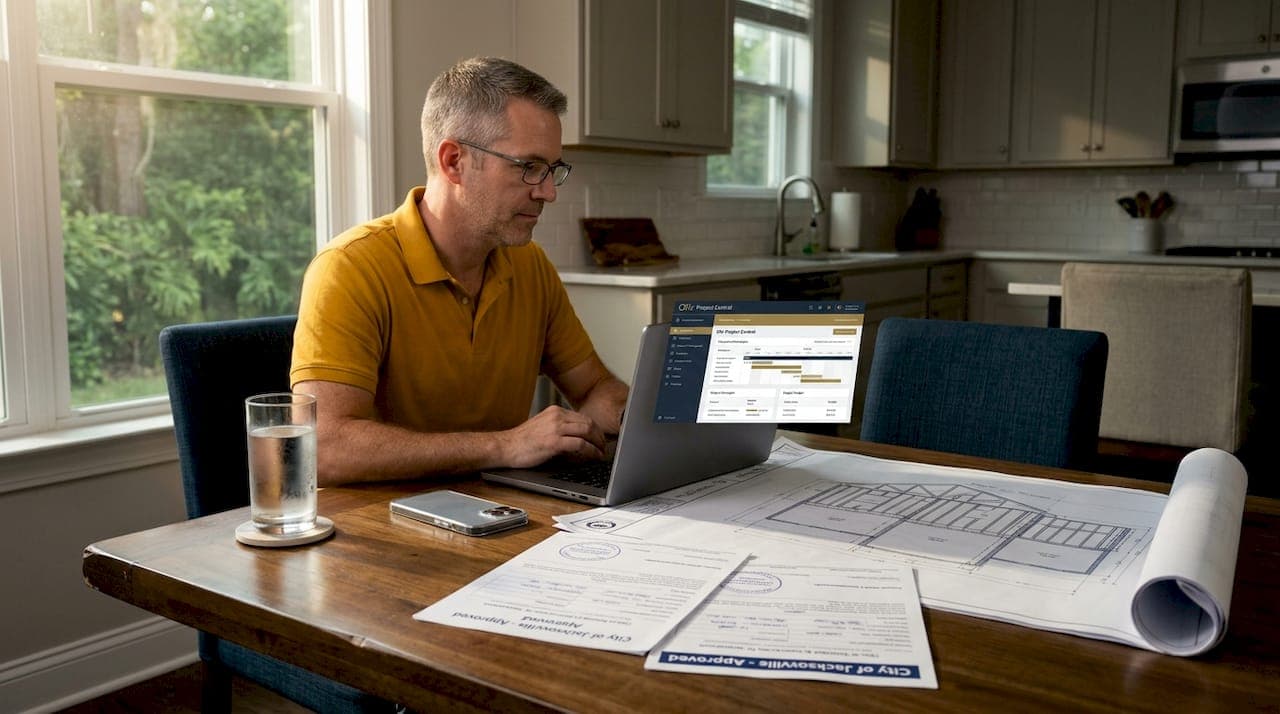
Residential construction in Jacksonville carries significant financial and logistical risk for homeowners and property investors who lack a structured management approach. 85% of construction projects overrun their budgets by an average of 28%, and 98% of large-scale builds experience schedule delays. Even smaller residential builds are not immune: single-family homes average 8.3 months to complete nationally, while Jacksonville custom homes can take 14 to 20 months when permitting timelines are factored in. This guide provides practical, field-tested strategies to help you plan, execute, and verify your project with confidence, keeping costs and timelines under control.
Table of Contents
- Common challenges in residential construction
- Preparation: Planning, documentation, and essentials
- Execution: Step-by-step project management for homeowners
- Troubleshooting and quality assurance
- A fresh perspective: What actually works for Jacksonville projects
- Unlock professional solutions for your Jacksonville project
- Frequently asked questions
Key Takeaways
| Point | Details |
|---|---|
| Budget overruns common | Most Jacksonville projects exceed budgets and timelines unless managed proactively. |
| Preparation is critical | Freezing design, setting contingencies, and digitizing documents prevent costly surprises. |
| Daily oversight needed | Effective project management requires consistent monitoring and issue resolution. |
| Lean planning outperforms | Pull planning methods better align trades and reduce schedule slips compared to rigid CPM. |
| Expert help bridges gaps | Professional tools, checklists, and service support connect homeowners to successful outcomes. |
Common challenges in residential construction
Understanding where projects go wrong is the first step toward preventing those failures. Residential construction in Jacksonville faces a combination of local and national pressures that can derail even well-intentioned projects.
According to a 2025 study published in Nature, the top causes of overruns include schedule lags (rated highest in both frequency and importance), rework from unforeseen conditions, inadequate access to skilled labor, mid-project design changes, and systemic poor planning at the project outset. Critically, labor shortages currently affect 89% of construction firms nationally, making trade availability one of the most pressing variables for any Jacksonville homeowner planning a build or renovation.
Supply chain volatility compounds the challenge. 40% of projects experience delays directly attributable to supply chain disruptions, including material lead times for framing lumber, steel components, roofing systems, and mechanical equipment. In Florida's market, hurricane-season demand spikes can make these delays even more acute.
The core risk factors include:
- Schedule lags from trade availability conflicts and inspection backlogs
- Rework costs from undiscovered site conditions or design ambiguity
- Design changes requested mid-construction, which can cascade into major cost events
- Labor shortages that extend timelines and reduce quality control capacity
- Supply chain delays affecting structural and finish materials
"Poor planning is not simply an operational problem; it is the root cause that amplifies every other risk factor in residential construction."
For Jacksonville homeowners navigating these conditions, proactive planning is not optional. Reviewing Jacksonville construction planning tips and understanding the full project lifecycle overview before breaking ground gives you a structural advantage over reactive management.
Preparation: Planning, documentation, and essentials
With the risk landscape clearly identified, the next step is building a preparation framework that reduces exposure before construction begins. The decisions made before the first permit is pulled have more impact on project outcomes than almost any action taken during construction itself.
Freeze your design before permitting
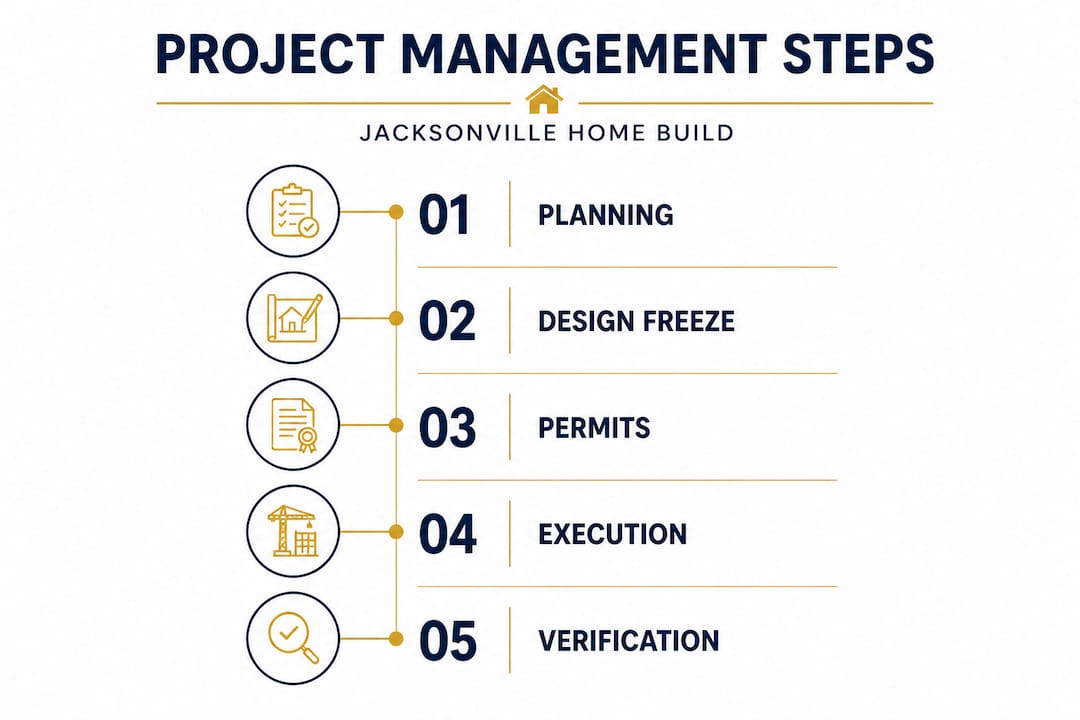
One of the most consequential best practices is achieving a true design freeze before submitting for permits. Scope creep, meaning the gradual addition of features, finishes, or structural modifications after construction begins, is a leading driver of budget overruns. Every design change after framing begins triggers a chain of rework costs, re-sequencing of trades, and potential re-permitting requirements. Discipline around design finalization is non-negotiable.
Establish a realistic budget contingency
Setting aside a 10 to 20% contingency on top of your contracted project cost is a standard best practice for residential builds. A 10% contingency is appropriate for straightforward renovations with well-defined scopes. A 20% contingency is more prudent for ground-up custom construction, older home renovations, or any project involving significant structural work where unforeseen conditions are more likely. For Jacksonville properties with older foundations or homes in flood-affected zones, erring toward the higher end of this range is advisable.
Documentation and communication standards
| Element | Recommended practice | Frequency |
|---|---|---|
| Client progress updates | Written status reports via email or project software | Weekly |
| Site photo documentation | Timestamped photos of all phases | Daily |
| Trade coordination meetings | Pull planning sessions with all active trades | Before each phase |
| Change order documentation | Written approval before any scope change begins | Per event |
| Budget tracking | Running cost log against original contract | Weekly |
Centralizing all documentation in a single digital platform, whether a dedicated construction management application or a shared cloud folder, eliminates the version-control problems that commonly arise when decisions are communicated verbally or through disconnected email threads.
Pro Tip: Before construction begins, use your contractor's project management platform to establish a shared document library. Make sure every approved plan, permit, change order, and inspection report lives in one location accessible to you, your contractor, and any inspecting authorities.
Engaging trades early through pull planning, where the schedule is built collaboratively by working backward from the desired completion date, produces significantly more realistic timelines than top-down scheduling imposed by a single party. Reviewing a project management checklist before finalizing your preparation will confirm you have not overlooked critical setup steps. Familiarizing yourself with standard construction terminology also reduces miscommunication with your contractor and trades throughout the process.
Execution: Step-by-step project management for homeowners
Effective execution requires both a clear sequence of activities and a defined decision-making structure. Homeowners who understand the standard phases of construction and their management responsibilities at each phase are far less likely to be caught off guard by cost events or quality issues.
The standard construction sequence
- Permitting and site preparation — Submit permit applications, secure approvals, establish site access, erosion controls, and temporary utilities. In Jacksonville, permitting for custom homes can add two to four months to the overall timeline.
- Foundation work — Excavation, footings, slab or stem wall construction, and required inspections before framing begins.
- Framing — Structural wall systems, floor systems, and roof framing. This is the phase where most structural decisions manifest physically.
- Rough-in MEP — Mechanical (HVAC), electrical, and plumbing rough-in work, followed by mandatory inspections before walls are closed.
- Insulation and drywall — Installation and finishing of wall and ceiling systems.
- Finish work — Cabinetry, flooring, tile, millwork, fixture installation, and exterior finishes.
- Final inspections and punch-list — Municipality inspections for certificate of occupancy, plus your own punch-list verification of all contracted work.
Residential single-family homes average 8.3 months nationally, but Jacksonville custom homes with full permitting cycles range from 14 to 20 months. Accurate timeline expectations at the outset prevent the frustration and reactive decision-making that often trigger unnecessary cost events.
Self-management versus hiring a general contractor
| Factor | Self-management | Hire a general contractor |
|---|---|---|
| Cost | Saves $50 to $100/hr in PM fees | GC markup typically 10-20% of project cost |
| Time commitment | Requires daily site oversight | GC manages day-to-day operations |
| Experience required | High; trade coordination and code knowledge essential | Lower; GC handles technical execution |
| Risk exposure | Higher without construction expertise | Lower; GC is accountable for workmanship |
| Best suited for | Experienced investors with construction knowledge | First-time builders and homeowners with limited time |
The financial case for self-management is real. Eliminating general contractor fees can represent significant savings on a $500,000 build. However, this approach only delivers value when you have the construction knowledge and availability to provide daily oversight, manage trade sequencing, review submittals, and respond to site conditions in real time. Attempting to self-manage without that foundation typically produces cost overruns that exceed the fee savings.
Pro Tip: If you choose to self-manage, commit to at minimum one daily site visit during active construction phases and hold a brief weekly coordination call with all active trades. Gaps in oversight are where quality problems and unauthorized substitutions occur most frequently.
For a detailed walkthrough of the renovation process, the step-by-step renovation guide provides phase-by-phase guidance tailored to Jacksonville properties. Homeowners focused on maximizing return on investment should also review construction upgrade guidance to prioritize improvements with the strongest value retention.
Troubleshooting and quality assurance
Even well-planned projects encounter problems. The difference between a project that recovers efficiently and one that spirals into major overruns lies in early detection and a pre-established response protocol.
Early warning indicators to monitor
The primary causes of overruns, including rework from unforeseen conditions, skilled labor gaps, and inadequate planning, tend to produce observable early signals before they escalate into significant cost events. Identifying these signals promptly allows corrective action before the schedule impact compounds.
Watch for the following indicators on any active project:
- Crew size reductions without explanation, which often signal labor reassignment to another project or subcontractor financial issues
- Material delivery delays of more than five business days beyond scheduled delivery dates, which can push back entire trade sequences
- Inspection failures that require rework and re-inspection scheduling, adding one to three weeks per event in Jacksonville's current inspection queue environment
- Unexplained work stoppages of more than one day without contractor communication
- Change order requests arriving without written documentation of scope, cost impact, and schedule impact
Pro Tip: Implement a simple photo log using a timestamped mobile application to document daily site conditions. In the event of a workmanship dispute or insurance claim, this documentation becomes critical evidence. Log every phase before it is concealed by subsequent work, particularly framing connections, plumbing rough-in, and insulation installation.
"Quality verification is not a one-time event at project completion; it is a continuous process embedded into every construction phase."
Establishing an escalation plan
Before construction begins, define a clear escalation protocol for three scenarios: schedule delays exceeding one week, quality deficiencies identified during phase inspections, and contractor communication failures. This protocol should specify who is contacted, in what sequence, and what contractual remedies are available at each stage. Having this structure documented in advance removes the ambiguity that slows corrective action when problems arise.
For renovation projects specifically, a structured remodeling checklist provides a phase-by-phase verification framework. Homeowners building with Light Gauge Steel framing systems should also consult steel frame construction tips for Florida-specific quality verification guidance.
A fresh perspective: What actually works for Jacksonville projects
The residential construction industry has long relied on the Critical Path Method (CPM) for project scheduling. CPM excels in organizing complex dependency chains and is well-suited for large commercial or infrastructure projects where sequences are highly predictable. However, CPM's rigidity creates friction in residential builds, particularly when trade availability is variable and design decisions continue to evolve during construction.
Lean pull planning and the Last Planner System offer a meaningful alternative for residential construction. Rather than imposing a master schedule from the top down, pull planning builds the schedule collaboratively by engaging all trades in backward-planning from the project completion date. This approach produces schedules that trades genuinely commit to, because they helped create them, and it surfaces conflicts between trade sequences before they cause site-level disruptions.
In Jacksonville's current labor market, where skilled labor shortages affect the majority of active firms, trade buy-in is not a soft benefit. It is a practical competitive advantage. Contractors who have committed to a pull-planned schedule are significantly less likely to reassign crews to competing projects during critical phases.
The second perspective worth challenging is the assumption that self-management is always the financially rational choice. Saving $50 to $100 per hour in project management fees is only a benefit if you have the time, knowledge, and attention to deliver effective oversight. For property investors managing multiple assets simultaneously, or homeowners without construction experience, the cost of errors made under inadequate supervision consistently exceeds the fee savings. The decision should be made objectively, not aspirationally.
Jacksonville's permitting environment adds a further local variable. Permit review cycles, inspection scheduling windows, and code interpretation nuances specific to Duval County require familiarity that experienced local contractors carry by default. Attempting to navigate this environment without established relationships or local code knowledge extends timelines and increases the probability of non-compliance findings that require expensive corrections.
The most effective approach for most Jacksonville homeowners and investors is a hybrid model: engage an experienced local general contractor for permit management, trade coordination, and code compliance while maintaining active owner oversight for design intent, quality verification, and budget tracking. This structure captures the efficiency benefits of professional management without removing the owner from critical decision points.
Unlock professional solutions for your Jacksonville project
Managing a residential construction project in Jacksonville demands more than good intentions. It requires structured preparation, disciplined execution, and access to experienced local expertise that understands the region's permitting requirements, labor landscape, and material supply dynamics.
Ofir Engineering (license CHC1540016) brings over 15 years of residential construction experience to Jacksonville homeowners and property investors. Whether you are planning new construction using Light Gauge Steel or Wood Frame systems, working through a full-home renovation using the detailed Jacksonville renovation guide, or simply looking to establish a solid management framework with a proven project management checklist, Ofir Engineering provides the precision planning and professional oversight that keeps your project on schedule and within budget.
Frequently asked questions
What is the average timeline for a custom home in Jacksonville?
Custom homes in Jacksonville typically take 14 to 20 months to complete, including the permitting process, which can add two to four months depending on plan review cycles.
How much budget contingency should I set aside?
10 to 20% contingency above your contracted project cost is the industry-recommended range, with the higher end appropriate for custom builds or projects involving significant structural unknowns.
Why do most construction projects face delays?
The leading causes of delays are schedule lags, skilled labor shortages, supply chain disruptions, and mid-project design changes, all of which are addressable through proactive planning and early trade engagement.
Can homeowners manage a project without a general contractor?
Yes, but self-management requires daily oversight and solid construction knowledge. Homeowners without that background or available time consistently achieve better outcomes by hiring an experienced general contractor.
What is "pull planning" and why is it effective?
Pull planning is a scheduling method that coordinates all trades by building the timeline backward from the project's completion date. It improves trade commitment to deadlines and reduces the sequencing conflicts that cause delays during active construction phases.