
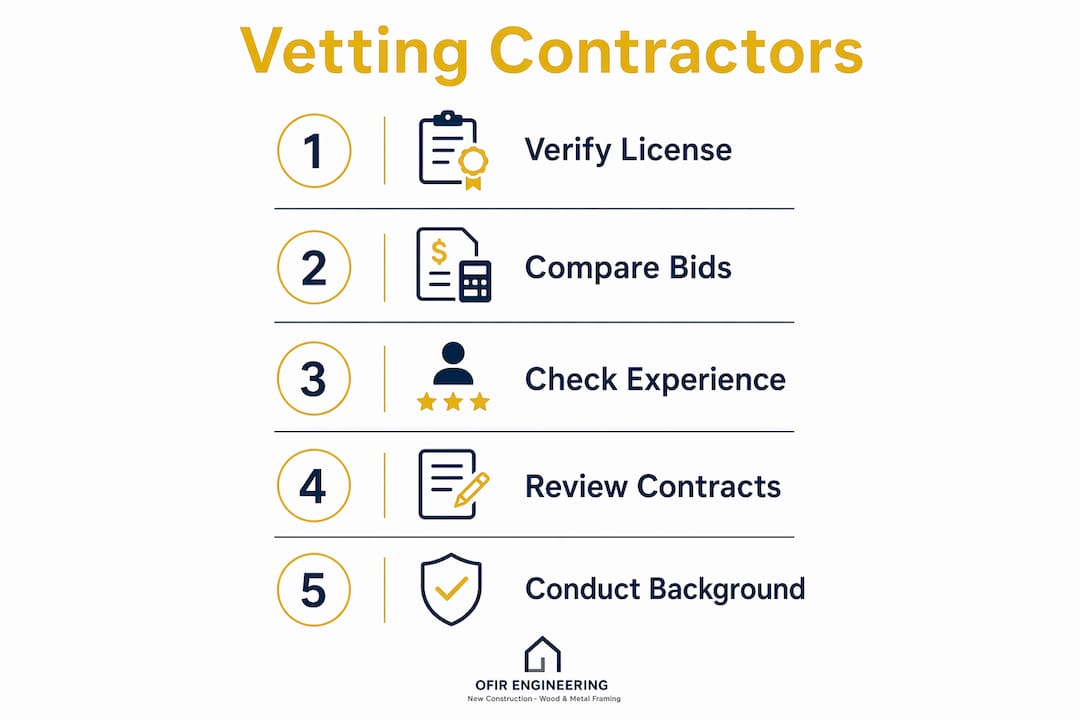
A commercial general contractor is defined as a licensed professional who manages all phases of a construction or renovation project, from permitting and subcontractor coordination to final inspection. Knowing how to find a commercial general contractor in Jacksonville, FL requires more than a quick web search. Jacksonville's unique soil conditions, hurricane-zone building codes, and Florida Department of Business and Professional Regulation (DBPR) licensing requirements create a vetting process that differs from most other U.S. markets. This guide walks homeowners and real estate investors through every critical step, from license verification to bid comparison, and explains how firms like Ofirengineering serve as a reliable starting point for sourcing qualified contractors.
How to find a commercial general contractor in jacksonville, FL
The first step is understanding what credentials a legitimate contractor must carry in Florida. The Florida DBPR requires all commercial contractors to hold a valid state license before performing any construction work. License verification can be completed online through the DBPR's license search platform, and it takes less than five minutes. Skipping this step is the single most common mistake property owners make.
Here is what to verify before signing any agreement:
- State license status: Confirm the contractor holds an active Florida Certified General Contractor or Certified Building Contractor license through the DBPR portal. Suspended or expired licenses are a hard disqualifier.
- Local registration: Duval County and the City of Jacksonville require contractors to register locally in addition to holding a state license. Check the City of Jacksonville's contractor search tool to confirm local standing.
- Certificate of insurance: Request a current Certificate of Liability Insurance and Workers' Compensation coverage. Ask to be named as an additional insured on the policy.
- Surety bond: A surety bond protects you if the contractor fails to complete the work or causes financial damage. Confirm the bond amount is proportionate to your project size.
- DBPR complaint history: The DBPR database shows any disciplinary actions, fines, or license suspensions on record. A single minor infraction may be acceptable; a pattern of violations is not.
If a contractor cannot produce these documents on request, that is grounds to walk away. Florida law also allows you to report unlicensed contractors anonymously through the DBPR website or mobile app, with documentation such as contracts, proof of payment, and written correspondence supporting the complaint.
How do you compare bids without getting burned?
Bid comparison is where most property owners lose money. General contractors in Jacksonville charge 10%–20% of total project costs for large commercial builds or renovations. That range is wide, and the difference between a 10% and 20% fee on a $500,000 project is $50,000. Getting the number right requires structured comparison, not just picking the lowest figure.
Follow these steps when evaluating proposals:
- Request a minimum of three to five bids. Standard practice recommends obtaining 3–5 quotes to compare scope and pricing comprehensively. Fewer bids give you no market baseline.
- Require a line-item breakdown. Each proposal should itemize labor, materials, subcontractor costs, permits, and the contractor's fee separately. A lump-sum bid with no breakdown is a red flag.
- Confirm what is excluded. Ask each bidder to list explicitly what is not covered. Permit fees, soil testing, and utility connections are commonly excluded and can add 5%–10% to a project's total cost.
- Evaluate the scope document. A well-written scope of work defines materials by specification, not just description. "Concrete block exterior walls" is vague. "8-inch CMU block per ASTM C90" is a specification you can hold a contractor to.
- Check payment schedule terms. Legitimate contractors do not require more than 10%–15% upfront. A demand for 50% before mobilization is a warning sign.
Pro Tip: Ask each bidder to provide a sample contract or a scope document from a completed project of similar size. This reveals how clearly they document work and whether their paperwork will protect you in a dispute.
Licensed contractors in Jacksonville charge fees proportionate to project complexity, and emergency services or peak-season demand can push costs higher. Comparing multiple providers is the only way to confirm you are receiving a competitive and complete proposal.
What experience indicators separate strong contractors from average ones?
A valid license confirms legal standing. It does not confirm competence. Licensing alone is insufficient; specialized experience with Jacksonville's soil and foundation challenges is critical for quality work. Jacksonville sits on sandy, expansive soils with a high water table in many areas. A contractor without local foundation experience can produce structurally sound work on paper that fails within five years.
Use these indicators to assess real-world competence:
- Visit recent job sites. Ask for two or three active or recently completed commercial projects you can inspect in person. Observe crew organization, site cleanliness, and material storage. These details reflect how a contractor manages your project.
- Request client references with contact information. Call those references and ask specifically about schedule adherence, communication quality, and how the contractor handled unexpected problems.
- Check Duval County Clerk records. Public court records for judgments or liens against contractors reveal financial or legal risks that strong marketing and positive reviews will never disclose. Contractors with multiple unpaid liens present a high financial risk to your project.
- Confirm permit pull history. Ways licensed remodelers handle permit pulls in Jacksonville include pulling all permits in their own name and coordinating directly with the Building Inspection Division. A contractor who asks the owner to pull permits is likely unlicensed or uninsured.
| Indicator | What to Look For | Red Flag |
|---|---|---|
| License status | Active DBPR license, no violations | Expired, suspended, or no record |
| Local job site visits | Organized, clean, professional crew | Refused access or no recent local work |
| Duval County records | No active liens or judgments | Multiple unpaid liens or lawsuits |
| Permit history | Permits pulled in contractor's name | Owner-pulled permits on past projects |
| Client references | Specific, verifiable contacts | Vague testimonials, no direct contacts |
Legal advisors emphasize rigorous scope-of-work documentation in contracts and proper business entity structures to protect investors in Jacksonville. Pairing thorough due diligence with a well-drafted contract is the most reliable protection available.
How can Ofirengineering and trusted local resources help you vet contractors?
Ofirengineering operates as a licensed construction company (license CHC1540016) based in Jacksonville, with over 15 years of experience in residential construction, renovation, and project management. For homeowners and investors who need guidance on how to find local design build firms in Jacksonville or evaluate contractor credentials, Ofirengineering's team provides direct consultation grounded in local market knowledge.
Beyond Ofirengineering, several resources support thorough contractor vetting:
- DBPR Online License Search: The primary tool for confirming state license status, disciplinary history, and license type for any Florida contractor.
- City of Jacksonville Contractor License and Complaint Search: Confirms local registration and surfaces any complaints filed with the city's Building Inspection Division.
- Better Business Bureau (BBB): Provides accreditation status, complaint history, and customer reviews. BBB ratings are most useful when read alongside court record searches, not as a standalone measure.
- Duval County Clerk of Courts: Allows free public searches for civil judgments, mechanic's liens, and contractor-related lawsuits filed in Duval County.
Online reviews can be manipulated. Checking Duval County Clerk's court records for liens and judgments provides a stronger risk assessment than any review platform. Use review sites to identify candidates, then verify those candidates through official databases before making any commitment.
Pro Tip: When onboarding a new contractor to an investor portfolio in Jacksonville, create a standardized vetting checklist that includes DBPR verification, Duval County lien search, insurance certificate review, and at least two verified client references. Apply the same checklist to every contractor regardless of referral source.
For a detailed walkthrough of the hiring process, Ofirengineering's guide on hiring a general contractor covers the full sequence from initial outreach to contract execution.
What mistakes derail jacksonville commercial construction projects?
Project failures in Jacksonville rarely stem from a single catastrophic decision. They accumulate from a series of overlooked details. Reliable local contractors communicate transparently about realistic pricing, labor availability, and Jacksonville-specific environmental issues like seasonal rain and soil challenges. A contractor who avoids these conversations is not protecting you. They are protecting themselves.
Common mistakes to avoid:
- Accepting verbal agreements. Every scope change, cost adjustment, and schedule modification must be documented in writing and signed by both parties. Verbal agreements are unenforceable in most Florida construction disputes.
- Ignoring weather planning. Jacksonville averages over 50 inches of rain annually, with a concentrated wet season from June through September. A project schedule that does not account for weather delays is not a realistic schedule.
- Skipping the new home construction inspection phases. Florida requires inspections at foundation, framing, rough-in mechanical, and final stages. Missing an inspection can require demolition and rebuilding of completed work.
- Choosing price over scope clarity. A low bid that lacks a detailed scope document will cost more in change orders than a higher bid with full documentation.
"A good contractor won't shy from delivering hard truths about delays, costs, and Jacksonville's environmental challenges. That willingness to communicate difficult realities is the clearest indicator of a trustworthy partner." — Jacksonville Contractors | Find Local Professionals
For ongoing oversight strategies, Ofirengineering's resource on managing your construction project addresses Jacksonville-specific challenges including weather delays, soil remediation timelines, and subcontractor coordination.
Key takeaways
Finding a qualified commercial general contractor in Jacksonville, FL requires verified licensing, structured bid comparison, local experience assessment, and contract documentation that protects your investment at every phase.
| Point | Details |
|---|---|
| Verify DBPR license first | Confirm active state license and local Duval County registration before any other step. |
| Collect 3–5 detailed bids | Compare line-item proposals, not lump sums, to identify scope gaps and hidden costs. |
| Check Duval County court records | Search for liens and judgments to uncover financial risks that reviews will not reveal. |
| Require site visits and references | Inspect recent local job sites and call verified references to confirm real-world competence. |
| Document everything in writing | All scope changes, costs, and schedule adjustments must be signed and in writing to be enforceable. |
What working in jacksonville construction has taught me about contractor selection
After years of observing construction projects across Duval County, one pattern stands out clearly. Investors and homeowners who focus exclusively on price at the selection stage consistently spend more money by the time a project closes. The savings from a low bid evaporate in change orders, schedule extensions, and remediation work that a more experienced contractor would have priced correctly from the start.
Jacksonville's construction environment has specific demands that contractors from outside the market frequently underestimate. The combination of sandy soils, a high water table in low-lying areas, and ASCE 7 wind zone requirements for hurricane exposure means that foundation design and structural detailing require local expertise, not just general competence. A contractor who has built extensively in Atlanta or Tampa has not necessarily built for Jacksonville's conditions.
The most overlooked protection available to any property owner is a well-constructed contract. Legal experts warn that overlooking scope documentation and proper entity structures leads to costly disputes and liability. A contract that defines materials by specification, sets milestone-based payment schedules, and includes a clear dispute resolution clause is worth more than any warranty a contractor offers verbally.
Ofirengineering's 15-plus years of licensed operation in Jacksonville reflects the kind of institutional knowledge that protects clients from these predictable failures. Building a long-term relationship with a contractor who understands your investment goals and Jacksonville's regulatory environment is a compounding asset. The time you invest in vetting the right partner at the start pays dividends across every subsequent project.
— Owen
Start your jacksonville project with Ofirengineering
Ofirengineering is a Jacksonville-based, licensed construction company (CHC1540016) with over 15 years of experience in new construction, residential renovation, and full-project management. Whether you are planning a commercial build, a full-home renovation, or a turnkey remodel, Ofirengineering provides the local expertise and contractor network to move your project forward with confidence. Their team guides clients through every phase, from initial planning and permit coordination to final inspection. Explore Ofirengineering's new construction services or review their renovation ROI strategies to understand how a structured approach protects your investment in Jacksonville's competitive construction market.
FAQ
What license does a commercial contractor need in jacksonville, FL?
A commercial general contractor in Jacksonville must hold an active Florida Certified General Contractor or Certified Building Contractor license issued by the DBPR, plus local registration with Duval County. Both can be verified online through official state and city databases.
How much does a commercial general contractor charge in jacksonville?
Commercial contractors in Jacksonville charge 10%–20% of total project costs, with fees varying based on project complexity, scope, and market demand. Obtaining at least three to five itemized bids is the standard method for confirming competitive pricing.
How do i report an unlicensed contractor in jacksonville?
Complaints against unlicensed contractors can be filed anonymously through the Florida DBPR website or mobile app. Supporting documentation such as contracts, payment records, and written correspondence strengthens the investigation.
What is the biggest risk of hiring the wrong contractor in jacksonville?
The primary risks are financial loss from unpaid subcontractors placing mechanic's liens on your property and structural deficiencies caused by contractors unfamiliar with Jacksonville's soil and foundation requirements. Checking Duval County court records before hiring mitigates both risks significantly.
How does Ofirengineering help investors find reliable contractors in jacksonville?
Ofirengineering provides direct consultation, local market knowledge, and project management services that help investors and homeowners evaluate contractors, understand permit requirements, and structure projects for on-time, on-budget delivery across Jacksonville and Duval County.