

Defining customized construction solutions is the first decision that separates a project that meets your expectations from one that exceeds them. Most homeowners approach construction assuming the process is largely fixed: a contractor shows up, follows a standard plan, and delivers a finished structure. That assumption leads to budget overruns, compromised quality, and spaces that feel like someone else's idea of a home. Tailored construction services work differently. They treat your site conditions, lifestyle, and financial parameters as the actual starting point, not as constraints to work around. This guide explains exactly how that process works and what you need to know before breaking ground.
Table of Contents
- Key Takeaways
- Defining customized construction solutions: core components
- Traditional builds vs. integrated design-build
- How specifications protect your residential project
- Applying personalized construction approaches on your project
- My perspective on what truly separates customized construction
- How Ofirengineering delivers customized solutions in Jacksonville
- FAQ
Key Takeaways
| Point | Details |
|---|---|
| Customization starts with alignment | Early goal-setting on budget, site, and design intent reduces costly change orders throughout the project. |
| Integrated teams outperform fragmented ones | Design-build models place architecture and construction under one accountable entity, reducing miscommunication. |
| Specifications protect your investment | Allowances, unit prices, and Approved Equal clauses define quality standards and prevent unauthorized substitutions. |
| Technology improves precision | BIM modeling and CNC fabrication reduce on-site variability before a single component reaches your lot. |
| Licensing matters more than price | Licensed, insured contractors deliver accountability that low-cost operators simply cannot replicate. |
Defining customized construction solutions: core components
Customized construction solutions are not simply choosing a different paint color or swapping cabinet hardware. The term refers to a coordinated approach in which every major decision, from structural system selection to finish materials, is calibrated to the specific conditions and goals of a single project. That definition stands in direct contrast to speculative or tract builds, where a developer makes uniform choices in bulk to reduce cost, leaving buyers to accept the result.
The core components of a truly tailored approach include:
- Site-specific structural design. A Jacksonville property in an ASCE 7 wind zone territory has different structural demands than a lot 50 miles inland. Personalized construction approaches begin with evaluating those site conditions before any design decisions are finalized.
- Material specification. Rather than accepting a contractor's default supplier list, customized projects define specific products, grades, and performance standards in writing before construction begins.
- Delivery model selection. The choice between a traditional design-bid-build process and an integrated design-build model has a direct effect on coordination quality and final cost. The design-build model consolidates architecture, design, and construction to minimize miscommunication and cost overruns.
- Lifestyle integration. True customization tailors every detail of a home to the owner's daily life, including millwork configurations, storage systems, and circulation patterns, not just the building's overall footprint.
- Budget structure. Bespoke building solutions require a budget framework that is granular enough to track individual line items, not just broad categories.
Ofirengineering applies this multi-layered framework on every residential project, using both Light Gauge Steel and Wood Frame systems selected to match the demands of each specific build.
Traditional builds vs. integrated design-build
To understand why integrated delivery models produce better results on customized projects, it helps to examine what typically goes wrong in the traditional process.
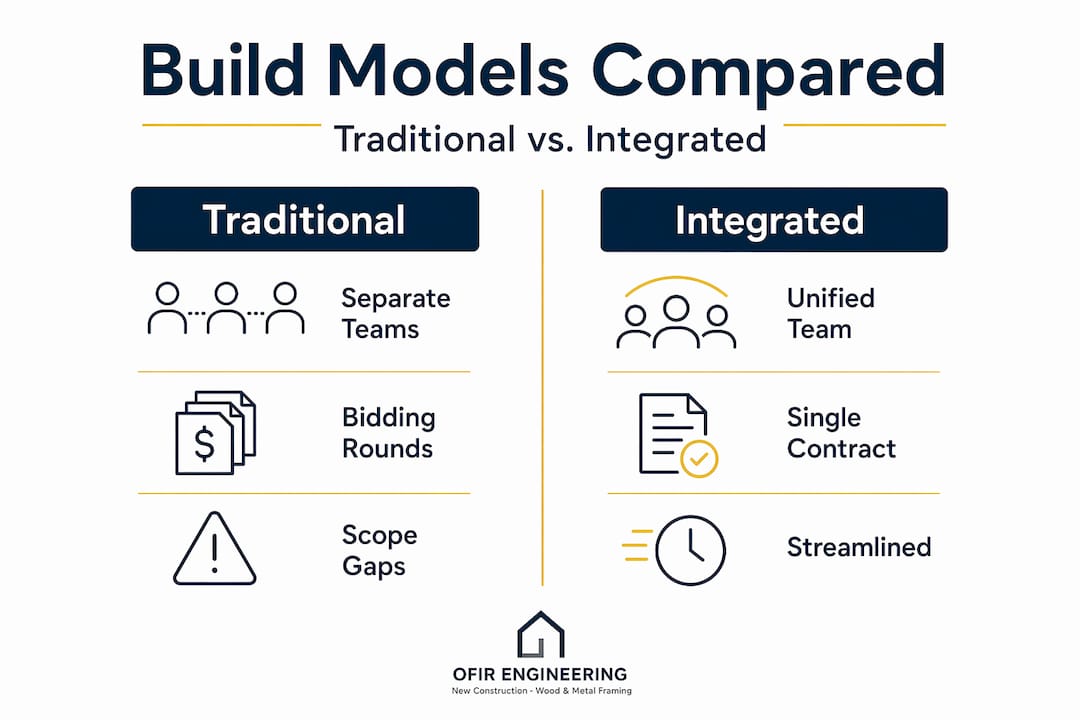
In a conventional design-bid-build arrangement, an architect completes drawings and hands them to a general contractor, who then manages a collection of subcontractors. Each party interprets the documents independently. The architect has moved on to another project. The contractor may value-engineer certain details to protect their margin. The homeowner has limited visibility into those decisions until problems surface during construction or, worse, after completion.
The integrated design-build model eliminates this structural problem. A single entity, carrying both design and construction responsibility, manages the project from site evaluation through final finishes. Integrated design-build teams reduce inefficiencies arising from typical handoffs in construction projects. The results are measurable: fewer change orders, faster decision cycles, and a cleaner chain of accountability.
| Approach | Key advantages | Common risks |
|---|---|---|
| Traditional design-bid-build | Competitive bidding on design and construction separately | Handoff gaps, conflicting interpretations, budget drift |
| Integrated design-build | Single accountable team, real-time coordination | Fewer competitive price checks on individual trades |
| Design-build with open-book accounting | Transparency on costs plus unified team | Requires a highly trustworthy construction partner |
Pro Tip: When evaluating firms for a customized project, ask directly whether their design staff and construction staff work in the same building and report to the same leadership. Firms that say yes are far more likely to operate as a true integrated unit.
The data supports the integrated model clearly. Firms that shift from fragmented to integrated delivery report consistently fewer delays and less budget inflation caused by separate handoffs. For homeowners undertaking bespoke building solutions, the integrated model is not a luxury upgrade. It is the delivery structure that makes genuine customization achievable.
How specifications protect your residential project
Construction specifications are the written documents that define exactly what gets built, using which materials, installed by what methods, and held to which quality standards. For any customized project, they are the primary tool for protecting your design intent and your budget from erosion over time.
A well-structured specification set includes several distinct clause types, each serving a specific protective function:
- Allowances. An allowance is a fixed dollar amount included in the contract to cover a category of work whose final product has not yet been selected. Clear specification language on allowances guides contractors on what is included and excluded financially, preventing disputes when the homeowner selects a fixture that costs more than the placeholder figure.
- Unit prices. When the exact quantity of a material cannot be determined at bidding, unit prices establish a per-unit cost for additions or reductions. This is particularly relevant for excavation, concrete, or drainage work on irregular lots.
- Basis of Design. This clause names a specific manufacturer and product model as the performance benchmark for a given component. It tells the contractor the acceptable baseline without fully restricting sourcing.
- Approved Equal. The Basis of Design and Approved Equal clauses are the primary tools for maintaining performance standards in custom projects. An Approved Equal clause requires that any product substituted for the named basis-of-design item must match or exceed every specified performance parameter, and that substitution must receive written approval before installation.
Pro Tip: Request a draft specification document before signing your construction contract. If the contractor cannot produce one, or offers only a vague scope-of-work statement, treat that as a significant red flag regardless of how competitive their price appears.
Common homeowner mistakes in this area include accepting contracts written solely as scope statements, agreeing to allowance figures without researching realistic market costs for the items they cover, and failing to require written approval for substitutions. Each of these gaps creates an opening for the finished project to diverge from the original vision. A complete custom home building guide will always address specification documentation as a foundational step, not an afterthought.
Applying personalized construction approaches on your project
Understanding the theory of customized construction is useful. Knowing how to apply it on your own project is what actually protects your investment. The following sequence reflects how Ofirengineering and other rigorous construction firms approach residential customization in practice.
- Hold a structured kickoff meeting. Early alignment on scope and design reduces change orders and keeps projects on budget. A kickoff meeting should cover site conditions, budget ceiling, lifestyle priorities, and a preliminary schedule. Decisions made here save disproportionately more time and money than decisions made mid-construction.
- Verify licensing and insurance before any contract is signed. Licensed and insured contractors cost more but deliver consistent quality, safety, and accountability that unlicensed operators cannot replicate. Ofirengineering holds license CHC1540016 in Florida, which provides homeowners with a verifiable accountability mechanism.
- Integrate BIM modeling into your design phase. Modern customization uses technology like BIM and CNC fabrication to reduce variability and increase precision before any component reaches the job site. For complex residential layouts, BIM allows the team to resolve spatial conflicts on screen before they become expensive field corrections.
- Model mechanical and thermal systems early. Performance modeling of the building envelope as a connected system informs cost-performance decisions before construction begins, preventing the type of post-construction corrections that arrive with full labor and material costs attached.
- Establish a transparent project management protocol. Transparent project management enhances client confidence and reduces uncertainty during custom builds. This means scheduled progress reports, documented decisions, and a clear change order process that requires written authorization before any scope deviation is executed.
- Plan interior customization as part of the original design. Details like millwork and personalized storage reflect the owner's daily routines and should be specified before framing is complete, not added as an afterthought during finishing.
Property investors applying how to define construction solutions for rental or resale projects should also factor in durability standards and material longevity, not just upfront cost. A finish that lasts 20 years under tenant use costs less over a 10-year hold period than a lower-cost finish requiring replacement at year six.
My perspective on what truly separates customized construction
I've reviewed hundreds of residential projects over the years, and the pattern is consistent. The projects that came in on budget, on time, and to the client's genuine satisfaction were almost never the ones with the most elaborate specifications. They were the ones where the contractor and the design team were functionally the same team.
What I've learned is that the handoff gap is the single most damaging structural flaw in traditional residential construction. When an architect finishes drawings and walks away, the contractor inherits a document, not a collaborative partner. Every ambiguity in those drawings becomes a decision the contractor makes alone, often in the direction that protects their margin rather than the homeowner's vision.
The firms that consistently deliver on personalized construction approaches are the ones that keep design and construction authority inside the same organization. Ofirengineering's approach, where the same team that evaluates a site also manages specifications and construction, is precisely the model that closes that gap. In my experience, homeowners who understand this before they sign a contract make dramatically better decisions about who to hire and why the lowest bid is almost never the right one.
— Owen
How Ofirengineering delivers customized solutions in Jacksonville
For homeowners and investors in the Jacksonville area, Ofirengineering brings over 15 years of residential construction experience to every customized project. The firm's new construction services cover both Light Gauge Steel and Wood Frame systems, giving clients genuine structural options calibrated to their site, budget, and long-term durability requirements.
Ofirengineering's approach to customized project management integrates design intent, material specification, and field execution under one accountable team. The firm's project management resources provide homeowners with documented processes for tracking scope changes, managing subcontractors, and maintaining schedule integrity. For investors focused on return on investment, Ofirengineering's renovation services are structured to maximize property value while controlling total project cost. To discuss your residential project and receive a structured project assessment, contact Ofirengineering directly through ofirengineering.com.
FAQ
What does defining customized construction solutions mean?
Defining customized construction solutions means establishing a project framework where structural systems, materials, delivery methods, and specifications are chosen specifically for one project's site conditions, budget, and owner goals, rather than applied uniformly across multiple builds.
Why is the design-build model better for custom residential projects?
The design-build model keeps architecture and construction under one accountable entity, which eliminates the handoff gap where miscommunication and unauthorized substitutions typically occur. Industry data shows this approach reduces both cost overruns and project delays.
What is an Approved Equal clause in construction specifications?
An Approved Equal clause requires that any material substituted for the specified product must match or exceed every documented performance parameter, and the substitution must receive written approval before installation, protecting the homeowner from quality-reducing swaps.
How early should performance modeling happen in a custom build?
Performance modeling of mechanical and thermal systems should occur during the design phase, before any construction documents are finalized. Modeling at that stage allows cost and performance trade-offs to be evaluated on screen rather than corrected in the field.
How do I verify a contractor's credentials for a tailored construction project?
Request the contractor's state license number and verify it through your state licensing board. In Florida, Ofirengineering holds license CHC1540016, which is publicly verifiable and confirms the firm meets the state's standards for residential construction accountability.