

Construction project delivery is defined as the contractual and organizational framework that determines who holds design and construction contracts, who bears risk, and how owners, designers, and contractors interact from concept through closeout. Defining construction project delivery correctly at the outset of any project is the single most consequential decision a project team makes, because it shapes communication flows, budget control, schedule flexibility, and dispute resolution pathways before a single drawing is produced. Organizations like the American Institute of Architects (AIA), Procore, and Ofirengineering have each recognized that delivery method selection is not a procurement formality. It is a governance decision that determines project outcomes. RICS frames construction project management as spanning the full lifecycle from client requirements through handover, but the delivery method is the structural layer beneath all of that execution.
What are the main types of construction project delivery methods?
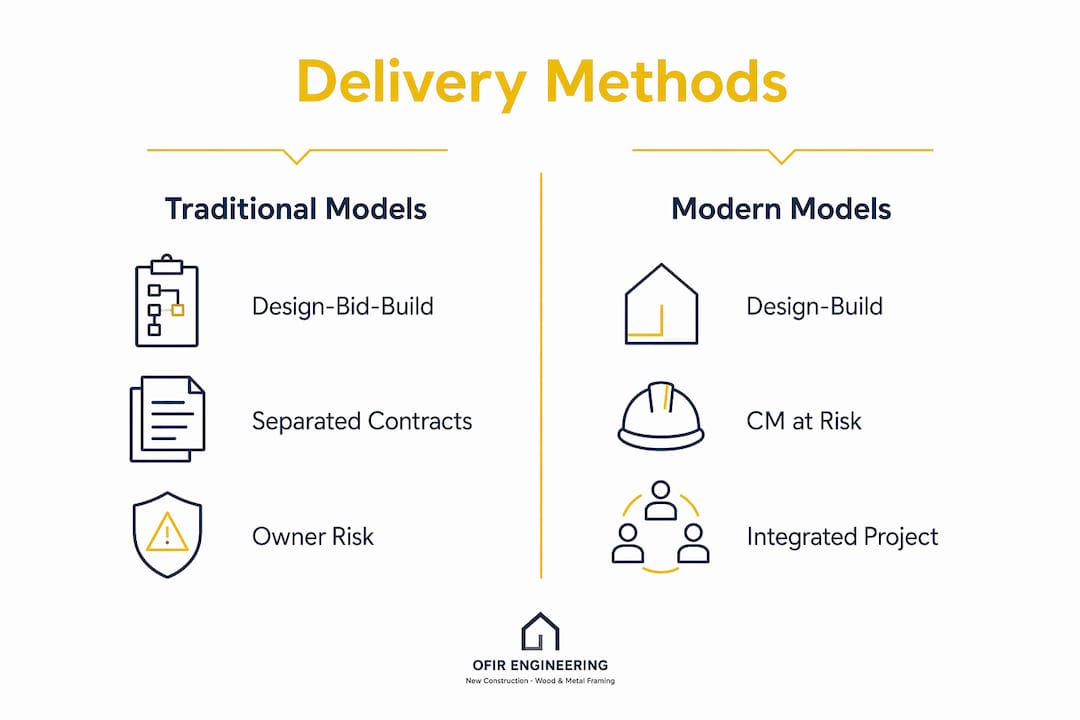
The construction industry recognizes five primary delivery methods, each with a distinct contractual structure, risk profile, and sequencing logic. Understanding these distinctions is the foundation of sound construction project management.
Design-Bid-Build (DBB) is the most traditional method. The owner contracts separately with a designer and a contractor, and construction procurement begins only after design is complete. This sequential process gives the owner maximum design control but transfers little design risk to the contractor. Federal guidance confirms that in DBB, the government retains design risk with complete drawings before bid, whereas in Design-Build, the contractor-led team assumes design performance responsibility. DBB works well for straightforward projects where scope is fully defined early.
Design-Build (DB) consolidates responsibility under a single entity that holds both design and construction under one agreement. This single-source responsibility shifts more design risk to the design-builder and typically compresses the schedule by allowing design and construction to overlap. Owners sacrifice some direct design control in exchange for faster delivery and clearer accountability.

Construction Management at Risk (CMAR) places the construction manager in a general-contractor-like role. The CM holds subcontracts and assumes construction liability, with pricing typically structured as a Guaranteed Maximum Price once design reaches roughly 60 to 90 percent completion. This protects the owner from cost overruns while allowing the CM to engage subcontractors early.
Construction Management as Agent (CMa) takes a fundamentally different approach. The CM provides advisory and preconstruction management without holding subcontracts or assuming financial risk. The owner directly contracts with subcontractors while the CM coordinates and advises. This preserves owner control but places more administrative burden on the owner.
Integrated Project Delivery (IPD) uses multi-party agreements designed around shared risk and reward, with teams contractually locked in during schematic design or design development. AIA integrated delivery forms such as A295-based structures formalize this early team alignment and shared incentives. Public-Private Partnership (P3) is a growing sixth model, particularly in infrastructure, where private entities finance and deliver public assets under long-term concession agreements.
| Method | Contract Structure | Risk Bearer | Sequencing |
|---|---|---|---|
| Design-Bid-Build | Separate owner-designer and owner-contractor | Owner holds design risk | Sequential |
| Design-Build | Single owner-design-builder | Design-builder holds design and construction risk | Overlapping |
| CMAR | Owner-CM plus CM-subcontractor | CM holds construction risk, GMP protects owner | Overlapping |
| CM Agency | Owner-CM advisory, owner-subcontractor | Owner holds all risk | Flexible |
| IPD | Multi-party agreement | Shared among all parties | Collaborative, early lock-in |
Pro Tip: Review the project lifecycle phases for your specific project type before selecting a delivery method. The right choice at concept stage prevents costly restructuring later.
How do contract documents align with different delivery methods?
Contract documents are not interchangeable across delivery methods. The AIA has developed distinct document families for each method, and using the wrong family creates gaps in risk allocation, payment procedures, and dispute resolution.
For Design-Bid-Build, the core AIA documents are:
- B101: Standard Form of Agreement Between Owner and Architect
- A101: Standard Form of Agreement Between Owner and Contractor (Stipulated Sum)
- A201: General Conditions of the Contract for Construction, which defines the tripartite relationship among owner, architect, and contractor
These three documents form an integrated governance system that coordinates roles, responsibilities, payment, change procedures, and dispute resolution across all project phases. Using them together is not optional. Omitting A201, for example, leaves critical procedural gaps that generate disputes.
For Design-Build, AIA A141 governs the agreement between owner and design-builder, while A142 addresses the design-builder's agreement with the architect. For CMAR, AIA A133 structures the CM at Risk relationship and incorporates the Guaranteed Maximum Price amendment. For IPD, AIA A295 and related forms such as A195, B195, and C191 create the multi-party, shared-risk framework that defines integrated delivery at the contractual level.
The practical implication is clear. Delivery method and contract documentation are inseparable. Selecting a delivery method without simultaneously selecting the corresponding contract family leaves the project without a coherent governance structure. Construction professionals who treat contract selection as a downstream task consistently encounter scope disputes, unclear change order authority, and ambiguous liability assignments.
Pro Tip: When evaluating delivery methods, pull the corresponding AIA contract family and read the risk allocation clauses before committing. The contract language reveals the true risk distribution far more accurately than any method description.
What practical factors affect delivery method selection and success?
Delivery method selection directly influences communication flows, risk allocation, bidding timing, and dispute pathways. Treating it as a purely administrative decision is a mistake that experienced project managers avoid. The following factors determine which method fits a given project:
-
Project complexity. IPD suits highly complex projects where early collaboration among owner, designer, and contractor reduces downstream uncertainty. DBB suits projects with well-defined scope where competitive bidding adds value.
-
Owner capacity. CM Agency requires the owner to hold and administer multiple trade contracts directly. Owners without dedicated project management staff typically perform better under CMAR or Design-Build, where the CM or design-builder absorbs administrative load.
-
Schedule priority. Design-Build and CMAR allow design and construction to overlap, compressing the overall schedule. DBB requires design completion before procurement begins, adding months to the timeline on large projects.
-
Budget certainty. CMAR's Guaranteed Maximum Price provides cost certainty once design matures. DBB's competitive bid process can yield lower initial prices but carries higher change order risk if design documents are incomplete.
-
Risk tolerance. Selecting delivery methods as a risk governance decision rather than a procurement choice is the standard recommended by legal and industry authorities. Separated responsibilities reduce early collaboration and can negatively affect both budget and schedule.
-
Communication structure. Procore's project delivery framework confirms that the delivery method defines how design and construction teams interface throughout the project. Misaligned communication structures are a leading cause of coordination failures on mid-size and large projects.
Ofirengineering applies these considerations directly in Jacksonville residential and commercial projects. For new construction using Light Gauge Steel and Wood Frame systems, the firm evaluates owner capacity, schedule requirements, and contract risk allocation before recommending a delivery structure. The construction project management workflow that supports each method is established during preconstruction, not after mobilization.
Pro Tip: Involve the project manager in delivery method discussions before the owner-architect agreement is signed. The PM's input on coordination complexity and subcontractor market conditions often changes the recommended method.
How do IPD and CM at Risk reshape traditional project delivery?
Integrated Project Delivery and Construction Management at Risk represent the most significant structural departures from traditional Design-Bid-Build practice. Both methods change the economics of claims, the governance of design decisions, and the contractual relationships among project participants.
IPD's defining characteristic is the contractual lock-in of the project team during schematic design or design development, well before construction documents are complete. Shared risk and reward in IPD replaces the adversarial claim dynamics of sequential delivery with a shared target cost model. When costs exceed the target, all parties absorb the overrun proportionally. When costs fall below target, all parties share the savings. This structure fundamentally changes how teams approach scope changes and value engineering decisions.
Implementing IPD requires disciplined scope validation during preconstruction. Early contractual team alignment and rigorous scope definition during the preconstruction phase are prerequisites for managing risk effectively across the shared cost pool. Teams that enter IPD agreements without completing this validation work find that the shared risk structure amplifies, rather than reduces, cost uncertainty.
CMAR differs from IPD in that it preserves a more conventional two-party structure between owner and CM, but it shifts construction risk to the CM through the subcontract-holding arrangement and the GMP. The table below highlights the key distinctions between traditional and emerging delivery models.
| Dimension | Design-Bid-Build | CMAR | IPD |
|---|---|---|---|
| Team alignment timing | After design completion | During design development | Schematic design or earlier |
| Risk structure | Owner holds design risk | CM holds construction risk via GMP | Shared among all parties |
| Claim dynamics | Change orders against fixed contract | GMP amendment process | Shared target cost, no downstream claims |
| Contract form | AIA B101, A101, A201 | AIA A133 | AIA A295, C191 |
| Best fit | Well-defined scope, competitive bid | Complex scope, cost certainty needed | Highly complex, collaborative teams |
The practical challenge with both CMAR and IPD is that they require higher levels of preconstruction investment and more sophisticated project management capability than DBB. Ofirengineering's project management services are structured to support this preconstruction phase rigorously, ensuring that contract documents, scope definitions, and risk allocations are fully coordinated before construction begins.
Pro Tip: For CMAR projects, negotiate the GMP amendment timing carefully. Setting the GMP too early, before design reaches 60 to 70 percent completion, exposes the CM to excessive contingency costs that ultimately flow back to the owner through higher GMP figures.
Key takeaways
The delivery method selected at project inception determines risk allocation, communication structure, contract governance, and dispute resolution pathways for the entire project lifecycle.
| Point | Details |
|---|---|
| Delivery method defines governance | The contractual framework assigns risk, responsibility, and communication flows before design begins. |
| Contract families must match the method | AIA document families (B101/A101/A201 for DBB, A133 for CMAR, A295 for IPD) are not interchangeable across delivery methods. |
| IPD requires early team lock-in | Shared risk and reward in IPD depends on contractual alignment during schematic design, not after construction documents are complete. |
| CMAR protects owners through GMP | The Guaranteed Maximum Price, set at 60 to 90 percent design completion, transfers construction cost risk to the CM. |
| Delivery selection is a risk decision | Treating delivery method selection as procurement rather than risk governance is the most common and costly mistake in construction project management. |
Why delivery method clarity is the most undervalued decision in construction
From direct experience working across residential and commercial projects in Jacksonville, the single most consistent source of budget overruns and schedule failures is not poor workmanship or bad weather. It is a mismatch between the delivery method the owner intended and the contract documents that were actually executed. Owners frequently select Design-Build in concept but execute DBB contracts because the project team defaulted to familiar AIA B101 and A101 forms without reviewing whether they matched the intended delivery structure.
The construction industry's legal community has been clear on this point for years. Delivery method selection as risk governance rather than procurement is not a theoretical position. It is a practical reality that shows up in claim frequency and dispute costs. Projects where the delivery method, contract family, and project management workflow are aligned from the start consistently outperform those where these elements are assembled independently.
The emerging models, particularly IPD, are not appropriate for every project. But the discipline they require, specifically early team alignment, rigorous scope validation, and shared accountability, is worth applying to every delivery method at whatever scale is practical. Ofirengineering's approach to managing risk at the design stage reflects this principle: the decisions made before the first permit application determine the project's trajectory more than any decision made during construction.
Construction professionals who treat delivery method selection as a one-time administrative task miss the opportunity to use contractual clarity as a competitive advantage. The firms that win repeat clients are those that make the delivery framework visible, legible, and aligned with the owner's actual risk tolerance and project goals.
— Owen
How Ofirengineering supports project delivery in Jacksonville
Ofirengineering brings over 15 years of licensed construction experience (CHC1540016) to residential and commercial projects across Jacksonville, with direct expertise in Design-Bid-Build, Design-Build, and Construction Management delivery structures. The firm's new construction services cover Light Gauge Steel and Wood Frame systems under delivery frameworks that are selected and documented before design begins, not after.
Every project engagement includes a preconstruction phase where contract documents, risk allocation, and project management workflows are aligned to the selected delivery method. Whether you are a homeowner planning a full renovation, a property investor structuring a new build, or a developer managing multiple sites, Ofirengineering provides the contractual and management framework to keep your project on schedule and within budget. Contact Ofirengineering to discuss which delivery structure fits your next project.
FAQ
What is construction project delivery?
Construction project delivery is the contractual and organizational framework that defines who holds design and construction contracts, who bears risk, and how the owner interfaces with designers and contractors from concept through closeout. It differs from contract type, which refers to payment structure such as lump sum or cost-plus.
What are the main types of project delivery methods?
The five primary construction delivery methods are Design-Bid-Build, Design-Build, Construction Management at Risk, Construction Management as Agent, and Integrated Project Delivery. Each assigns risk, responsibility, and sequencing differently among the owner, designer, and contractor.
How does IPD differ from Design-Bid-Build?
IPD uses a multi-party agreement with shared risk and reward, locking in the project team during schematic design. Design-Bid-Build uses separate owner-designer and owner-contractor agreements in a sequential process where construction procurement begins only after design is complete.
Why does contract document selection matter for delivery methods?
AIA contract families are designed to match specific delivery methods. Using the wrong document family creates gaps in risk allocation, change order authority, and dispute resolution procedures that generate costly conflicts during construction.
When should a project use CMAR instead of Design-Build?
CMAR suits projects where the owner wants to retain design control through a separate architect relationship while transferring construction cost risk to the CM through a Guaranteed Maximum Price. Design-Build is better suited when the owner prioritizes schedule compression and single-source accountability over direct design oversight.