
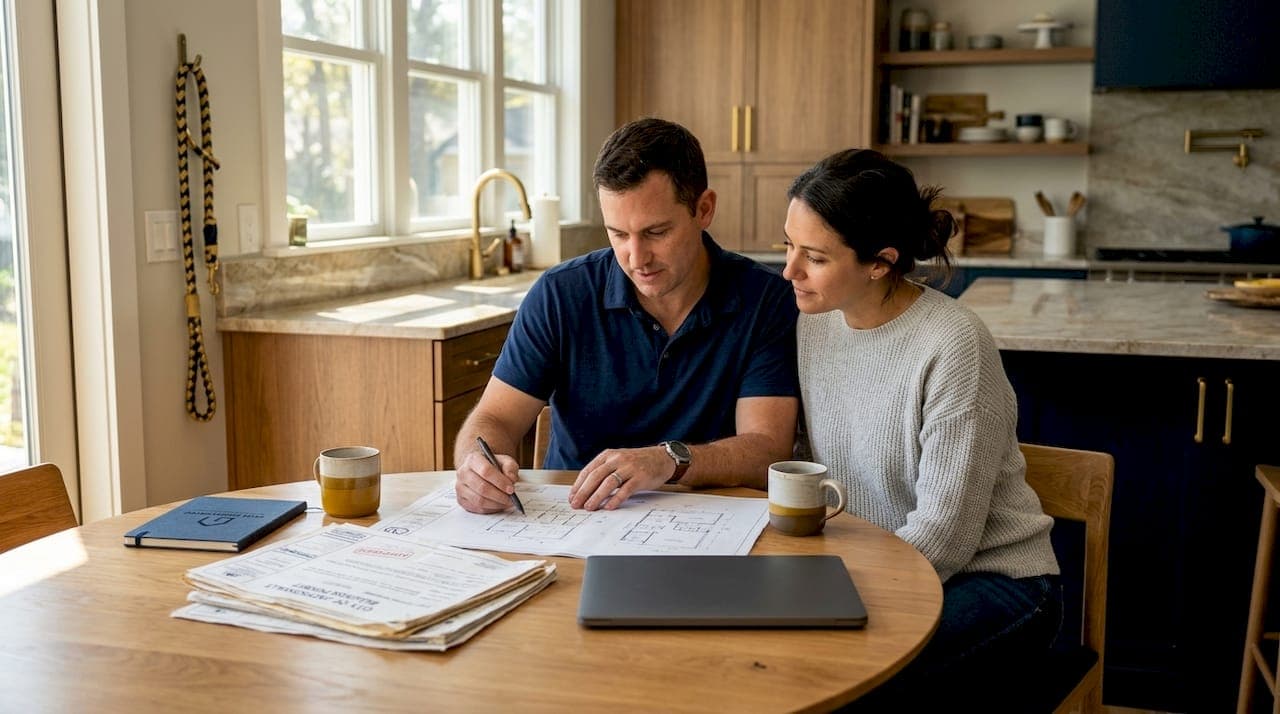
Building a custom home is one of the most consequential financial decisions a Jacksonville homeowner or property investor can make, yet the custom home building process is rarely as straightforward as early conversations with contractors suggest. Between zoning reviews, permit applications, sequenced inspections, and the final certificate of occupancy (CO), there are dozens of decision points where a single misstep can stall your project for weeks. Understanding the full scope of home construction steps before breaking ground is the most effective way to protect your investment, manage your timeline, and avoid the costly rework that derails so many residential projects across Duval County.
Table of Contents
- Prepare for your custom home project in Jacksonville
- Executing construction: stages and inspections in the custom home build
- Obtaining final approvals and certificate of occupancy for your custom home
- Beyond the build: expert perspective on mastering the custom home process
- How Ofir Engineering LLC supports Jacksonville custom home builders
- Frequently asked questions
Key Takeaways
| Point | Details |
|---|---|
| Plan occupancy early | Start permit and certificate of occupancy planning at the project’s inception to avoid major delays. |
| Follow inspection sequence | Schedule and pass inspections in the proper order to keep your construction on track. |
| Manage corrections promptly | Address inspection corrections quickly to prevent them from blocking final approvals. |
| Document approvals | Always obtain official certificates or written confirmations rather than assuming approval. |
| Leverage expert help | Use Ofir Engineering LLC’s expertise for smooth building, permit management, and timely project completion. |
Prepare for your custom home project in Jacksonville
The custom home building process begins well before a shovel touches the ground. In Jacksonville, the preparation phase involves several parallel workstreams: understanding local zoning classifications, securing the correct permits, assembling a qualified project team, and building a schedule that accounts for regulatory review times. Skipping or rushing any of these steps creates compounding delays later in the build.
Jacksonville falls within Duval County's jurisdiction for most permitting matters, and the City of Jacksonville's Building Inspection Division oversees permit applications, plan reviews, and inspection scheduling. Knowing which permits apply to your project — building permit, electrical permit, plumbing permit, mechanical permit, and potentially a land disturbance permit — allows you to structure your custom home project timeline around realistic approval windows rather than optimistic guesses.
One often overlooked early step is understanding what will be required to obtain your certificate of occupancy. As noted in occupancy planning guidance, homeowners should think about the CO early, integrating it into schedule and contract planning. This means your construction contract should reference CO issuance as a project milestone, not an afterthought.
Key preparation actions before breaking ground:
- Confirm zoning classification and allowable use for your parcel through the Jacksonville Planning and Development Department.
- Review Florida permit requirements to understand state-level code adoptions that affect local plan review.
- Engage a licensed architect and structural engineer early to ensure drawings meet Jacksonville's adopted Florida Building Code editions.
- Assemble a construction team with verified experience in Jacksonville's specific inspection and approval environment.
- Establish a master schedule with permit application dates, expected approval windows, and inspection milestones built in.
Pro Tip: When reviewing construction planning tips specific to Jacksonville, pay close attention to plan review turnaround times. In Duval County, complex residential projects can take four to six weeks for initial plan review, and resubmittals add additional time. Build those windows into your schedule explicitly.
Table: Key permits, typical timelines, and responsible parties
| Permit type | Typical review time | Responsible party |
|---|---|---|
| Building permit (new construction) | 4 to 6 weeks | Licensed general contractor |
| Electrical permit | 1 to 2 weeks | Licensed electrical contractor |
| Plumbing permit | 1 to 2 weeks | Licensed plumbing contractor |
| Mechanical permit (HVAC) | 1 to 2 weeks | Licensed mechanical contractor |
| Land disturbance / site work permit | 2 to 4 weeks | Civil engineer or general contractor |
| Driveway / right-of-way permit | 1 to 2 weeks | General contractor or civil engineer |
With the groundwork laid, next we explore the step-by-step execution phase of your home build.
Executing construction: stages and inspections in the custom home build
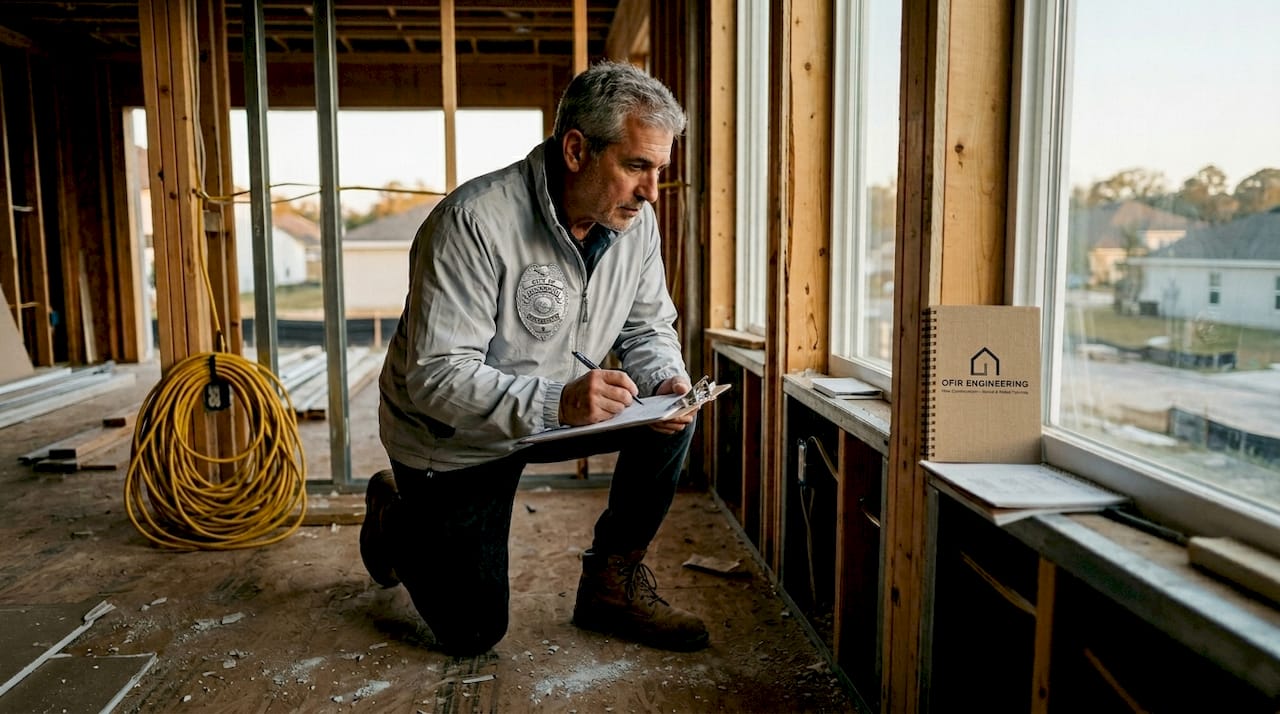
The physical construction phase of building a custom home follows a defined sequence of stages, each gated by inspections that must be passed before the next phase begins. Understanding this sequence is critical to maintaining project flow and avoiding the costly scenario of completed work being rejected during inspection.
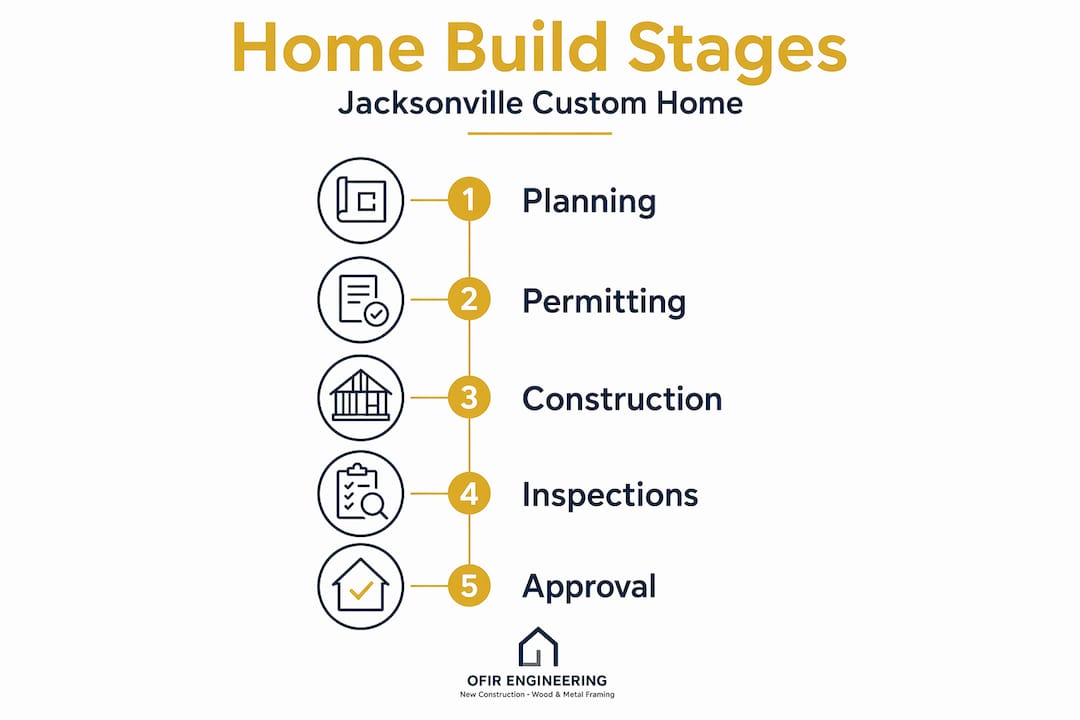
The primary construction stages in sequence are:
- Site preparation: Clearing, grading, and erosion control measures are completed and inspected before foundation work begins.
- Foundation: Footings, slab, or stem wall construction is inspected for depth, reinforcement, and compliance with geotechnical requirements before concrete is poured.
- Framing: Structural framing, whether wood frame or Light Gauge Steel (LGS) systems, is inspected for compliance with structural drawings and wind load requirements specific to Jacksonville's high-wind zone designation.
- Rough-in inspections: Electrical, plumbing, and mechanical rough-ins are inspected before walls are closed with insulation and drywall. This is a gating inspection: walls cannot be closed until rough-in inspections are passed.
- Insulation inspection: Insulation installation is inspected for compliance with Florida's energy code requirements before drywall installation.
- Drywall / interior finishes: Work proceeds after insulation clearance, followed by finish inspections.
- Final inspections: All subsystems receive final inspections confirming that installed systems match approved plans and meet code requirements.
The rough-in inspection stage deserves particular attention. Electrical and other subsystem upgrades require permits and inspections before final reconnection and occupancy clearance. If your custom house design includes a service upgrade to a 200-amp panel, coordination with JEA (Jacksonville Electric Authority) for utility reconnection must be scheduled alongside the inspection timeline, not after it.
Critical inspections and responsible parties:
| Inspection type | Typical timing | Responsible inspector |
|---|---|---|
| Footing / foundation | Before concrete pour | City of Jacksonville building inspector |
| Framing | After framing complete, before rough-in | City of Jacksonville building inspector |
| Electrical rough-in | Before closing walls | City of Jacksonville electrical inspector |
| Plumbing rough-in | Before closing walls | City of Jacksonville plumbing inspector |
| Mechanical rough-in | Before closing walls | City of Jacksonville mechanical inspector |
| Insulation | After rough-ins cleared | City of Jacksonville building inspector |
| Final electrical | After finishes | City of Jacksonville electrical inspector |
| Final plumbing | After finishes | City of Jacksonville plumbing inspector |
| Final building | All work complete | City of Jacksonville building inspector |
Maintaining detailed documentation at each stage is essential. Inspection correction notices, called "red tags" in field parlance, require written responses with corrective action and re-inspection scheduling. A well-maintained project management checklist tracks open corrections and their resolution status, keeping the project moving.
Pro Tip: Photograph all rough-in work before walls are closed. If an inspector raises a question about concealed work after closing, photographic documentation can resolve the issue without requiring demolition.
Having covered construction phases, let's now focus on the critical last steps that verify project completion and legal occupancy.
Obtaining final approvals and certificate of occupancy for your custom home
The final phase of the custom home building process is often where projects lose weeks of time unnecessarily. The certificate of occupancy is a legal document issued by the local building authority confirming that the structure meets all applicable codes and is safe for occupancy. Without it, no one can legally live in the home, and lenders will not release final draws on construction loans.
The CO must be managed proactively as a workstream with specific inspection sequencing; informal assumptions can cause major delays. This means treating the CO not as paperwork that follows construction, but as a scheduled deliverable with its own milestone dates, responsible parties, and verification checkpoints.
Final approvals required before CO issuance in Jacksonville:
- Final building inspection confirming all structural and architectural work matches approved drawings.
- Final electrical inspection confirming panel, devices, fixtures, and grounding meet the current Florida Building Code.
- Final plumbing inspection confirming fixtures, water heater, and drainage systems are correctly installed.
- Final mechanical inspection confirming HVAC equipment, ductwork, and ventilation meet code.
- Fire safety inspection for smoke detectors, carbon monoxide (CO) alarms, and egress compliance.
- Site work confirmation verifying grading, drainage, and driveway completion to approved civil drawings.
- Zoning compliance confirmation that the finished structure matches the approved site plan.
"The certificate of occupancy is not a formality. It is the final confirmation that every subsystem in your home has been independently verified as code-compliant and safe. Treat it as a project milestone from day one."
Managing the sequence of these inspections matters. Fire safety inspections in Jacksonville typically cannot be scheduled until final electrical clearance is received, since alarm system functionality depends on final electrical energization. Scheduling fire safety inspection before electrical final clearance wastes time and generates re-scheduling fees.
Pro Tip: Tie contractor final payment releases and your planned move-in date to actual CO issuance in writing. Informal verbal confirmations from inspectors that "everything looks good" carry no legal weight, and conditions identified at the final walkthrough can still delay CO issuance by days or weeks.
For a structured view of how these final stages connect to the full project lifecycle guide, reviewing the sequencing in detail before construction begins will prevent surprises at completion. Refer to a project management guide specific to Jacksonville homes to ensure every workstream is accounted for.
With final approval secured, let's share unique insights that most homeowners overlook when building a custom home.
Beyond the build: expert perspective on mastering the custom home process
After working on residential construction projects in Jacksonville for over 15 years, certain patterns emerge in projects that struggle versus those that finish on time and within budget. The most consistent differentiator is not the quality of the construction crew. It is the quality of the project management structure around the build.
The most overlooked failure mode in the custom home building process is what could be called "occupancy drift." This happens when the project team treats CO as something that will sort itself out at the end, rather than as a tracked deliverable. As CO readiness research confirms, successful CO readiness is best treated as a coordinated scheduled workstream rather than a last-minute paperwork task. Projects that discover at the final stage that smoke detectors are missing from specific locations, or that site grading does not match approved drawings, routinely absorb two to four week delays that were entirely preventable.
A second pattern is plan drift, where the actual build gradually deviates from the approved drawings through field decisions made without formal documentation. Each informal change may seem minor at the time. Collectively, they create a structure that inspectors will flag during final inspection because it does not match the permitted drawings. The correction process then requires revised drawings, re-submission, re-approval, and re-inspection, which adds significant time and cost.
The residential upgrade process benefits substantially from formal change control. Every deviation from approved drawings should be documented, reviewed for code compliance, and submitted as a formal plan revision if required. This discipline protects the homeowner because it maintains the as-built record, speeds inspections, and preserves the basis for contractor accountability.
Jacksonville's local code environment also has specific requirements that can surprise teams unfamiliar with Florida's building code adoption cycles. The state adopts updated versions of the Florida Building Code on a defined schedule, and projects permitted under one edition must be completed under that edition's requirements even if a new edition takes effect during construction. Knowing which edition governs your project from the moment of permit application is essential to avoiding compliance conflicts mid-build.
Pro Tip: Maintain a running project management checklist of all open corrections, pending inspections, and approval statuses. Review it weekly with your contractor. Items that are not on a list do not get acted on.
The custom home building guide for Jacksonville-area projects should account for the full range of subsystem approvals, not just structural milestones. Electrical, plumbing, mechanical, fire safety, and site work each have their own approval chain, and managing them in parallel with clear ownership is what separates projects that close efficiently from those that stall in the final weeks. Review the full custom home building guide to understand how these workstreams interconnect in practice.
How Ofir Engineering LLC supports Jacksonville custom home builders
Navigating the custom home building process in Jacksonville requires a team with direct experience in Duval County's permitting environment, inspection sequencing, and code requirements.
Ofir Engineering LLC provides full-service design, engineering, and construction management for custom residential projects across Jacksonville, with over 15 years of local experience. Their services cover permit application management, plan review coordination, inspection scheduling, and CO tracking as a dedicated project milestone, not an afterthought. Using their construction project management guide and structured project management checklist, Jacksonville homeowners and property investors gain a clear, stage-by-stage view of their project from initial site assessment through final CO issuance. For homeowners who want their custom home built correctly, on time, and with full code compliance, Ofir Engineering LLC offers the local expertise and process discipline to make it happen.
Frequently asked questions
What is the most important first step in the custom home building process?
Early planning, including understanding Jacksonville permits, zoning, and CO requirements, sets a solid foundation. As occupancy guidance confirms, homeowners should integrate CO planning into scheduling and contracts from the start.
Why are inspections critical during construction?
Inspections confirm that each phase of construction meets safety and code standards before work is concealed or the next phase begins, preventing costly rework and protecting occupant safety.
How can I avoid delays when obtaining a certificate of occupancy?
Schedule all final inspections proactively in the correct sequence, confirm written approval from each subsystem inspector, and avoid relying on informal clearances. As CO planning resources note, waiting until late stages to address subsystem approvals routinely causes hold-ups.
What electrical upgrades should I consider during home construction?
Upgrading to a 200-amp electrical panel, installing AFCI and GFCI breakers, and roughing in circuits for future EV charging stations are high-value decisions. Electrical upgrades involve permits, load calculations, utility coordination, and inspections to meet current safety standards.
How does Ofir Engineering LLC help with custom home building in Jacksonville?
Ofir Engineering LLC provides expert design, permit management, construction oversight, and inspection coordination, ensuring that Jacksonville custom home projects meet all code requirements and complete on schedule.