

Construction quality standards are the documented criteria governing materials, workmanship, and processes that define acceptable outcomes across every phase of a construction project. These standards function as benchmarks for compliance, safety, and client satisfaction, drawing from contract documents, adopted building codes such as the International Building Code (IBC) and International Residential Code (IRC), and recognized technical references including ASTM International, the American Concrete Institute (ACI), and the American Welding Society (AWS). Understanding this layered framework is not optional for construction professionals. It is the foundation of every compliant, durable, and cost-effective project. Ofirengineering, with over 15 years of licensed residential construction experience in Jacksonville, guides clients through this framework at every project stage.
What are the main components of construction quality standards?
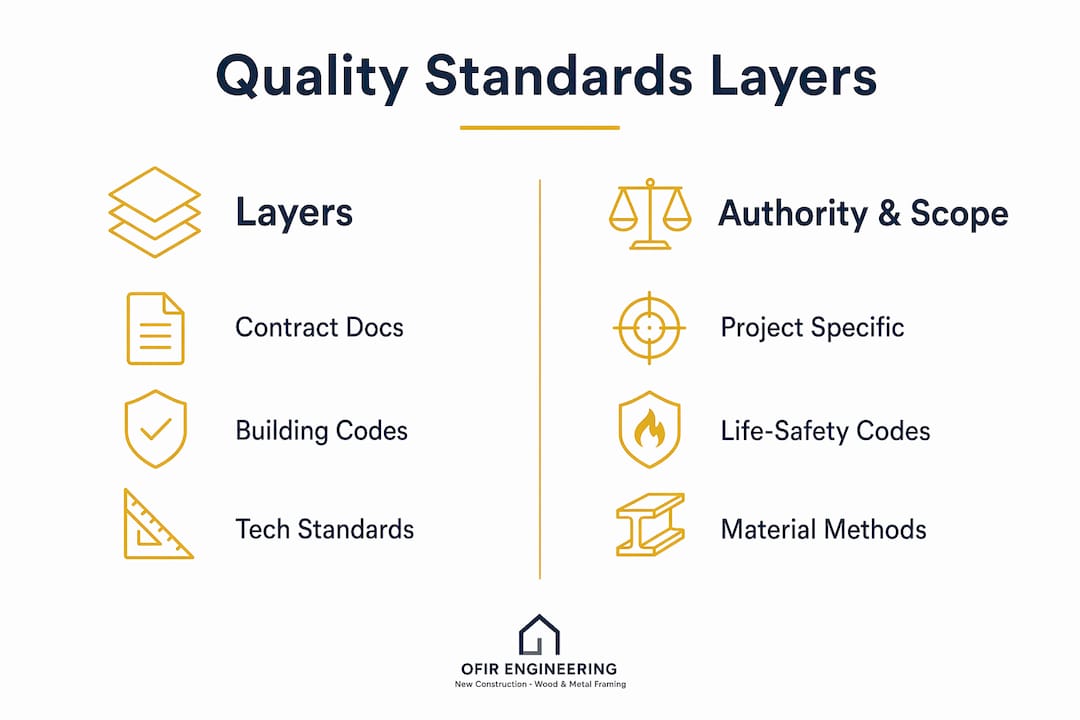
Construction quality standards operate across three distinct layers, each carrying specific authority and scope. Recognizing which layer governs a given situation is the first step toward proper QC inspection adherence on any project.
Layer 1: Contract documents. Drawings and specifications define the project-specific scope, materials, and quality expectations. These documents establish the baseline against which all installed work is measured. A specification calling for 4,000 psi compressive strength concrete, for example, overrides a general assumption that standard mix designs will suffice.

Layer 2: Adopted building codes. The IBC and IRC set minimum life-safety and structural requirements. Local jurisdictions in Florida adopt and amend these codes, meaning the version in force at permit issuance governs the project. Misidentifying the applicable code edition is a common source of plan-check failures.
Layer 3: Reference technical standards. ASTM, ACI, and AWS publish material-specific and method-specific requirements that the codes and specifications incorporate by reference. ACI 318 governs reinforced concrete design; AWS D1.1 covers structural welding; ASTM A615 defines deformed steel bar properties. These documents carry the technical precision that general code language cannot provide.
The table below compares these three layers by authority, scope, and enforcement mechanism.
| Layer | Primary source | Scope | Enforced by |
|---|---|---|---|
| Contract documents | Owner/design team | Project-specific quality | QC inspection team |
| Building codes (IBC/IRC) | Jurisdiction | Minimum life-safety | Authority Having Jurisdiction (AHJ) |
| Reference standards (ASTM, ACI, AWS) | Technical bodies | Material and method detail | QC team and third-party testing |
One distinction professionals often miss: QC inspection differs from AHJ code compliance inspections. The AHJ confirms minimum code compliance; the QC team verifies full contract specification compliance. Both are necessary, and neither substitutes for the other.
How does quality control inspection verify compliance with construction standards?
Quality control in construction is defined as the reactive process of verifying that completed work matches project specifications through inspection, testing, and documented records. This definition matters because it separates QC from quality assurance (QA). QA is the proactive system of planned processes and procedures designed to prevent defects before they occur. QC is the verification that those processes produced the intended result.
A credible QC program follows this sequence:
- Develop an Inspection and Test Plan (ITP). The ITP maps every inspection activity to a specific work stage, identifies the governing specification clause, and assigns hold, witness, or review points. ITP sequences tied to hold points prevent nonconformance from being discovered only after the work is concealed.
- Execute hold and witness points. A hold point requires a qualified inspector to verify and accept work before the next phase proceeds. Concrete reinforcement placement is a classic hold point because the rebar becomes inaccessible once the pour occurs. A witness point allows the inspector to attend but permits work to continue if the inspector does not appear within a defined window.
- Document all inspections and test results. Traceability linking materials to inspection records and environmental conditions at time of placement is critical for insurance claims, warranty disputes, and regulatory audits.
- Issue Non-Conformance Reports (NCRs) for deviations. An NCR formally records a departure from specification, assigns corrective action, and tracks resolution. Closing NCRs before project completion prevents defect liability from transferring to the owner.
- Assign trade-specific credentials to inspectors. ACI certification for concrete and AWS credentials for welding are not administrative formalities. They determine whether inspection results carry legal and contractual weight.
Pro Tip: Risk-based sequencing is more effective than evenly distributing inspections across all work stages. Concentrate hold points on irreversible or concealed work, such as foundation waterproofing, structural connections, and rough-in MEP, where a missed defect compounds in cost and complexity.
Ofirengineering applies this documentation-driven approach across all residential projects in Jacksonville, maintaining project management workflows that align ITP milestones with permit inspection schedules.
What 2026 statutory guidance updates affect building regulation standards?
The most significant regulatory shift affecting construction quality standards in 2026 is the simultaneous update of Approved Document L and Approved Document F under the Future Homes and Buildings Standards framework. While these documents originate from England's Building Regulations 2010, they signal a global direction in energy and ventilation compliance that influences how quality metrics are defined and documented on new construction projects worldwide.
Approved Document L (2026), published March 24, 2026, sets statutory guidance for energy efficiency and greenhouse gas emissions compliance for both dwellings and other buildings. The update requires new buildings to meet performance thresholds that eliminate the need for future zero-carbon retrofitting. This means energy performance is now a quality standard, not an afterthought.
Approved Document F (2026), published the same date, addresses ventilation compliance for dwellings. Ventilation design and installation now carry the same documentation burden as structural and fire-resistance elements. Inspectors must verify that installed systems match the approved design, not merely that a system exists.
The table below summarizes the 2026 updates and their documentation implications.
| Document | Subject | Key 2026 change | Documentation requirement |
|---|---|---|---|
| Approved Document L | Energy and emissions | Zero-carbon-ready performance thresholds | SAP 10.3 energy calculations |
| Approved Document F | Ventilation | Dwellings compliance guidance update | As-installed ventilation records |
| Building Circular 01/2026 | Low-carbon heating | Amendments to Docs L and F | Updated specification references |
Using exact statutory guidance versions avoids documentation version drift that causes plan-check or certification failures. Practitioners should anchor all energy performance calculations to SAP 10.3 and reference Approved Documents L and F 2026 explicitly in project specifications.
Pro Tip: When preparing permit documentation for new construction, confirm the exact edition of every referenced standard and approved document. A specification referencing a superseded document version can trigger a plan-check rejection even when the physical construction meets current requirements.
The Future Homes and Buildings Standards reinforce that construction quality standards are not static. Professionals who monitor official statutory updates as they are published avoid the compliance gaps that create costly project delays. Ofirengineering's energy code compliance resources reflect these 2026 updates for Jacksonville-area projects.
What are best practices for maintaining quality standards on construction projects?
Applying construction quality standards consistently across a project requires deliberate planning from the pre-construction phase through final inspection. The following practices define the difference between projects that pass first-time inspections and those that accumulate NCRs and rework costs.
- Define quality expectations in specifications before breaking ground. Ambiguous specifications produce ambiguous results. Every material, mix design, coating system, and installation tolerance should carry a named standard reference, such as ASTM C94 for ready-mixed concrete or AISI S100 for cold-formed steel members.
- Hire inspectors with credentials aligned to the work category. An inspector without ACI Field Testing Technician certification cannot produce a defensible concrete test report. Credential verification is a procurement step, not an afterthought.
- Establish supplier and vendor quality expectations in purchase orders. Mill certifications, material test reports, and certificates of conformance should be contractual deliverables, not optional documents. Receiving materials without traceability documentation creates gaps in the QC record.
- Conduct consistent site inspections at defined intervals, not only at permit milestones. AHJ inspections confirm minimum code compliance at specific stages. Internal QC inspections should occur at every ITP hold point, which is typically more frequent than the permit schedule requires.
- Maintain a centralized documentation system. Whether the team uses construction management software such as Procore or Buildertrend, or a structured paper-based system, all inspection records, test reports, NCRs, and corrective actions must be retrievable by work stage, date, and inspector.
- Communicate quality requirements to subcontractors at mobilization. A pre-construction quality meeting that walks subcontractors through the ITP, hold points, and NCR process reduces first-time defect rates by aligning expectations before work begins.
Ofirengineering's construction quality control approach for Florida residential projects integrates these practices into every project phase, from Light Gauge Steel framing inspections to final finish reviews.
Key takeaways
Construction quality standards require a three-layer framework of contract documents, adopted codes, and reference technical standards, verified through documented QC inspections at defined hold and witness points.
| Point | Details |
|---|---|
| Three-layer standards framework | Contract documents, IBC/IRC codes, and ASTM/ACI/AWS references each govern distinct aspects of quality. |
| QC versus AHJ inspections | QC verifies contract specification compliance; AHJ confirms minimum code compliance. Both are required. |
| ITP hold points prevent rework | Sequencing inspections at irreversible work stages stops defects from being concealed before discovery. |
| 2026 regulatory updates | Approved Documents L and F 2026 make energy performance and ventilation formal quality documentation requirements. |
| Documentation traceability | Linking materials to inspection records and environmental conditions protects against insurance and regulatory disputes. |
Why construction quality standards are more complex than most professionals expect
Having worked across residential construction projects in Jacksonville for over 15 years, I have seen one pattern repeat itself more than any other: professionals who understand the physical work thoroughly but underestimate the documentation layer that governs it.
The most common misconception is that passing the AHJ inspection means the project meets quality standards. It does not. The AHJ confirms that minimum code thresholds are satisfied. The contract specifications, which often exceed code minimums, are the actual quality benchmark. A project can pass every permit inspection and still carry significant nonconformance liability if the QC record does not demonstrate specification compliance.
The 2026 updates to Approved Documents L and F make this gap more consequential. Energy performance and ventilation are now quality metrics with documentation requirements, not just design parameters. A project that installs a compliant HVAC system but lacks the as-installed ventilation records to prove it faces the same certification risk as a project with a deficient installation.
What I have found works in practice is treating the ITP as a living document rather than a pre-construction formality. When hold points are reviewed and adjusted as the project evolves, the QC record reflects actual site conditions rather than a theoretical inspection plan. That distinction matters enormously when a dispute arises six months after project completion.
Ofirengineering's clients in the Jacksonville area consistently achieve first-time inspection pass rates because quality planning begins at specification writing, not at the first site visit. The investment in upfront documentation discipline pays for itself in avoided rework and reduced closeout delays.
— Owen
How Ofirengineering supports quality compliance on every project

Ofirengineering brings licensed construction expertise and a documentation-driven quality management approach to residential projects across Jacksonville, FL. Whether you are planning a new build using Light Gauge Steel or Wood Frame systems, or managing a full-home renovation, the team at Ofirengineering structures every project around the three-layer quality standards framework described in this article. From specification writing and ITP development through final inspection documentation, Ofirengineering's new construction services are built to meet 2026 building regulation standards and deliver compliant, durable results. Explore how Ofirengineering's project management checklist can support your next project from groundbreaking to certificate of occupancy.
FAQ
What are construction quality standards?
Construction quality standards are documented criteria that define acceptable materials, workmanship, and processes for a construction project. They draw from contract documents, adopted building codes such as the IBC, and technical reference standards from bodies like ASTM, ACI, and AWS.
What is the difference between quality control and quality assurance in construction?
Quality assurance is the proactive system of planned processes designed to prevent defects, while quality control is the reactive verification that completed work meets specifications through inspection and testing. Both functions are necessary and complementary on any well-managed project.
What is a hold point in a construction inspection?
A hold point is a defined stage in the Inspection and Test Plan where work cannot proceed until a qualified inspector verifies and accepts the completed phase. Hold points prevent rework by requiring sign-off before irreversible or concealed work advances.
How do the 2026 Approved Document L and F updates affect construction projects?
The 2026 updates establish energy performance and ventilation as formal quality documentation requirements for new dwellings. Projects must reference SAP 10.3 for energy calculations and maintain as-installed ventilation records to satisfy certification requirements under the Future Homes and Buildings Standards.
Why does documentation traceability matter for construction quality compliance?
Traceability links materials to inspection records, test results, and site conditions at the time of installation. This documentation is required for insurance claims, warranty disputes, and regulatory audits, and its absence can invalidate an otherwise compliant QC record.