
The definition of construction project phases is the classification of a construction project's life cycle into sequential, manageable stages, each with distinct objectives, deliverables, and decision gates that collectively govern the project from initiation through final closeout. Industry frameworks from Procore, Asana, and Autodesk all confirm this foundational structure, though they differ in how many phases they recognize, ranging from five to seven depending on how steps are grouped. Understanding these phase boundaries is not optional for project success. It is the structural logic that separates projects delivered on time and within budget from those that spiral into delays and cost overruns. Ofirengineering, with over 15 years of licensed residential construction experience in Jacksonville, applies this phase-based discipline across every new build and renovation project it manages.
What are the main phases of a construction project?
Construction projects typically follow five distinct phases: initiation, planning, execution, monitoring and control, and closure. This five-phase model, formalized by Procore's 2025 framework, represents the minimum structure needed to manage complexity and accountability across a build. Each phase produces outputs that the next phase depends on, which is why skipping or compressing any stage creates downstream problems.
The phases and their core activities are as follows:
- Initiation (Conception): Define the project scope, establish feasibility, identify stakeholders, and produce a project charter or brief. For a Jacksonville homeowner working with Ofirengineering, this phase includes site assessment, preliminary budget discussions, and alignment on construction method, whether Light Gauge Steel or Wood Frame.
- Planning and Design: Develop architectural drawings, structural engineering plans, material specifications, and a detailed project schedule. This phase also includes assembling the project team and refining workflows before any physical work begins. Preconstruction lays the groundwork through defining needs, assembling teams, and refining workflows, according to Asana's 2026 framework.
- Permitting: Submit permit applications, respond to municipal review comments, and obtain all required regulatory approvals. Autodesk treats permitting as a standalone phase because its timeline is controlled by external agencies, not the project team.
- Procurement: Source and contract subcontractors, order materials, and confirm delivery schedules. Poor procurement coordination at this stage is one of the most common causes of construction delays.
- Execution (Construction): Physical construction work begins, from site preparation and foundation through framing, mechanical, electrical, plumbing, and finishes.
- Monitoring and Control: Track cost, schedule, scope, quality, and safety performance throughout execution. This phase often runs concurrently with construction rather than sequentially.
- Closure and Post-Construction: Conduct final inspections, obtain certificates of occupancy, complete punch lists, and hand over documentation to the owner.
Pro Tip: Document the specific deliverables required to exit each phase before the project starts. A signed-off design package, a received permit, or an executed subcontractor agreement are concrete exit criteria that prevent ambiguous phase transitions.
Each phase requires a formal handoff. Clear phase definitions and documentation enable smooth transitions and accountability, according to Buildxact's 2026 analysis. Without that documentation discipline, teams move forward on assumptions rather than confirmed outputs.

How do different frameworks compare in defining construction phases?
No universal number of phases exists. Five, six, or seven phases are all common depending on how steps are grouped, but the core handoff logic remains consistent across all frameworks. This matters because the framework a project team adopts shapes how they plan, staff, and govern the work.
The table below compares three widely referenced frameworks:
| Framework | Phase Count | Key Distinguishing Feature |
|---|---|---|
| Procore (2025) | 5 phases | Monitoring and control treated as a distinct structured workstream |
| Asana (2026) | 6 phases | Commissioning and occupancy/warranty separated as explicit stages |
| Autodesk (2026) | 6 phases | Permitting isolated as a standalone phase with scheduling implications |
| Buildxact (2026) | Variable | Emphasizes deliverable-based phase exits over fixed phase count |
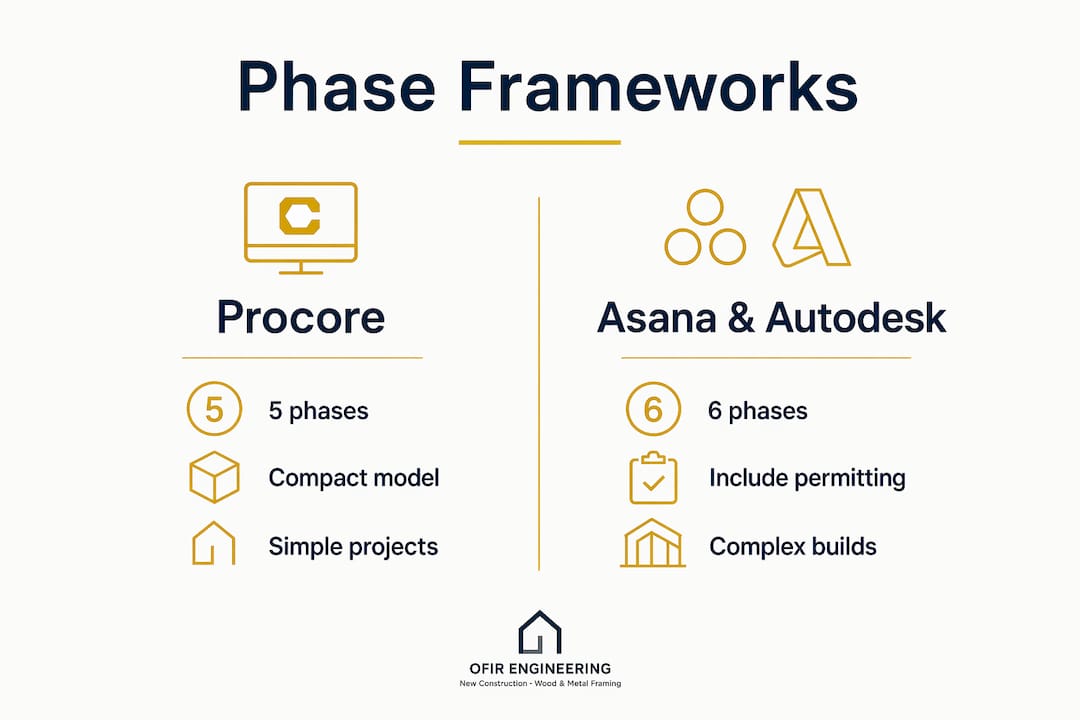
Procore's five-phase model is the most compact and works well for straightforward residential builds. Asana's six-phase model adds commissioning and a warranty period as distinct stages, which is particularly relevant for larger or more complex projects where systems testing and owner training require dedicated time. Autodesk's approach is notable for separating permitting from preconstruction entirely, reflecting the reality that permit timelines in jurisdictions like Jacksonville, Florida, are controlled by the city, not the contractor.
Treating permitting as a standalone phase reflects its complexity and impact, making regulatory approvals a critical scheduling milestone. Ofirengineering applies this logic directly: permit applications are tracked as a separate workstream with their own schedule milestones, preventing the common mistake of assuming permits will arrive on a contractor's preferred timeline.
Pro Tip: When selecting a phase framework for your project, choose based on project complexity, not preference. A simple bathroom renovation may need only four phases, while a new Light Gauge Steel home in Jacksonville warrants a full six-phase structure including permitting and commissioning.
Why do phase boundaries and decision gates matter in construction?
Phase boundaries function as formal management gates where stakeholders assess whether the project is ready to proceed, requires re-scoping, or should be paused. The SEBoK generic life cycle model describes these gates as the governance mechanism that separates structured project management from uncontrolled execution. Without them, teams advance on momentum rather than verified readiness.
A decision gate at the end of the planning phase, for example, requires that architectural drawings are complete, structural calculations are approved, and the budget is confirmed before procurement begins. If any of those outputs are missing, the gate does not open. This discipline prevents the most expensive type of construction problem: discovering a design conflict after framing is complete.
Clear phase boundaries and formal decision gates improve governance and reduce risks by requiring acceptance of key deliverables before proceeding. The practical implication for homeowners and developers is that a contractor who skips formal phase reviews is not saving time. That contractor is transferring risk onto the owner.
Phase boundaries also produce critical handoff documents. Design drawings, estimates, and procurement commitments are the outputs that enable downstream phases to proceed on a confirmed basis. Ofirengineering structures its project management workflow around these handoff documents, treating each phase exit as a formal milestone with documented sign-off from both the project team and the client.
"Monitoring and controlling is not a phase that begins after construction starts. It is a continuous discipline that tracks cost, schedule, scope, quality, and safety from the first day of planning through the final inspection."
Monitoring and controlling runs concurrently with execution as a structured workstream, not as a passive observation activity. This distinction matters because teams that treat monitoring as an end-of-phase review rather than a daily discipline consistently miss early warning signals on budget drift and schedule slippage.
What are the most common pitfalls in managing construction phases?
Construction phase management fails in predictable ways. Recognizing these patterns before they occur is the most cost-effective form of risk management available to any project team.
-
Inadequate planning before execution. Teams that compress the planning phase to accelerate the start of physical construction consistently encounter design conflicts, missing specifications, and scope gaps during execution. A residential new build in Jacksonville that begins framing before structural drawings are finalized will face costly rework when the framing does not match the engineer's intent.
-
Ignoring permitting timelines. Starting construction before completing permitting increases the risk of delays and cost overruns significantly. Autodesk's analysis confirms that collapsing the permitting phase into preconstruction is one of the most frequent sources of project disruption. In Jacksonville, permit review cycles can extend several weeks, and any construction work performed without an active permit creates legal and insurance exposure.
-
Poor procurement coordination. Procurement that begins too late or without confirmed design specifications results in material substitutions, delivery delays, and subcontractor conflicts. Procurement must be treated as a discrete phase with its own schedule, not as a background activity that runs alongside construction.
-
Ineffective monitoring during execution. Teams that review project performance weekly rather than continuously miss the narrow window when corrective action is still low-cost. By the time a weekly report reveals a schedule problem, the delay has already compounded.
-
No formal closure process. Projects that end without a structured closeout phase leave punch list items unresolved, documentation incomplete, and warranty obligations unclear. This creates disputes between owners and contractors that are entirely avoidable.
Pro Tip: Build a phase-specific checklist before each phase begins. For the permitting phase, that checklist includes confirmed drawing sets, completed application forms, fee payments, and a realistic review timeline from the local building department. Ofirengineering provides clients with a construction management checklist tailored to Jacksonville's permitting requirements.
How to apply phase knowledge for better project execution
Applying the definition of construction project phases in practice requires more than knowing the names of the stages. It requires translating phase logic into specific documentation requirements, communication protocols, and monitoring routines.
The following practices produce measurable improvements in project outcomes:
- Define deliverables per phase in writing before the project starts. Each phase should have a written list of outputs required for phase exit. For the design phase, that list includes stamped architectural drawings, a structural engineering package, a finalized material schedule, and a confirmed budget. Ambiguity about what constitutes phase completion is the primary cause of premature phase transitions.
- Track permitting and procurement as separate schedule items. Both activities have external dependencies that the project team cannot fully control. Treating them as background tasks rather than tracked phases means their delays are invisible until they become critical path problems.
- Implement continuous monitoring from day one. Monitoring and control as a structured workstream requires daily or weekly tracking of cost, schedule, scope, quality, and safety. Ofirengineering uses structured progress reporting at defined intervals to give clients real-time visibility into phase status. For more on managing costs across phases, the cost control guide from Ofirengineering covers the monitoring discipline in detail.
- Conduct formal phase reviews with all stakeholders. A phase review is a structured meeting where the project team confirms that all phase deliverables are complete and that the project is ready to proceed. This is not a status update. It is a formal go/no-go decision with documented outcomes.
- Maintain a phase log throughout the project. A phase log records when each phase started, when it ended, what deliverables were produced, and what issues were identified. This document becomes the primary reference for dispute resolution and post-project analysis.
For homeowners and developers in Jacksonville, Ofirengineering's construction project lifecycle guide provides a locally contextualized breakdown of how these practices apply to residential builds in Florida's regulatory environment.
Key takeaways
Successful construction projects depend on treating each phase as a discrete unit of work with defined deliverables, formal decision gates, and documented handoffs that enable the next phase to proceed on a confirmed basis.
| Point | Details |
|---|---|
| Phase count varies by framework | Procore uses 5 phases, Asana and Autodesk use 6; choose based on project complexity. |
| Permitting is a standalone phase | Treat permit timelines as external dependencies tracked separately from preconstruction. |
| Decision gates prevent costly errors | Formal go/no-go reviews at each phase boundary stop teams from advancing on unverified assumptions. |
| Monitoring runs throughout execution | Continuous cost, schedule, and quality tracking catches problems before they compound. |
| Documentation enables accountability | Phase handoff documents like drawings, estimates, and contracts are the foundation of dispute-free project delivery. |
Phase clarity is the discipline that separates good projects from failed ones
After more than 15 years of managing residential construction projects in Jacksonville, the pattern is consistent: the projects that finish on time, within budget, and without significant disputes are the ones where the team treated phase boundaries as real governance checkpoints, not administrative formalities.
The most common mistake I see is not skipping phases entirely. Teams rarely do that consciously. The mistake is compressing phases under schedule pressure, specifically starting procurement before design is finalized, or beginning site work before permits are in hand. Both decisions feel like they are saving time. Both decisions reliably cost more time than they save, because the rework, reordering, and regulatory complications that follow are far more expensive than the days saved at the front end.
In 2026, the construction industry has better tools for phase tracking than ever before. Platforms like Procore and Autodesk Construction Cloud give project teams real-time visibility into phase status and deliverable completion. But tools do not replace discipline. A team that does not enforce phase exit criteria will not be saved by software.
The practical advice I give every client at Ofirengineering is this: before you approve the start of any phase, ask what documents need to exist for this phase to be considered complete. If you cannot answer that question, the phase is not ready to begin. That single discipline, applied consistently, eliminates the majority of construction project failures before they start.
— Owen
How Ofirengineering supports every phase of your construction project

Ofirengineering is a licensed construction company (CHC1540016) based in Jacksonville, Florida, with over 15 years of experience managing residential construction projects from initiation through final closeout. The team applies a structured, phase-based approach to every project, whether a new Light Gauge Steel home, a full-home renovation, or a targeted remodel. Clients receive clear phase plans, documented deliverables, and formal phase reviews at every milestone. For homeowners and developers ready to start a new build, the new construction services page outlines how Ofirengineering manages each phase from site assessment through certificate of occupancy. Contact Ofirengineering to discuss how structured phase management applies to your specific project.
FAQ
What is the definition of construction project phases?
Construction project phases are the distinct, sequential stages that organize a construction project's life cycle, each with defined objectives, deliverables, and decision gates. Common frameworks from Procore, Asana, and Autodesk identify between five and six phases, from initiation through closure.
How many phases does a typical construction project have?
Most construction projects follow five to six phases, though the exact number depends on how steps like permitting and procurement are grouped. Procore uses five phases, while Asana and Autodesk each define six, with permitting and commissioning treated as standalone stages.
Why is permitting treated as a separate construction phase?
Permitting is isolated as its own phase because its timeline is controlled by municipal agencies, not the project team. Treating permitting separately prevents schedule surprises caused by assuming regulatory approvals will align with contractor timelines.
What is a decision gate in construction project management?
A decision gate is a formal review point at the end of a phase where stakeholders confirm that all required deliverables are complete before authorizing the next phase to begin. These gates function as go/no-go checkpoints that protect projects from advancing on incomplete or unverified work.
What happens if construction phases are skipped or compressed?
Collapsing phases for speed increases the risk of delays, cost overruns, and quality failures. Starting construction before permitting is complete or before procurement is finalized are the two most common examples, and both consistently produce more schedule loss than the time they were intended to save.