
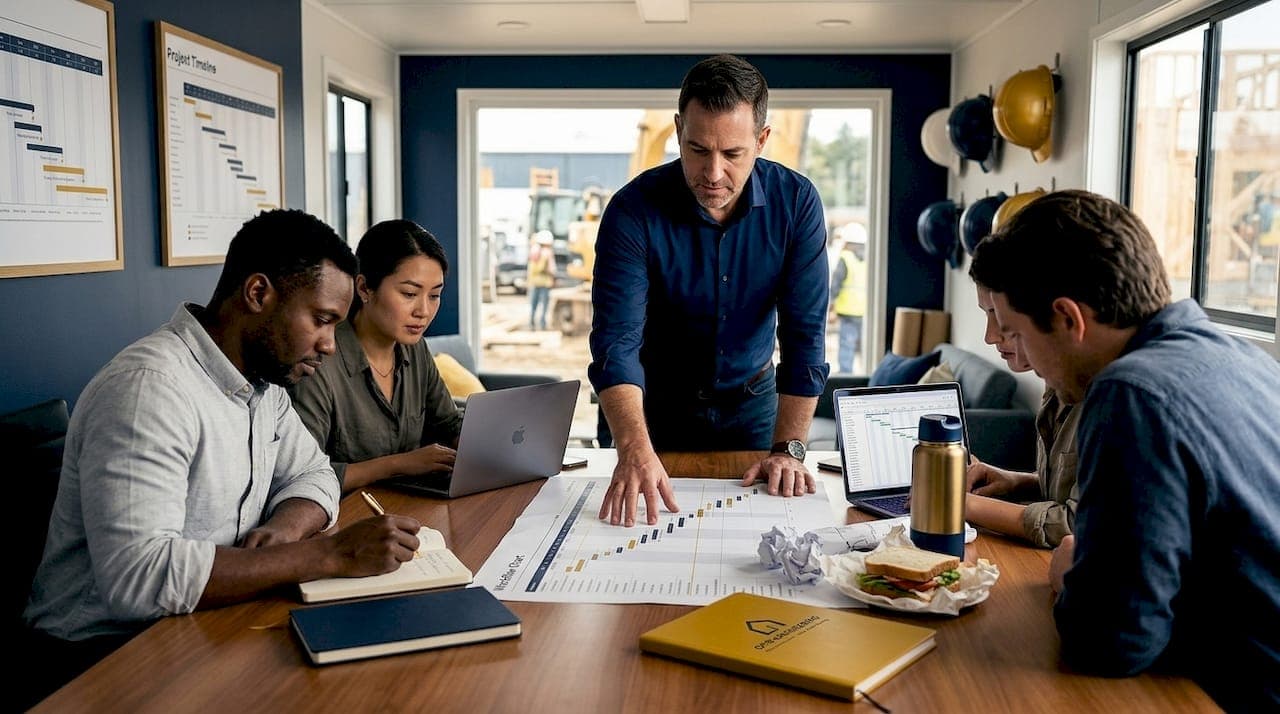
Delays that push budgets past breaking points rarely trace back to a single missed task. They compound through broken handoffs, missing approvals, and crews showing up to sites that aren't ready. A well-designed project management workflow construction teams can actually execute on the ground is what separates projects that close on time from those that spiral into expensive recoveries. This guide covers the tools, sequencing logic, tracking methods, and communication structures that construction project managers need to build workflows that hold under real site conditions. Ofirengineering draws on over 15 years of residential construction experience to frame each section around what works in practice, not just in theory.
Table of Contents
- Key takeaways
- Building a project management workflow in construction
- Step-by-step construction workflow development
- Monitoring and tracking workflow health
- Collaboration and communication for workflow success
- My perspective on what actually drives workflow success
- How Ofirengineering supports your construction workflow
- FAQ
Key takeaways
| Point | Details |
|---|---|
| Map before you automate | Identify bottlenecks in your manual process before applying automation to avoid multiplying errors. |
| Dependency tracking prevents delays | Linking tasks with clear dependencies triggers automatic crew notifications and eliminates costly sequencing mistakes. |
| Schedule health requires weekly checks | Treating the schedule as a living document with regular scoring exposes compression early and prevents expensive recoveries. |
| Poor information flow causes most delays | Labor shortages contribute, but cascading rework typically starts with missing or late information between teams. |
| Governance drives predictable outcomes | Defining approval pathways and accountability rules for every phase keeps scope, cost, and schedule aligned. |
Building a project management workflow in construction
Effective project management in construction depends on four reinforcing practices: planning, monitoring, collaboration, and communication. Research confirms that projects close on time and on budget more consistently when all four are active simultaneously, and that failure in any single one creates schedule and margin problems across the others. Understanding this framework is the starting point for building a workflow that functions as a system, not a collection of isolated tasks.
Tools and technology your team needs
The table below outlines the core tool categories for a functioning construction project management workflow and the specific function each serves.
| Tool category | Primary function |
|---|---|
| Cloud project management platform | Centralized task tracking, document control, and schedule visibility |
| Mobile field reporting app | Real-time progress updates, photo documentation, and daily logs from site |
| Workflow automation software | Approval routing, notification triggers, and dependency management |
| BIM or digital takeoff tool | Preconstruction quantity verification and clash detection |
| Communication platform | Structured messaging by project, trade, and phase |
Mobile and cloud tools close the gap between the field and the office. When site supervisors log progress directly from a phone or tablet, project managers get current data rather than end-of-day summaries that are already hours out of date. Workflow automation in construction begins with platforms that connect field data to office decisions in real time.
Team roles and preconstruction requirements
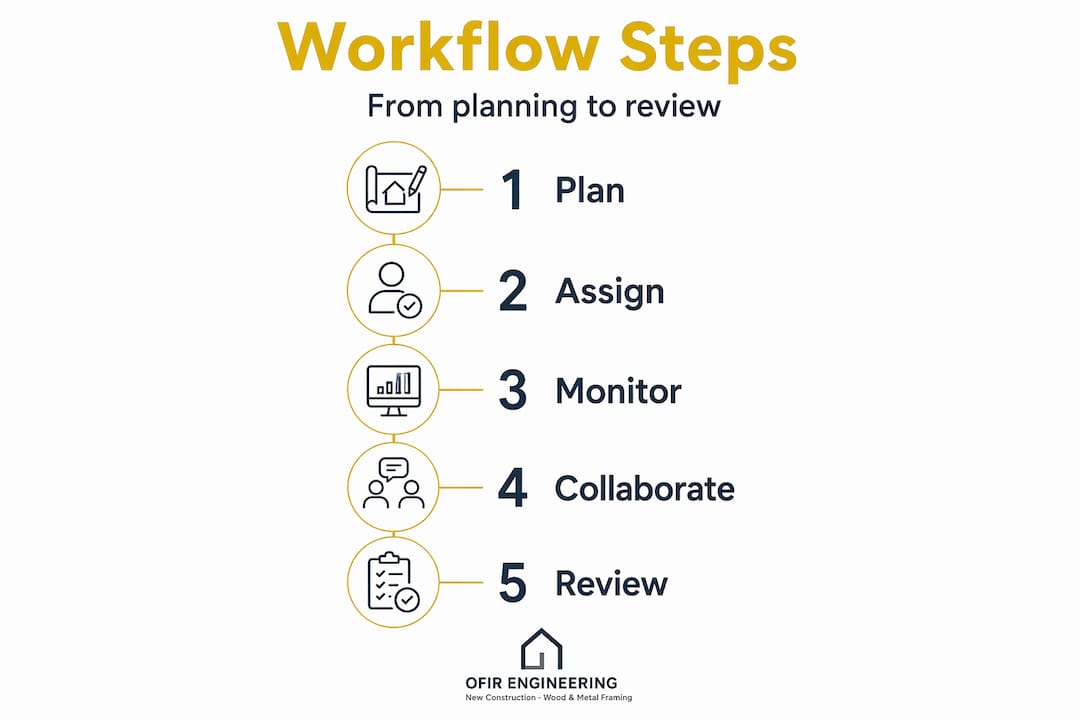
Clear role definitions are not optional. Predictable outcomes require that every phase ties to defined responsibilities, approval pathways, and measurement rules. Before a single workflow goes live, the following prerequisites need to be confirmed:
- A designated workflow owner for each project phase
- A baseline schedule with task durations and dependencies documented
- A risk register identifying high-probability delays by trade or material category
- Defined approval chains for change orders, submittals, and RFIs
- Confirmed subcontractor availability windows tied to the baseline schedule
Pro Tip: Complete preconstruction planning before mobilization, not during. Teams that finalize their baseline schedule and subcontractor coordination windows before breaking ground avoid the reactive scramble that defines poorly managed projects.
Ofirengineering applies this structure across its residential new construction and renovation projects in Jacksonville, integrating a project management checklist into preconstruction that covers scheduling, permitting, and trade sequencing in a single documented format.
Step-by-step construction workflow development
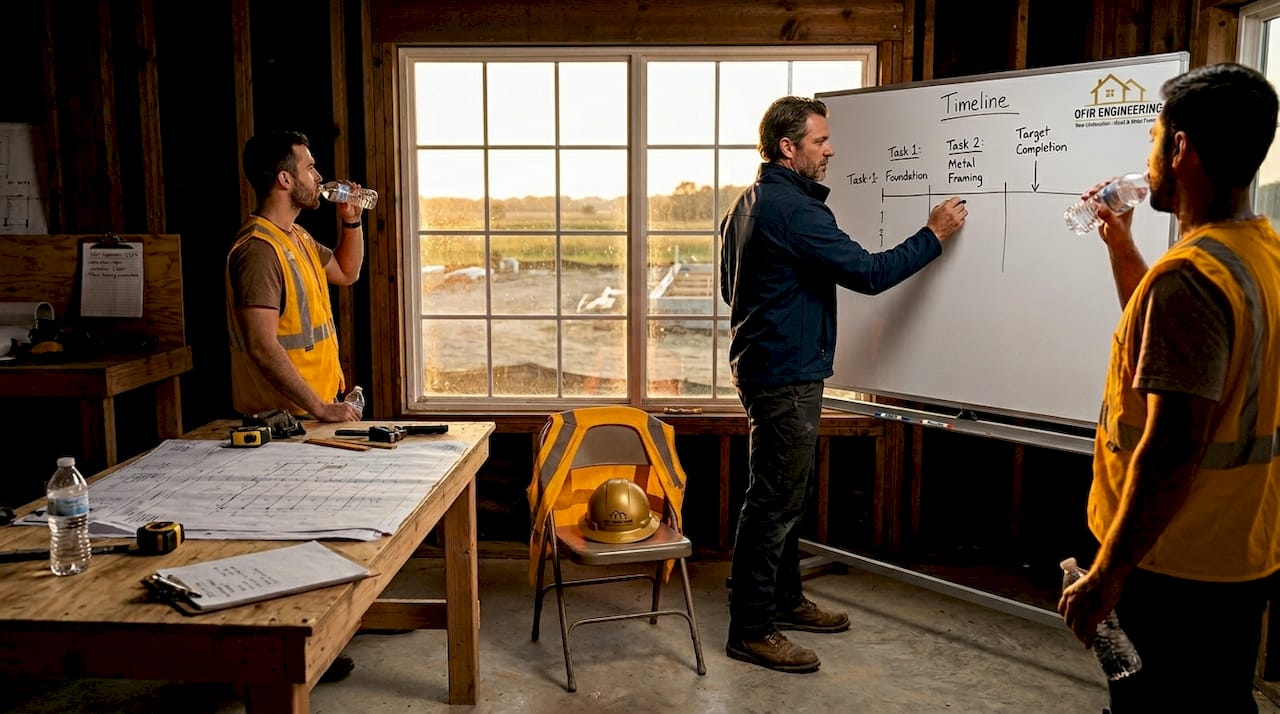
Building a construction workflow from scratch requires breaking the project into clearly bounded phases and then mapping every task within each phase to the one that must precede it and the one that follows.
How to sequence tasks and avoid dependency failures
The construction process divides logically into five workflow phases:
- Preconstruction: Site assessment, design finalization, permitting, and subcontractor agreements
- Site preparation: Clearing, grading, utility connections, and foundation work
- Structural phase: Framing with Light Gauge Steel or wood systems, roof structure, and exterior sheathing
- Mechanical, electrical, and plumbing (MEP) rough-in: Sequential installation by trade with inspection gates between each
- Finish phase: Interior work, final inspections, punch list completion, and certificate of occupancy
Within each phase, task dependencies need explicit documentation. Top firms use workflows where a task passing inspection automatically notifies the next crew that their work window is open. This removes the project manager from the role of manual traffic controller and reduces the gap between finishing one trade and starting the next from days to hours.
Applying automation without accelerating errors
Automating broken processes makes errors happen faster, not less often. Before enabling any automated approval routing or notification logic, map the current manual process in full. Identify redundant approvals, data entry that happens more than once, and handoff points where work is regularly stalled waiting for sign-off. Fix those first, then automate the corrected version.
Pro Tip: Run one workflow phase manually with the new process design before activating automation. This surfaces gaps in role definitions and approval logic while the cost of fixing them is still low.
Subcontractor coordination deserves specific attention in workflow design. Scheduling subcontractor windows to match site readiness rather than billing milestones reduces idle time, prevents material staging conflicts, and keeps trade sequences intact. Ofirengineering manages subcontractor coordination as a defined workflow component, with clear entry and exit conditions for each trade that connect directly to the inspection schedule.
AI-driven workflow tools are expected to become critical for 80% of commercial contractors within three years, largely because labor shortages and project complexity have outpaced manual coordination capacity. That adoption pressure makes it more important than ever to build a sound manual process first.
Monitoring and tracking workflow health
A workflow without monitoring is a schedule without enforcement. Tracking project health requires structured data collection, regular review cycles, and clear criteria for when to escalate a risk before it becomes a delay.
Daily and weekly tracking practices
The following practices form a reliable monitoring framework for active construction projects:
- Daily field logs: Every site supervisor submits a log that includes tasks completed, crew count, weather conditions, and any issues blocking progress
- Weekly schedule health check: Project managers score the current schedule against the baseline, measuring float consumed, tasks behind, and critical path exposure
- Inspection gate tracking: Each phase exit inspection is logged with the result, the date, and the corrective action if failed
- RFI and submittal aging reports: Any open RFI or submittal past its response deadline gets flagged in the weekly review
Schedule health scoring and weekly checks expose schedule compression early, when recovery actions are still within normal cost range. Projects that skip weekly health reviews often discover compression only after it has pushed the critical path past the contract completion date.
Technology-driven progress tracking
The financial case for advanced tracking tools is documented. Using machine learning-based visual monitoring on a major airport project, Hensel Phelps saved $342,000 in labor costs and eliminated nearly 3,000 hours of manual coordination. The platform flagged progress gaps before they became schedule events, allowing the team to reallocate resources before the critical path was affected.
| Tracking method | Risk detection timing | Labor impact |
|---|---|---|
| Manual daily reporting | 24-48 hours after event | High coordination burden |
| Mobile field reporting apps | Same day | Moderate reduction |
| Machine learning visual monitoring | Real-time or near-real-time | Significant reduction |
That level of precision is increasingly accessible on residential and mid-scale projects as platform costs decline. The principle transfers directly: capturing data closer to when work happens gives project managers time to act rather than react.
Collaboration and communication for workflow success
Most project delays trace back to poor information flow between teams, not exclusively to labor shortages. When subcontractors operate from different versions of the schedule or when RFI responses sit unanswered for days, cascading rework follows. Strong collaboration practices prevent those gaps from forming in the first place.
What effective collaboration looks like in practice
The following protocols establish the communication structure that supports workflow execution:
- A single designated point of contact per subcontractor with authority to confirm scheduling commitments
- A defined communication cadence: daily field reports, weekly project meetings, and a documented action log from every meeting
- All submittals, RFIs, and change orders routed through a central platform rather than email threads
- Owner updates at defined phase gates, not just at billing milestones
- A documented escalation path so field issues reach the right decision-maker within a specified timeframe
"Construction project management is a set of reinforcing practices, not a single skill. Failure in any one area creates cascading problems across the entire project." — ConstructConnect
Transparency with owners and investors matters as much as coordination between trades. When stakeholders receive regular, structured updates that connect physical progress to schedule and budget status, they trust the process. That trust reduces the informal inquiries and scope changes that disrupt workflow momentum. Ofirengineering builds this communication structure into every project, from preconstruction kickoff through final walkthrough, using a construction project management guide tailored to the Jacksonville residential market.
Defining accountability rules across the full project lifecycle is what separates teams that hit their dates from those that manage constant recoveries. Governance models that tie scope, cost, and schedule decisions to clear approval chains produce predictable outcomes because no one is operating from a personal version of the plan.
My perspective on what actually drives workflow success
I've worked on enough construction projects to know that a sophisticated workflow tool can coexist with a completely dysfunctional project. The tool doesn't fix the problem. The problem is usually that the team treats the schedule as a document rather than a working instrument.
What I've seen consistently is that the projects with the fewest recoveries are run by managers who walk the work daily and reconcile what they see with what the schedule says. Reports capture what people choose to report. A site walk captures what is actually happening. Those two things are not always the same, and the gap between them is where delays originate.
I've also found that incremental improvement outperforms the pursuit of a perfect workflow. Teams that fix one handoff at a time, document what changed, and measure the result build workflows that actually hold under site conditions. Teams that attempt full automation before their manual process is sound tend to create faster, more expensive versions of the same problems.
My honest take on workflow automation in construction: it is worth pursuing, but only after you have walked every phase of the process yourself and corrected what does not work. Automation should formalize a process that already functions. It should not be asked to compensate for one that does not.
— Owen
How Ofirengineering supports your construction workflow

Ofirengineering brings over 15 years of licensed residential construction experience to every project, with a project management approach built on the same workflow principles covered in this guide. From preconstruction planning through final inspection, the team manages scheduling, subcontractor coordination, phase gate tracking, and owner communication as integrated workflow components, not separate tasks.
Whether you are managing a new construction project using Light Gauge Steel or Wood Frame systems, or overseeing a full-home renovation, Ofirengineering's process is structured to keep your project on schedule, within budget, and compliant with Jacksonville permitting requirements. The full range of construction and project management services is available to homeowners, property investors, and developers across the Jacksonville area. Contact Ofirengineering to discuss how a structured workflow approach can be applied to your next project.
FAQ
What is a construction project management workflow?
A construction project management workflow is a structured sequence of tasks, approvals, and handoffs organized by project phase, with defined roles and dependencies that keep work progressing without gaps or conflicts.
How do you optimize construction processes with workflow tools?
Start by mapping your current manual process to identify bottlenecks and redundant approvals, then apply workflow automation to the corrected version. Tools are most effective when the underlying process is already sound.
Why do most construction project delays happen?
Poor information flow between teams causes most delays, as missing or late information triggers cascading rework that labor shortages alone cannot explain.
How often should construction schedules be reviewed?
Construction schedules should be reviewed weekly using a health scoring method that measures float consumed, tasks behind baseline, and critical path exposure to catch compression before it requires expensive recovery actions.
What are the best practices for subcontractor workflow coordination?
Schedule subcontractor windows to match verified site readiness rather than billing milestones, assign a single point of contact per trade with scheduling authority, and route all commitments through a central platform so every team works from the same current plan.