
Most Jacksonville homeowners and property investors assume a residential build or renovation begins the moment a crew arrives on site. In reality, months of planning, permitting, and compliance work precede that first day of construction, and Florida's unique regulatory environment adds layers that other states simply do not require. Residential construction typically follows 5-7 distinct phases, each with its own deliverables, risks, and timelines. Understanding this lifecycle from initiation through closeout is the single most effective way to avoid costly delays and budget overruns on Jacksonville residential projects.
Table of Contents
- What is the construction project lifecycle?
- Key delivery methods: Design-bid-build vs. design-build
- Jacksonville permitting and compliance: Local realities
- Budget, timeline, and risk: Controlling the outcome
- The uncomfortable truth: What most guides miss about the Jacksonville lifecycle
- Next steps: Unlock local expertise in Jacksonville construction
- Frequently asked questions
Key Takeaways
| Point | Details |
|---|---|
| Lifecycle phases matter | Understanding each step prevents missed deadlines and costly mistakes in Jacksonville projects. |
| Delivery method impacts speed | Design-build generally finishes 10–20% faster and reduces change orders compared to traditional approaches. |
| Permitting is the bottleneck | Early permitting and compliance planning are crucial to avoiding months of delay in Jacksonville. |
| Budget for contingencies | Set aside 10–15% extra to cover FL-specific risks like hurricanes and flood zone compliance. |
| Use modern tracking tools | Cost and timeline control improve with BOQ, BIM, and NLP scheduling for both new builds and renovations. |
What is the construction project lifecycle?
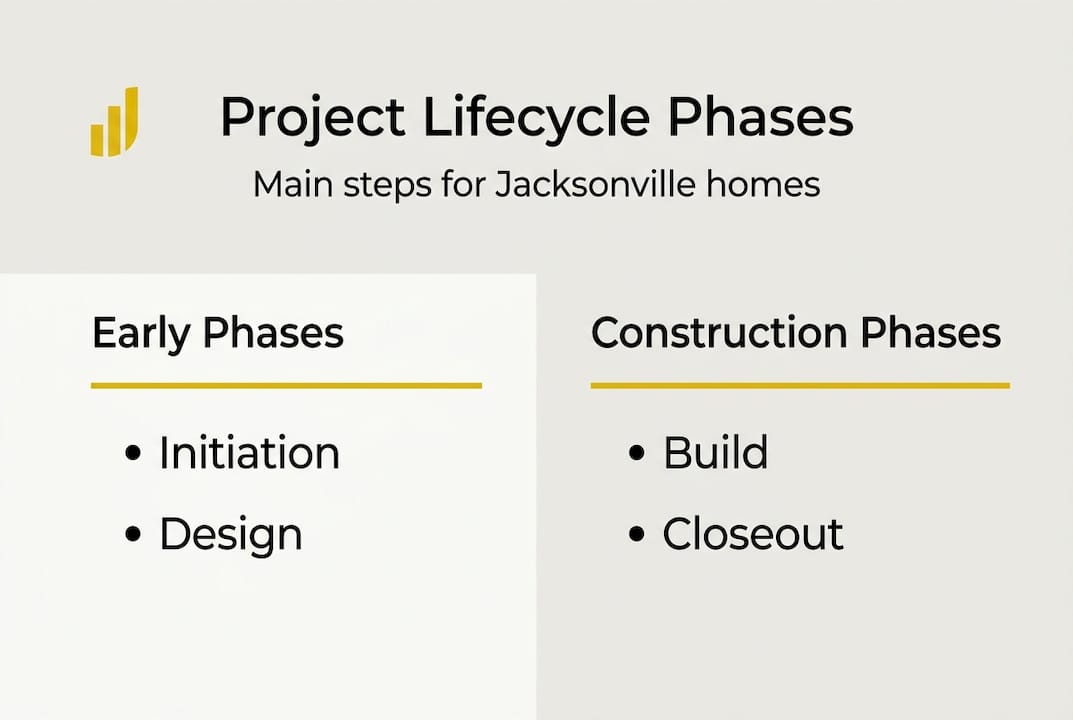
Having previewed the lifecycle, let's break down each phase and how they fit together in Jacksonville residential projects. The construction project lifecycle is a structured sequence of phases that governs every residential new build and renovation, from the first feasibility conversation through the final certificate of occupancy. Skipping or rushing any phase typically creates compounding problems later, particularly in a market as code-intensive as Jacksonville.
The six core phases are as follows:
- Initiation and conception: Site selection, feasibility analysis, preliminary budgeting, and defining project scope.
- Planning and preconstruction: Architectural drawings, structural engineering, permit application submission, and subcontractor qualification.
- Procurement: Material sourcing, subcontractor contracting, equipment scheduling, and supply chain coordination.
- Execution: Active construction, including foundation work, framing, mechanical, electrical and plumbing rough-ins, insulation, drywall, and finishes.
- Monitoring and control: Ongoing inspections, schedule tracking, change order management, and quality assurance.
- Closeout: Final inspections, punch list completion, certificate of occupancy issuance, and owner handover.
For Jacksonville projects specifically, the step-by-step home building process reflects timelines that surprise many first-time builders. New builds in Duval County typically require 14 to 24 months, while renovations range from 3 to 12 months depending on scope. Refer to the table below for a phase-by-phase breakdown.
| Phase | Key activities | Typical duration (new build) |
|---|---|---|
| Initiation | Feasibility, lot selection, budget draft | 1-2 months |
| Planning/Preconstruction | Design, engineering, permit applications | 3-6 months |
| Procurement | Material orders, subcontractor contracts | 1-2 months |
| Execution | All construction trades active | 8-14 months |
| Monitoring/Control | Inspections, change orders | Ongoing |
| Closeout | Final inspection, certificate of occupancy | 1-2 months |
For Jacksonville-specific construction planning tips, understanding each phase's dependencies is essential. Florida's hurricane code requirements, environmental assessments, and Duval County permitting details all extend the preconstruction phase well beyond what builders in other states experience. The project life cycle overview from industry resources confirms that preconstruction delays are the most frequent cause of total project overruns.
Key delivery methods: Design-bid-build vs. design-build
Now that you know the lifecycle phases, let's examine how your project's approach, or delivery method, shapes everything from speed to change order risk. The delivery method you select determines how design, procurement, and construction responsibilities are allocated, and it has a direct impact on timeline, cost predictability, and your level of control as an owner.
Design-bid-build (DBB) is the traditional method. The owner hires an architect to complete full design documents, then solicits competitive bids from general contractors, and finally awards a construction contract. This sequence maximizes design control but creates clear risk: any ambiguity in the drawings generates change orders during execution, and the competitive bid process adds several months to the preconstruction phase.
Design-build consolidates design and construction under one contract and one team. A single entity is accountable for both delivering the drawings and building to them, which eliminates the adversarial handoff between designer and contractor. Design-build is 10-20% faster and offers measurably better cost predictability for Jacksonville homes, while traditional DBB maximizes design control but carries higher delay risk.
Refer to the comparison below:
| Factor | Design-bid-build | Design-build |
|---|---|---|
| Timeline | Longer (sequential phases) | Shorter (overlapping phases) |
| Cost predictability | Lower | Higher |
| Owner control | High | Moderate |
| Change order risk | High | Low |
| Best for | Custom, architect-driven projects | Efficiency-focused builds |
For a practical Jacksonville renovation guide, the design-build model is often the preferred starting point. The construction management phases involved in DBB projects demand more owner oversight and longer pre-approval lead times.
The numbered steps in a design-build engagement look like this:
- Owner briefs the design-build team on scope, budget, and timeline goals.
- Preliminary design and cost estimation occur simultaneously.
- Permit applications are submitted as design is finalized.
- Construction begins with a single point of accountability.
- Closeout and inspection are managed by the same team.
Pro Tip: In Jacksonville, where permitting alone can consume four to six months, the design-build model's ability to overlap design and permitting phases can save significant calendar time and reduce carrying costs on land or interim financing.
Jacksonville permitting and compliance: Local realities
Knowing your delivery method, you'll face specific local hurdles. Here's how Jacksonville rules and permitting impact your project. Florida's regulatory environment is among the most demanding in the United States, and Duval County adds its own procedural layers on top of the statewide Florida Building Code requirements.
Key compliance areas every Jacksonville owner must account for include:
- Florida Building Code wind resistance: Structures must be engineered for 130-plus mph wind loads, which requires certified structural drawings and specific impact-rated windows and doors.
- Duval County permit review: Plan review timelines range from 4 to 6 months for new construction, depending on project complexity and reviewer workload.
- Required inspections: Foundation, framing, rough-in plumbing, rough-in electrical, rough-in mechanical, insulation, and final inspection are all mandatory hold points.
- Flood zone and wetland compliance: Properties in FEMA-designated flood zones require elevation certificates, flood-resistant construction methods, and sometimes separate FEMA permits.
- Environmental site assessment: Wetland buffers and tree preservation ordinances in Jacksonville can restrict buildable area and add review time.
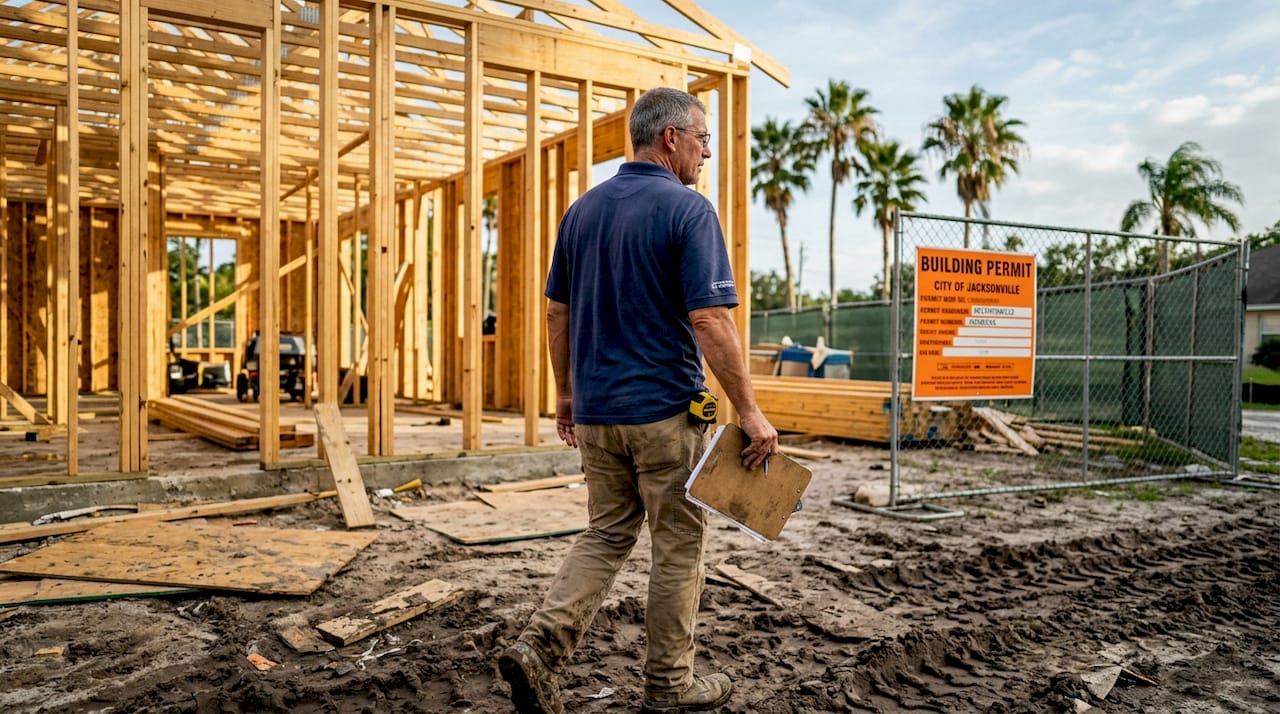
The numbers are instructive: a custom home in Jacksonville carries a total timeline of 14 to 20 months, with permitting alone accounting for 4 to 6 months of that span. Flood zone compliance on coastal or low-lying lots adds between $8,000 and $15,000 in direct costs and frequently extends the schedule further. Reviewing site plan requirements early in the initiation phase is one of the most effective ways to avoid late-stage surprises.
Pro Tip: Submit permit applications as early as technically possible, ideally before construction drawings are fully finalized, by using preliminary drawings acceptable to Duval County's plan review office. This approach can prevent a six-month delay from stacking on top of your procurement and execution schedule.
For details on how Ofir Engineering manages permitting and environmental requirements, or for broader construction planning tips tailored to Jacksonville conditions, both resources offer practical guidance for the local market.
Budget, timeline, and risk: Controlling the outcome
Once you've navigated compliance, it's time to focus on managing your budget, timeline, and avoiding surprise costs. Empirical benchmarks for Jacksonville residential construction show that custom home costs range from $200 to $350 per square foot for standard builds, rising to $400 or more per square foot on coastal sites with elevated foundation requirements. These figures come from Jacksonville construction cost data and reflect material, labor, and compliance costs but not land acquisition.
Execution consumes 60 to 70 percent of both the total timeline and the total budget on most Jacksonville residential projects. Every decision made in planning either protects or erodes that margin.
A reliable budget framework for Jacksonville projects includes three components: base construction cost, a contingency allowance of 10 to 15 percent for unforeseen site conditions and change orders, and a separate line item for environmental and flood compliance costs. Underestimating any of these three categories is the most common reason projects stall mid-execution.
Common risks and corresponding mitigation steps include:
- Material price volatility: Lock in lumber and steel pricing early through firm subcontractor contracts with material escalation clauses.
- Subcontractor availability: Jacksonville's active construction market means top-tier subcontractors book months in advance; secure commitments during preconstruction.
- Weather and hurricane season delays: Build a minimum 30-day weather buffer into the execution schedule for the June through November window.
- Inspection hold delays: Pre-schedule inspections as soon as preceding work phases are confirmed to avoid waiting queues.
For construction timeline benchmarks relevant to Jacksonville, practical risk management follows this numbered sequence:
- Complete a detailed Bill of Quantities (BOQ) before procurement begins to establish a defensible cost baseline.
- Use BIM (Building Information Modeling) to identify design conflicts before they become field change orders.
- Assign a dedicated project manager to monitor schedule adherence and flag risks weekly.
- Review and update the contingency reserve at each phase transition.
- Document all change orders in writing before work proceeds to maintain budget integrity.
BOQ management platforms and NLP-based scheduling tools are increasingly accessible for residential projects and provide real-time cost tracking that manual spreadsheets cannot match.
The uncomfortable truth: What most guides miss about the Jacksonville lifecycle
Most construction lifecycle guides present the phases as a tidy, sequential process where each step follows the previous one on schedule. That framing is useful for orientation, but it does not reflect the operational reality of building in Jacksonville. The genuine bottleneck is not build speed. It is permitting, environmental assessment, and regulatory coordination, and most homeowners and investors discover this only after they have already committed to a start date that the permitting timeline makes impossible.
Design-build and BOQ-based planning are significantly underutilized in the Jacksonville residential market. Owners who default to design-bid-build because it feels more familiar often absorb six to twelve additional months of elapsed time and a higher incidence of change orders. Early permitting and site assessment combined with a contingency budget sized for Florida-specific risks are the two factors that most reliably separate successful projects from stalled ones.
The most actionable guidance: engage with Jacksonville planning resources before finalizing your lot purchase, not after. Environmental and flood zone status, wind zone classification, and Duval County's current plan review backlog should all inform the acquisition decision. Nobody skips steps in Jacksonville construction. Those who plan for local realities finish on time. Those who do not plan absorb the costs that local realities impose.
Next steps: Unlock local expertise in Jacksonville construction
Understanding the lifecycle is only the first step. Translating that knowledge into a well-executed Jacksonville project requires local expertise, proven processes, and a team that knows Duval County's regulatory environment from the inside.
Ofir Engineering has delivered residential new builds and renovations across Jacksonville for over 15 years, managing everything from permit applications through final inspection. Whether you are planning a new construction project using Light Gauge Steel or Wood Frame systems, working through the process of renovating a Jacksonville home, or exploring options for a full Jacksonville home remodeling engagement, the firm provides structured project management at every phase. Reach out to discuss your project scope, timeline, and compliance requirements with a licensed team that builds in Jacksonville every day.
Frequently asked questions
How long does a typical residential new build take in Jacksonville?
Most custom homes in Jacksonville require 14 to 24 months from initiation through certificate of occupancy, with permitting alone accounting for 4 to 6 months of that total.
What is the most common cause of delay for residential projects in Jacksonville?
Permitting review timelines, flood zone compliance requirements, and hurricane season weather interruptions are the three most consistent sources of schedule delay in Duval County.
How much should homeowners budget for contingencies?
A contingency allowance of 10 to 15 percent of total project cost is the standard recommendation for Jacksonville residential builds, given Florida's environmental and weather-related risk profile.
Why is design-build often preferred for Jacksonville homes?
Design-build reduces schedule duration by 10 to 20 percent and consolidates accountability under one contract, which is particularly valuable in Jacksonville's permitting-intensive environment.
What are some emerging tools for tracking progress and controlling costs?
BOQ platforms, BIM software, and NLP-based scheduling tools are increasingly adopted on residential projects to provide real-time cost tracking and automated schedule management.