

The design-build approach is defined as a project delivery method that places design and construction services under a single contract with one accountable entity. For homeowners and real estate developers, this structure produces measurably faster timelines, lower cost growth, and fewer disputes compared to the traditional design-bid-build process. Research from the Construction Industry Institute (CII) and Penn State University confirms 33.5% faster delivery with approximately 6.1% cost savings over conventional methods. Ofirengineering, a licensed construction firm based in Jacksonville, applies this integrated delivery model across residential new construction and full-home renovation projects to give clients a direct path from concept to completion.
What are the main benefits of design-build approach for construction projects?
The core advantages of design-build stem from one structural fact: the designer and builder operate as a unified team from day one. That integration eliminates the adversarial dynamic that routinely inflates costs and extends timelines in traditional contracting, where architects and contractors work in separate silos with separate contracts.
Key benefits documented across peer-reviewed and industry research include:
- Faster project delivery. Overlapping design and construction phases compress the schedule in ways that sequential delivery cannot match. CII and Penn State data place this advantage at 33.5% faster completion.
- Reduced cost growth. DBIA and FMI Corporation research shows design-build projects carry approximately 3.8% less cost growth than design-bid-build. On a $5 million project, that translates to $190,000 to $305,000 in avoided overruns.
- Single point of accountability. One contract means one entity owns the outcome. Disputes over who caused a delay or defect are resolved internally rather than through litigation between separate design and construction firms.
- Proactive value engineering. In design-build, value engineering occurs during design rather than after construction documents are finalized. This shifts cost control to the earliest and most effective stage of the project.
- Fewer change orders from coordination gaps. Because the builder's input shapes the design from the start, constructability problems surface before they become expensive field changes.
Pro Tip: Engage the design-build team at or before the schematic design phase. Early preconstruction involvement is where the greatest cost efficiency gains are captured, since design decisions made at that stage carry far lower correction costs than changes made during construction.
The single-team accountability model also reduces the delays typical in multi-party contracting, which is especially valuable when projects face time constraints or unexpected disruptions. For Jacksonville homeowners managing residential construction timelines, that reliability has direct financial consequences.

How does design-build compare to traditional design-bid-build methods?
Design-bid-build is a sequential process: the owner hires an architect, completes full design documents, solicits bids from contractors, and then awards a construction contract. Each phase must finish before the next begins. Design-build overlaps these phases, allowing procurement and early construction activities to proceed while design is still being refined.
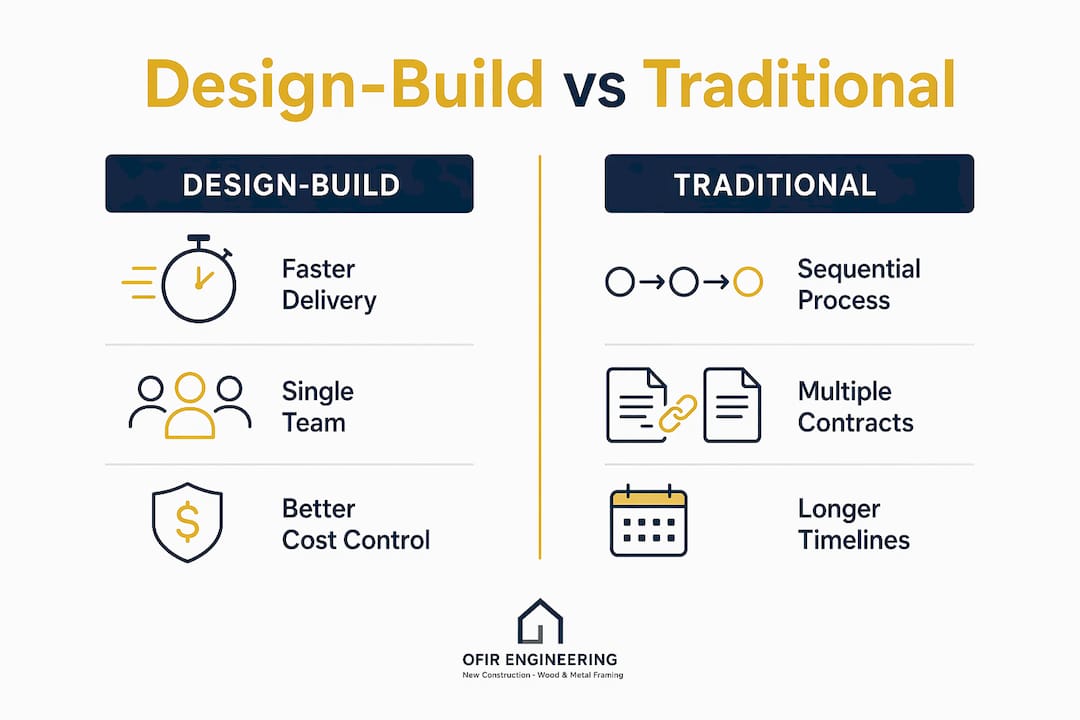
The performance difference is well-documented. An MDPI 2026 study of 351 water and wastewater projects found 11.4% less schedule growth in design-build projects compared to design-bid-build, with construction speed running 12% faster. That data comes from infrastructure projects, but the underlying mechanism, which is phase overlap and integrated team coordination, applies equally to residential and commercial construction.
A third delivery method worth comparing is Construction Manager at Risk (CMAR). CMAR brings the contractor in earlier than design-bid-build but still maintains separate design and construction contracts. Design-build consolidates both under one agreement, which concentrates risk and responsibility more directly.
| Factor | Design-bid-build | CMAR | Design-build |
|---|---|---|---|
| Contract structure | Separate design and construction | Separate, but contractor joins early | Single contract for both |
| Phase sequencing | Sequential | Partially overlapping | Fully overlapping |
| Cost growth risk | Higher | Moderate | Lower (approx. 3.8% less than DBB) |
| Schedule growth | Higher | Moderate | Lower (11.4% less in studied projects) |
| Owner involvement | High during design | Moderate | Active, with open-book options |
| Accountability | Split between parties | Shared | Single entity |
One persistent misconception is that design-build reduces owner control. Open-book and shared-savings contracting structures, which are standard practice among experienced design-build firms, give owners full visibility into costs and decisions throughout the project. Transparency is a contractual choice, not a limitation of the delivery method itself.
How to optimize the design-build approach for cost savings and efficiency
Realizing the full advantages of design-build requires deliberate decisions at each project stage. The method creates the conditions for efficiency, but owners who engage passively still leave value on the table.
- Commit to early preconstruction involvement. Engaging the design-builder's preconstruction team at or before schematic design is the single most effective step for cost control. Constructability feedback at that stage shapes material selections, structural systems, and site logistics before any costs are locked in.
- Structure the contract for transparency. Open-book contracting gives owners direct visibility into subcontractor bids, material costs, and fee structures. Shared-savings provisions align the contractor's financial incentives with the owner's budget goals.
- Establish a rigorous change order process. Design-build projects can generate more change orders than traditional methods because early-stage schematic designs leave some scope details unresolved. A clear written scope definition at contract execution, combined with a formal change management system, prevents scope creep from eroding the cost savings the method delivers.
- Prioritize early procurement of long-lead materials. Schedule advantages in design-build come partly from overlapping procurement with design maturity. Owners who commit early to key material and system selections, such as structural framing, mechanical equipment, and windows, allow the contractor to place orders before construction begins, avoiding delays that compress the schedule advantage.
- Partner with an experienced firm. Ofirengineering's construction project management process integrates these steps into every project, from initial planning through final delivery, giving Jacksonville homeowners and developers a structured path to the outcomes the research documents.
Pro Tip: When reviewing design-build proposals, ask specifically how the firm handles value engineering during design. A team that cannot describe a concrete process for proactive cost analysis is likely treating it as a post-design afterthought.
In which project types do design-build advantages show most clearly?
Design-build delivers its strongest results in projects where schedule pressure, technical complexity, or high coordination requirements make the integrated team structure especially valuable.
Complex commercial builds, including medical offices, warehouses, and mixed-use developments, benefit from the method because mechanical, electrical, and structural systems must be coordinated across multiple disciplines simultaneously. A fragmented design-bid-build process creates coordination gaps that generate costly field conflicts. An integrated team resolves those conflicts during design, where corrections cost a fraction of what they cost in the field.
Emergency and accelerated projects represent another clear application. DBIA case documentation shows that design-build enables rapid infrastructure recovery in critical situations, with unified design-builder teams extending service life by 50 years in documented rehabilitation projects. The single-team accountability model eliminates the coordination delays that would otherwise slow emergency response.
For residential construction in Jacksonville, the advantages are equally concrete. New home builds using Light Gauge Steel or Wood Frame systems require tight coordination between structural design, permitting, and subcontractor scheduling. Ofirengineering's new construction services apply integrated delivery principles to manage these dependencies from the earliest planning stage. Renovation projects benefit similarly, particularly full-home renovations where structural, mechanical, and finish work must proceed in a coordinated sequence.
The broader market reflects these advantages. Design-build is projected to represent nearly 47% of U.S. construction spending by 2028, according to the DBIA and FMI 2025 Design-Build Data Sourcebook. That figure reflects owner preference based on documented performance, not marketing. When nearly half of all construction spending flows through a single delivery method, the evidence base for that preference is substantial.
Key takeaways
The design-build approach delivers faster schedules, lower cost growth, and clearer accountability by placing design and construction under a single contract with one responsible entity.
| Point | Details |
|---|---|
| Faster delivery documented | CII and Penn State research confirms 33.5% faster completion than design-bid-build. |
| Lower cost growth | DBIA data shows 3.8% less cost growth, saving $190,000 to $305,000 on $5M projects. |
| Single-entity accountability | One contract eliminates disputes between separate design and construction parties. |
| Proactive value engineering | Cost control happens during design, not after, reducing expensive late-stage changes. |
| Early engagement is critical | Preconstruction involvement at schematic design stage maximizes budget and schedule outcomes. |
Why the design-build model changes how I advise clients on project delivery
After working through dozens of residential and commercial projects in Jacksonville, the pattern is consistent: owners who enter a project with separate architect and contractor agreements spend the first two months managing a relationship between parties who have different financial incentives. The architect is paid to produce thorough documents. The contractor is paid to build what those documents specify. When the documents contain constructability problems, the cost of resolving them falls on the owner.
Design-build removes that dynamic entirely. The team that designs the project is accountable for building it within the budget they helped establish. That alignment changes the quality of decisions made during design in ways that are difficult to quantify but immediately visible in project outcomes.
One misconception worth addressing directly: some owners assume that consolidating design and construction under one contract means giving up control. The transparency available through open-book delivery disproves that assumption. Owners who request open-book structures see every subcontractor bid and every material cost. They are more informed, not less.
The firms that execute design-build well, including Ofirengineering's team in Jacksonville, treat preconstruction as the highest-value phase of the project. Getting the scope, budget, and schedule right before breaking ground is where the method's advantages are actually created. The construction phase delivers on decisions made earlier. That is the practical reality behind the research numbers, and it is why the method continues to gain market share.
— Owen
How Ofirengineering delivers design-build results in Jacksonville
Ofirengineering brings over 15 years of licensed construction experience to every project, integrating design coordination, value engineering, and construction management under a single accountable team. For Jacksonville homeowners and real estate developers, that means one point of contact from initial planning through final inspection, with full transparency into costs and schedule at every stage.
Whether you are planning a new construction home using Light Gauge Steel or Wood Frame systems, or pursuing a full-home renovation to maximize your property's value, Ofirengineering's integrated approach applies the same principles that the research confirms: early preconstruction involvement, proactive cost control, and coordinated execution. Developers focused on renovation ROI in Florida will find a partner with the process discipline to protect both budget and timeline from the first design meeting forward.
FAQ
What is the design-build approach in construction?
The design-build approach is a project delivery method that combines design and construction services under a single contract with one responsible entity. This structure eliminates the separation between architect and contractor that characterizes traditional design-bid-build delivery.
How much faster are design-build projects compared to traditional methods?
CII and Penn State University research confirms design-build projects are completed 33.5% faster than design-bid-build projects. An MDPI 2026 study of 351 projects also found 11.4% less schedule growth in design-build delivery.
Does design-build reduce owner control over the project?
Design-build does not reduce owner control when the contract is structured correctly. Open-book and shared-savings contracting models give owners full visibility into costs and decisions throughout the project, as documented by CDM Smith's expert analysis of common design-build misconceptions.
What types of projects benefit most from design-build delivery?
Projects with high coordination requirements, tight schedules, or technical complexity benefit most from design-build. These include new residential construction, full-home renovations, medical offices, warehouses, and emergency infrastructure recovery projects.
How does design-build control costs better than traditional contracting?
Value engineering in design-build occurs proactively during the design phase rather than reactively after construction documents are complete. DBIA research shows this approach produces approximately 3.8% less cost growth, saving $190,000 to $305,000 on a $5 million project.