

Construction innovation is defined as the deliberate adoption of new tools, technologies, methodologies, and organizational practices to improve project outcomes across cost, schedule, safety, and sustainability. The benefits of construction innovation are measurable and well-documented: lean construction methodologies deliver 10–15% cost savings across project activities, while digital platforms like Building Information Modeling (BIM) reduce coordination failures that cause costly rework. Firms like Ofirengineering, operating in Jacksonville's competitive residential market, integrate these advances into every phase of construction. Understanding the full scope of construction innovation benefits is no longer optional for professionals who want to stay competitive in 2026.
What are the real cost and efficiency benefits of construction innovation?
The most direct advantage of adopting modern construction methods is a measurable reduction in project cost and duration. Lean construction practices integrating digital and AI tools deliver 10–15% cost savings across many project activities. That figure represents real dollars recovered from waste elimination, reduced rework, and tighter schedule control.
The mechanism behind these savings is worth understanding. Lean construction embeds continuous improvement and collaboration into daily workflows, which reduces schedule overruns and material waste simultaneously. Digital tools amplify this effect by giving project managers real-time visibility into resource consumption, subcontractor progress, and procurement status. Without that visibility, cost overruns accumulate silently until they become unmanageable.
Three specific efficiency gains stand out for residential and commercial construction teams:
- Reduced rework costs. BIM-enabled clash detection identifies design conflicts before ground breaks, eliminating the expensive field corrections that account for a significant share of project overruns.
- Faster procurement cycles. Digital procurement platforms and bid tracking tools compress the time between design completion and material delivery, keeping schedules intact.
- Lower labor waste. AI-assisted scheduling allocates crews to tasks based on real-time site conditions rather than static plans, reducing idle time on site.
Pro Tip: Start with one high-impact pilot project before scaling any new technology. A single project using BIM coordination or digital cost tracking will generate the data you need to justify firm-wide adoption and train your team effectively.
Ofirengineering applies smart cost control practices across its Jacksonville residential projects, using structured planning and technology-assisted coordination to keep budgets predictable for homeowners and investors alike.
How does innovation improve safety, collaboration, and sustainability?
The non-financial benefits of construction technology adoption are equally significant. Technology reduces accident risk and fosters collaboration by aligning competing priorities across project teams. These two outcomes directly affect project quality, workforce retention, and client satisfaction.
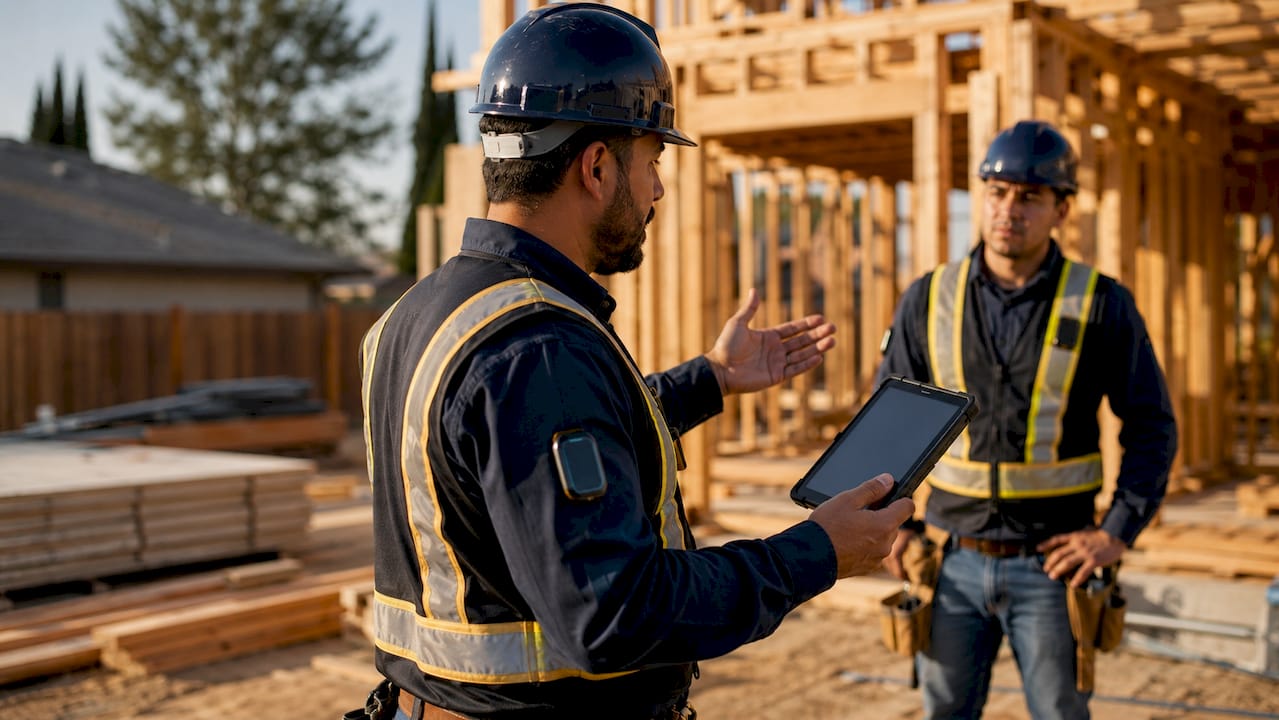
On the safety side, wearable sensors, drone-based site inspections, and AI-powered hazard detection systems identify risks before workers encounter them. Drones survey roof structures, excavation depths, and scaffolding conditions without placing personnel in danger. Wearables monitor fatigue and environmental exposure in real time, triggering alerts before conditions become hazardous.
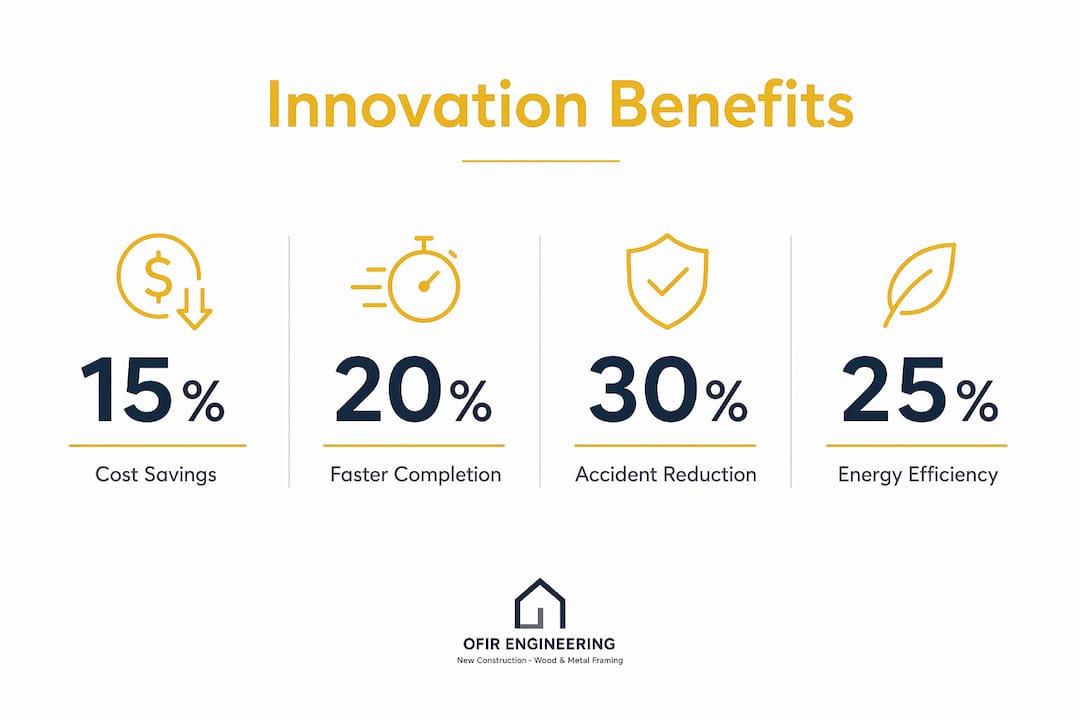
Collaboration improvements are equally concrete. Digital coordination platforms give architects, contractors, and subcontractors access to the same project data simultaneously. That shared visibility eliminates the version-control failures and miscommunication that generate costly field changes. Startup engagement in mid- to large-sized construction firms confirms that flexible, customized technology solutions encourage teams to rethink established workflows rather than simply digitizing old ones.
Sustainability benefits from construction innovation include:
- Material waste reduction through precise digital quantity takeoffs and prefabrication, which cuts jobsite waste by eliminating over-ordering and on-site cutting errors.
- Energy-efficient design enabled by simulation software that models thermal performance, daylighting, and HVAC loads before construction begins.
- 3D printing applications for structural components and architectural elements, which reduce formwork waste and allow complex geometries with less material.
- Reduced carbon footprint from Light Gauge Steel framing systems, which use recycled content and generate less site waste than traditional wood framing methods.
- Water management improvements through digital grading and drainage modeling that reduces site runoff and erosion during construction.
Ofirengineering's use of Light Gauge Steel and Wood Frame systems reflects a deliberate commitment to material efficiency and durability, both of which are direct expressions of construction innovation applied at the residential scale. You can explore how innovation transforms renovation outcomes in practical terms through Ofirengineering's published project analysis.
What role do leadership and culture play in innovation adoption?
Technology alone does not produce innovation benefits. Proactive leadership that scans for future disruptions and reconfigures resources strategically is the decisive factor in successful digital transformation. Firms that treat technology as a core infrastructure investment rather than a departmental add-on consistently outperform those that purchase tools without organizational alignment.
The distinction matters in practice. A firm that installs a BIM platform without training its project managers, updating its procurement process, or integrating the tool into its contract templates will see minimal return. The same platform, deployed within a culture of continuous improvement and supported by disciplined change management, delivers the full efficiency and cost benefits the research documents.
Investing in centralized ERP systems is a prerequisite for advanced tools like AI and IoT to deliver true ROI. That infrastructure investment signals organizational readiness and creates the data foundation that AI systems require to generate useful predictions and recommendations.
A common concern among construction professionals is workforce displacement. The evidence does not support that fear. Technology augments worker capabilities by automating repetitive tasks, freeing skilled tradespeople for high-craft activities that require judgment and experience. A framing crew freed from manual quantity calculations can focus on precision installation. An estimator freed from spreadsheet reconciliation can focus on value engineering.
Pro Tip: Treat workforce training as a capital investment, not an operational expense. Firms that budget for structured onboarding of new technology see adoption rates two to three times higher than those that rely on self-directed learning.
Leadership insights on managing project teams through innovation are available through Ofirengineering's project management resources, which address the organizational side of technology adoption directly.
How does stakeholder coordination influence innovation outcomes?
The impact of construction innovation depends heavily on how well architects, contractors, subcontractors, and owners coordinate throughout the project lifecycle. Architects enable innovation most effectively in early design phases, but their influence diminishes in later stages due to fragmented procurement structures and contractual rigidities. That dilution is not inevitable. It is a coordination failure that disciplined project management can prevent.
BIM implementation mediates benefits to project success through stakeholder satisfaction and tactical use rather than software capability alone. A study drawing on 314 valid responses confirmed that the pathway from BIM adoption to project success runs through stakeholder alignment, not through the platform itself. The tool is only as effective as the collaboration framework surrounding it.
The table below illustrates how sustained coordination changes innovation outcomes across key project dimensions:
| Project Dimension | With Sustained Coordination | Without Sustained Coordination |
|---|---|---|
| Design intent preservation | High: architect's innovation carried through delivery | Low: design intent lost during procurement handoffs |
| Rework frequency | Reduced through early clash detection and shared data | Elevated due to version conflicts and late-stage changes |
| Schedule adherence | Improved through aligned subcontractor sequencing | Disrupted by fragmented communication and scope gaps |
| Cost predictability | Strong: shared visibility into procurement and labor | Weak: surprises accumulate from siloed information |
| Sustainability outcomes | Achieved: material specs and energy targets maintained | Compromised: substitutions made without design review |
Ofirengineering addresses this coordination challenge directly through its subcontractor coordination framework in Jacksonville, which maintains continuous communication among all project stakeholders from design through final inspection. That framework is not incidental. It is the operational mechanism that preserves innovation benefits from concept to completion.
Fragmented procurement is the single largest threat to sustained innovation in residential construction. When risk allocation separates design from delivery, the incentives that drive innovation in early phases disappear. Firms that structure contracts to maintain architect and engineer involvement through construction administration protect their investment in early-stage innovation.
Key takeaways
Construction innovation delivers its greatest returns when technology adoption is paired with disciplined coordination, proactive leadership, and a trained workforce aligned around continuous improvement.
| Point | Details |
|---|---|
| Cost savings are quantifiable | Lean construction with digital tools delivers 10–15% cost savings across project activities. |
| Safety and sustainability improve together | Technology reduces accident risk and material waste simultaneously, strengthening both outcomes. |
| Leadership drives adoption success | Proactive leadership and centralized data infrastructure determine whether technology delivers real ROI. |
| Coordination preserves innovation value | Sustained stakeholder alignment from design through delivery prevents innovation benefits from eroding. |
| Workforce augmentation, not replacement | Technology automates repetitive tasks, freeing skilled workers for high-value construction activities. |
What i have learned about innovation in construction practice
By Owen
After years of observing how construction firms adopt and misapply technology, the pattern is consistent. Firms that succeed with innovation share one characteristic: they treat organizational readiness as the primary constraint, not technology availability. The tools are accessible. The discipline to deploy them correctly is not.
The most common failure I see is firms purchasing BIM licenses or AI scheduling platforms and then measuring success by adoption rate rather than project outcome. Adoption rate is a vanity metric. What matters is whether the tool changed a decision that improved a result. That requires a feedback loop, and feedback loops require leadership that asks hard questions about what the data actually shows.
Pilot projects are genuinely underused in residential construction. A single project using structured digital coordination will reveal more about your firm's readiness than any vendor demonstration. It will also build the internal case for scaling, because the data comes from your own projects, your own crews, and your own clients.
Ofirengineering's approach in Jacksonville reflects this discipline. The firm's integration of Light Gauge Steel systems and structured project management is not a technology showcase. It is a deliberate operational choice that produces better outcomes for homeowners and investors. That is the standard worth holding.
— Owen
Build smarter with ofirengineering's proven approach

Ofirengineering brings over 15 years of licensed construction experience to Jacksonville's residential market, applying lean construction principles, Light Gauge Steel framing, and structured project coordination to every project it undertakes. Whether you are planning new construction in Jacksonville or a full-home renovation, Ofirengineering's team provides the technical depth and coordination discipline that turns innovation from a concept into a measurable project advantage. Explore Ofirengineering's construction measurement tools and service offerings to understand how modern construction methods translate into better outcomes for your property.
FAQ
What are the main benefits of construction innovation?
Construction innovation delivers cost savings of 10–15%, reduced schedule overruns, improved safety through technology-assisted hazard detection, and lower material waste through digital quantity management and prefabrication.
How does BIM improve construction project outcomes?
BIM improves project success through stakeholder satisfaction and tactical coordination rather than software capability alone, as confirmed by a study of 314 construction projects showing the mediation pathway to project success.
Does construction technology replace skilled workers?
Technology augments worker capabilities by automating repetitive tasks, freeing skilled tradespeople to focus on high-craft activities that require judgment, precision, and experience.
Why does stakeholder coordination matter for innovation?
Architects and engineers enable innovation most effectively in early design phases, but fragmented procurement structures can dilute that influence later. Sustained coordination from design through delivery preserves the full value of early-stage innovation decisions.
How should a construction firm start adopting innovation?
Start with a single pilot project that tests one specific tool or methodology, measure the outcome against a baseline, and use that data to build the internal case for broader adoption before committing to firm-wide implementation.